



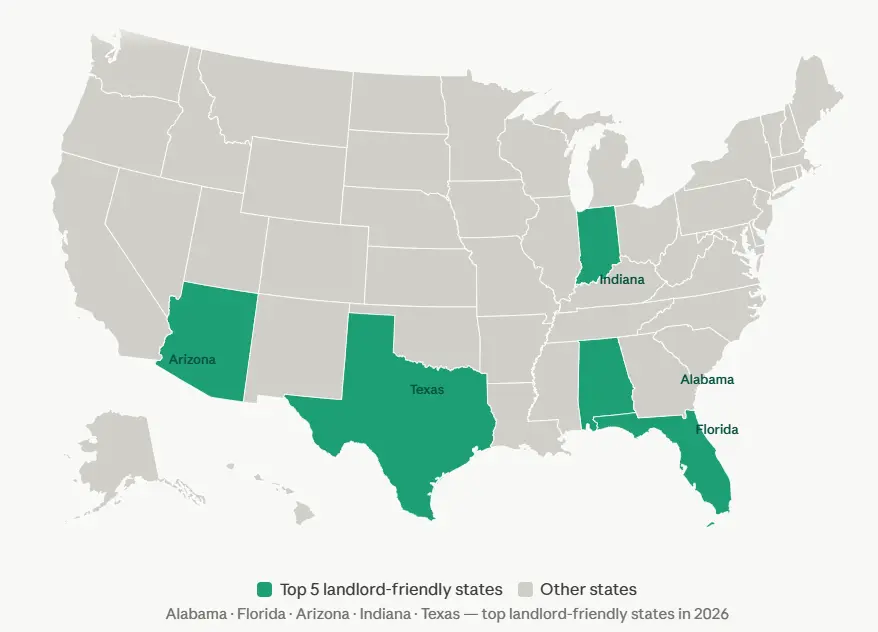
The top 5 most landlord-friendly states in the US housing market are:
Why are we investigating this market label today and why do some investors care about landlord-friendliness vs tenant-friendliness? These labels can ultimately impact your cash flow and return on investment. Let’s take a closer look at how and whether you should use these classifications to make investment decisions.
What Is a Landlord-Friendly State?
A landlord-friendly state is simply a state where it’s easier to be a landlord and manage rental properties. This is because the local laws and regulations favor landlords and actively help to lower entry and/or operating costs.
Does this mean that renters are mistreated in these housing markets?
Not at all.
Every state has tenant laws that protect the rights of renters and you absolutely need to understand them and always be compliant. After all, tenants are your partners in this business and a good landlord-tenant relationship is key to your success.
Rather, landlord-friendly markets have some combination of the following characteristics to support rental property businesses and their owners.
Low Property Taxes
In 2026, effective property tax rates in the US typically range from 0.25% to 2% of a property’s assessed value. Even though you can write off property tax and reduce your taxable income, you’re still paying more in higher tax states. This means your cash flow and cap rate are going to be higher. Additionally, real estate taxes are subject to annual increases. So, in order to keep more cash in your pocket, you might consider investing in a landlord-friendly state with a low property tax.
No Rent Control
Rent control is a set of rules that limits how much landlords can charge for rent as well as when and how often they can increase rent. This is meant to act as a protection for tenants, keeping the rental market affordable and stable. At the same time, such limits can hurt long-term cash flow and growth. When ongoing costs like insurance premiums, taxes, property management fees, and repair costs go up, a landlord can’t offset these by raising rent. Some owners may even end up putting off maintenance or major repairs, hurting the value of an investment property that promises no revenue growth. Without a good strategy in place, rent control can be a major financial burden on landlords. This is why some new real estate investors choose landlord-friendly states with no rent control laws in place.
Low-Barrier Entry
When you become a landlord, there are different licenses and permits that you may have to obtain to legally run your business. These can depend on the property type, rental strategy (long term or short term rental), and location. Some examples include:
- Rental Property License/Registration
- Business License
- Certificate of Occupancy (CO)
- Short Term Rental License
- Safety Permit
- Lead-Free Certification
Some US states have strict licensing requirements that can increase your set-up costs significantly. Landlord-friendly states typically make it easier for an investor to set up their rental property business without jumping through hoops or forking over too much cash.
No Caps on Security Deposits
Security deposits act as protection for landlords in cases of missed rent or utilities, property damage, lease violations, and even when professional cleaning is required during turnover.
When a renter-friendly state caps security deposits, it poses a problem for landlords. Damages may exceed the maximum amount allowed for deposits. Additionally, lower security deposits won’t help a landlord understand a tenant’s financial standing.
Overall, a real estate market without limits on security deposits offers much more protection for landlords. Just keep in mind that states without a cap on these fees expect you to set a “reasonable” amount.
No/Short Notice-of-Entry Requirements
Being able to enter your rental property without legally-mandated long notice periods is important for many reasons including:
- Confirming abandonment of rental when tenant leaves and goes no contact
- Quickly and efficiently attending to maintenance issues and major repairs
- Being able to bring prospective tenants for showings in a timely manner and speeding up turnover
- Protecting the investment property by allowing landlords to quickly inspect for illegal pets or activities before such problems escalate
The typical notice required is 24 to 48 hours.
Quick and Seamless Eviction Process
No landlord signs with a tenant assuming eviction will happen and for many, it never does. But with a couple million evictions being filed every year in the US real estate market, it could happen in your career.
In some locations, the eviction process can become a messy, costly, and drawn-out affair. The entire eviction process from notice to lockout ranges greatly across the US, from around 3 weeks to as long as 6 months!
When you’re not receiving rent, a long eviction notice period mandated by law as well as long proceedings means you’re covering ongoing costs from your own pockets. Disgruntled tenants may cause more damage to the rental during this period. In some states, evictions require more legal documentation and higher fees.
Because eviction is naturally unpleasant and unfortunate for everyone involved, it’s best when the local laws ease the process for landlords.
Additional Landlord Rights
Beyond what we’ve listed, some states have extra incentives for becoming a landlord like no limits on late rent fees and immediate disposal rights of property left in a rental. Some also implement state preemption. This means that local governments within the state cannot enact additional laws and regulations regarding rental properties.
Note that not every state listed below has all of the above characteristics. It’s the balance of such characteristics vs typical laws that makes them the top landlord-friendly states. For example, in the Texas housing market, landlords trade no rent control and an easy eviction process for higher property taxes.
Another thing to keep in mind is that some cities and local municipalities have their own laws regarding landlords and rental properties. So while the state may seem landlord-friendly, a major city may not be. And even if the labels match, you still need to familiarize yourself with the specific local laws of a city.
The Top 5 Most Landlord-Friendly States in 2026
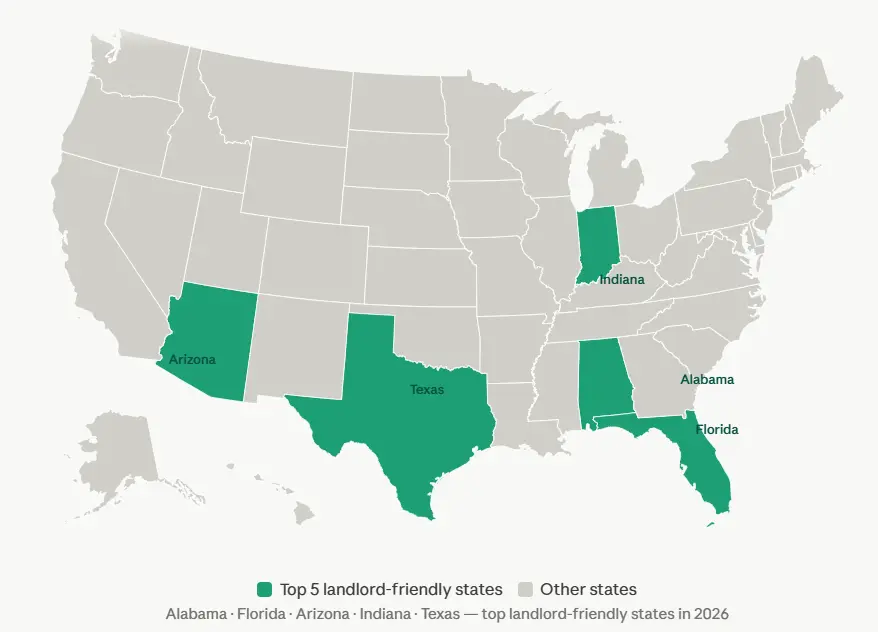
Alabama
In 2026, Alabama is actually one of the few states with very little regulations in place for individual landlords.
- No statewide licensing requirements.
- No limit on security deposits or late rent fees. Landlords can charge based on what is agreed upon in the lease.
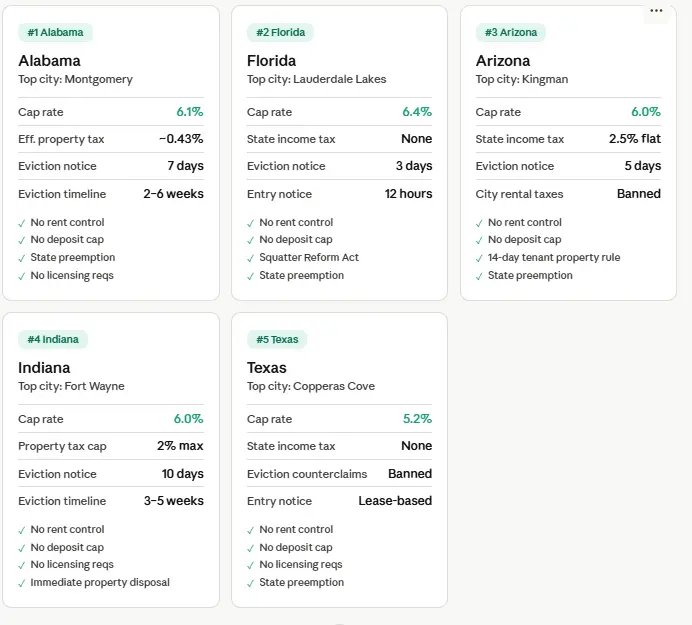
- Very low property taxes – some of the lowest in the US. Investment properties are typically assessed at 20% of the market value and the effective tax rate is usually below 0.5% (median around 0.43%).
- Statewide ban on rent control.
- State preemption for rental laws in place.
- 7-day notice of eviction for nonpayment of rent. If uncontested, the whole process takes 2 to 6 weeks in Alabama. If contested, it’s closer to 2 to 3 months.
Top Landlord-Friendly City with High Average Cap Rate:
Florida
- No statewide licensing requirements.
- No limit on security deposits or late rent fees.
- No state income tax.
- 12-hour notice of entry.
- Statewide ban on rent control.
- State preemption for rental laws in place.
- 3-day notice of eviction for nonpayment of rent. The recent Squatter Reform Act allows for a landlord to skip court proceedings and have the Sheriff remove the occupant if it’s been verified that they never had legal tenancy.
Top Landlord-Friendly City with High Average Cap Rate:
Arizona
- No limit on security deposits or late rent fees.
- Rental taxes on a city level (previously 2 to 4%) are now illegal. Low state income tax (2.5% flat).
- Statewide ban on rent control.
- State preemption for rental laws in place.
- 5-day notice of eviction for nonpayment of rent. Courts in Arizona historically have immediately sided with landlords in cases on nonpayment.
- Tenant property left in a rental must be stored for only 14 days and storage/moving fees must be paid by the former tenant.
Top Landlord-Friendly City with High Average Cap Rate:
Indiana
- No statewide licensing requirements and the state bans local governments from requiring licenses or mandatory rental inspections.
- No limit on security deposits or late rent fees.
- Statewide cap on rental property taxes (2% max).
- No state-mandated timeline for notice of entry. Landlords follow what is agreed upon in the lease.
- Statewide ban on rent control.
- State preemption for rental laws in place.
- A 10-day “Pay or Quit” notice is standard. The eviction process is extremely efficient, usually 3 to 5 weeks from filing to move out.
- Tenant property left behind can be disposed of immediately if you have a court order proving possession of the rental space.
Top Landlord-Friendly City with High Average Cap Rate:
Texas
- No statewide licensing requirements.
- No limit on security deposits or late rent fees.
- No state income tax. A pilot program is in place to cap property appraisals for tax purposes – keep an eye on whether this becomes a permanent change after 2026.
- Statewide ban on rent control.
- No state-mandated timeline for notice of entry. Landlords follow what is agreed upon in the lease.
- State preemption for rental laws in place.
- As of 2026, Texas has made it illegal for tenants to bring up counterclaims during the eviction proceedings. They will have to sue separately, preventing any stalling of the process.
Top Landlord-Friendly City with High Average Cap Rate:
Visual summary
Why Do Investors Choose to Buy Property in Tenant-Friendly States?
If you’re a beginner, you may be wondering why real estate investors would even choose a tenant-friendly market over a landlord-friendly one. Well, it happens every day and for good reason, too.
For example, a recent Q4 2025 Redfin report highlighted that investor purchases increased by 24% in the Milwaukee housing market. Although it’s located in a generally landlord-friendly state, Milwaukee’s newest regulations have been renter-friendly. Recently enacted laws slow down the eviction process, forcing multiple hearings as well as require more security deposit documentation and stricter inspections.
Daryl Fairweather, Chief Economist at Redfin, explains:
“Landlord-friendly and tenant-friendly labels can be helpful, but they can be too broad to guide an investment decision on their own. What matters more is the underlying economics (fundamentals) of a market, like home prices, rent levels, job growth, and long-term demand. A landlord-friendly market with weak fundamentals can underperform a tenant-friendly market with strong population growth and tight supply, for example. I would suggest that investors should treat the regulatory environment as just one of many factors.”
Landlord-friendly states are not inherently the best places to invest in real estate. These laws that support rental owners are just a part of the picture. In fact, sometimes landlord-friendly states can come with a host of issues like low appreciation rates. Fairweather went on to tell us what investors should watch out for in states labeled as such:
“Landlord-friendly doesn’t always mean low risk. Typically in some of these markets, rapid investor activity has already driven up prices, which can compress yields. There’s also the risk of overbuilding or economic volatility. Just because regulations are favorable doesn’t mean the investment will perform well. Always start by paying close attention to fundamentals like affordability, migration trends, and local employment.”
Expert Tips for Investing in Renter-Friendly Markets
Because you may find a great real estate deal in a tenant-friendly market, it’s important to know how to navigate some of the issues that stand against landlords.
As we mentioned, rent control is a major concern. Fairweather offers some advice on how to optimize cash flow in markets with rent control:
“In rent-controlled markets, cash flow starts with the purchase price. You need to buy at a basis that makes sense given future rent constraints. After that, focus on minimizing turnover and vacancy, since you might not be able to raise rents between tenants. Keeping units well-maintained and building good tenant relationships can reduce churn. I’ve seen some investors also look for properties where allowable increases like inflation-based adjustments or capital improvement passthroughs can help offset costs over time.”
She went on to offer a few more tips for buying rental property in tenant-friendly states:
“In tenant-friendly states, it’s important to underwrite conservatively and operate professionally. That means screening tenants carefully, setting rents appropriately from the start, and budgeting for longer timelines if issues arise. You also want to understand local regulations in detail—notice periods, eviction timelines, and rent increase rules—so there are no surprises. Work with a local property manager or legal expert, especially if you’re a first-time investor.”
The Bottom Line: Don’t Choose a Location Based on a Label Alone
It’s safe to say that we are in an era where new real estate investors shouldn’t let “landlord-friendliness” hold so much weight in their decision. Redfin’s Fairweather agrees:
“That’s increasingly true. What we’re seeing now is that investors are prioritizing fundamentals over labels. A market like Milwaukee, for example, may be considered tenant-friendly, but if it offers relatively affordable entry points and stable rental demand, it can still be attractive. Meanwhile, some traditionally landlord-friendly markets—like parts of Florida—have cooled due to rising prices and insurance costs. So today, the more important question is: ‘Does the deal make sense given the local market conditions?’ Regulation matters, but it’s not the whole story.”
The bottom line is to always look at the numbers of the deal, including market numbers. This is the key to a landlord’s success and that’s why Mashvisor provides all the data and tools to help you underwrite deals.
Sign up today and find a profitable deal in any market.