



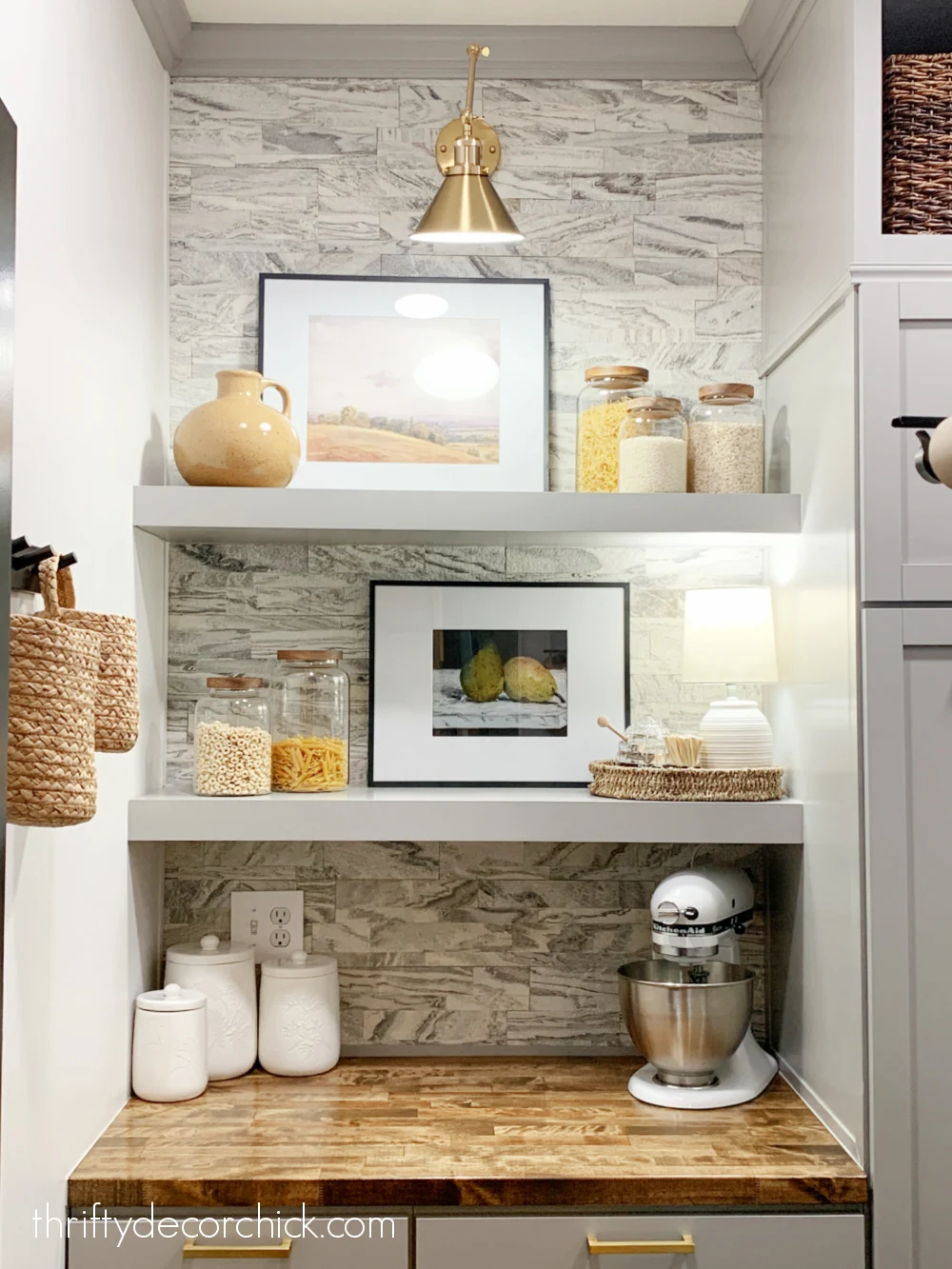

It functions more like a “butler’s” pantry now — we often keep extra food containers and dishes in here when we entertain. It’s great to have the countertop to use our small appliances too.
This peel and stick tile option is more realistic than many I’ve seen — the texture feels and looks authentic. That was the problem though — it was just SO rough to the touch. And if anything rubbed against it, little particles of the tile would come off.
NOT ideal near food!
I think this tile would be really lovely around an electric fireplace!
This tile came in sections that you fit together as you install it:

This post may contain affiliate links for your convenience.
I may earn a small commission when you make a purchase through links.
Because of this shape, the installation was actually not bad! If you had a bigger or wider space, it would be even easier.
The adhesive on these suckers was thick and VERY sticky. There are a lot of peel and stick options that aren’t as heavy duty as ours — many I’ve seen are more of a thin plastic that can be removed relatively easily.
There were a few sections of this tile that didn’t lay completely flat, but it was minor. A few weeks ago, I took advantage of one of those areas and started pulling to see how easily it would come off of the drywall.
Spoiler alert: it did not come off easily. 🙂
The moral of this story — make sure you REALLY LOVE the peel and stick tile you’re installing!
Finally I decided to go for it — I grabbed a scraper with a thin, flat edge and started tapping it under the tile:

This involved a lot of hammering to scooch the scraper under the tile, and then rocking it up so the tile would come away from the wall.
The end result was a disaster, but not quite as bad as I thought it would be! I figured big chunks of drywall would come off with the sticky tile, but it was only the top paper layer:

The black splotches were the residual adhesive from the tiles. When I was done with each section, I used the scraper tool across those parts to get as much excess off as possible.
I initially planned to use a heat gun to remove this product, but I have no doubt there would still be some residual adhesive on the wall.

But then I started making some other changes to the room (that I will share very soon!), and realized the tile I was planning to use was going to be way too busy. Plus, that leftover adhesive wouldn’t have been a good base for tile — it wouldn’t have laid flat against the wall.
This ended up saving me a ton of money! These are so pretty, but expensive for such a small tile.
Instead, I decided on a tongue and groove look for the backsplash. The pieces fit against each other on the wall:

Because these are nice and thick, I knew they would hide any inconsistencies on the damaged drywall.
Also, I installed a similar planked look around the other side of the room when I first made over this space:

So it tied in beautifully!

I LOVE the look! I had some leftover from that project, so I only had to purchase six boards for this little wall.
Tip: The primed versions of these boards are much cheaper than the painted option!
Usually I wait until after install to paint most of my wood projects, but with these notches I find it much easier to paint beforehand:

I started the install at the middle of the wall and worked from there. My wall was almost the perfect width to fit nine vertical boards, but I was going to have a little too much extra space on each side
So instead of butting these right up to each other, I figured out the perfect spacing (using some scrap wood and a line of brad nails) so they fit perfectly across:

Using my makeshift spacer, I nailed in each board at the bottom first. Then I moved the spacer up to the top and secured it with my nail gun, making sure each piece was level as I went:

After install, I filled the nail holes, caulked along the edges and gave everything one final coat of paint:

Look at those matching lines top to bottom! 😍 It looks like they were installed behind the built in shelves, but I had to do each portion separately. (Starting from the middle and keeping the spacing consistent was key.)

They are such great quality, and are so much more substantial than what we had before.

I’ll be sharing the full reveal of this little makeover shortly! Just a couple more little projects to finish up.
We love how this planked backsplash turned out! It’s a classic, timeless look and calms the room a bit. Have you used this tongue and groove product in your home?