



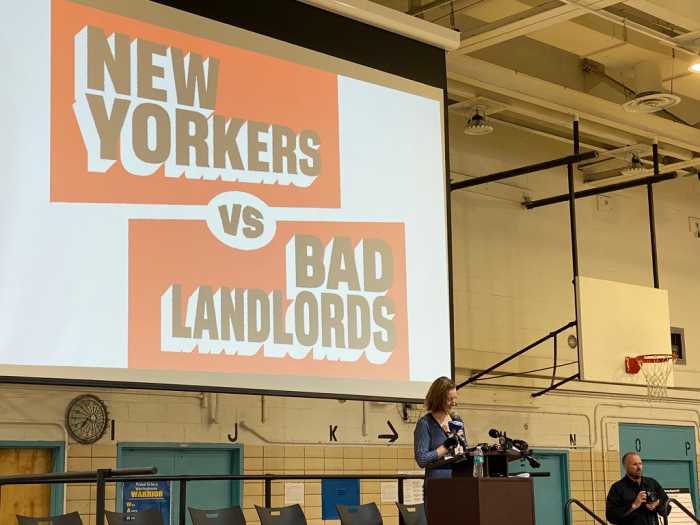
Mayor Zohran Mamdani’s series of “rental ripoff hearings” kicked off Thursday evening in Downtown Brooklyn, where tenants were invited to share stories about deteriorating conditions, hidden fees, and landlord retaliation — testimony the administration says will directly shape new housing policy.
The hearings, created under an executive order signed during Mamdani’s first day in office, are scheduled to take place across the five boroughs during his first 100 days.
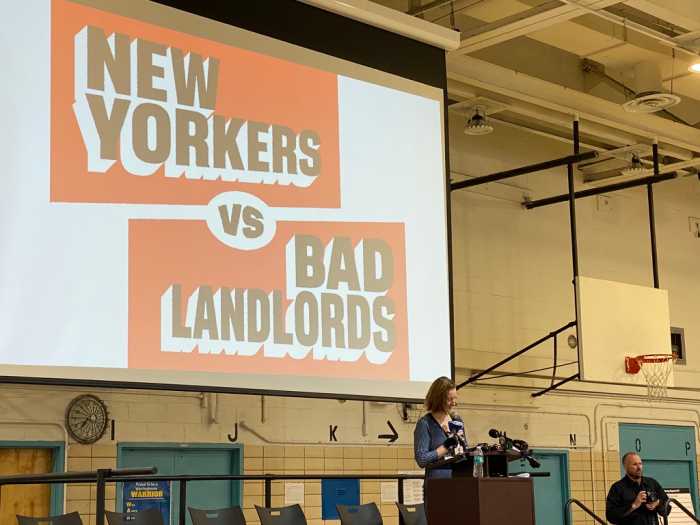
Cea Weaver, who heads the Mayor’s revitalized Office to Protect Tenants, opened the evening by explaining how the hearings would work and what the administration hoped to learn.
Tenants would deliver timed testimony directly to agency leaders, and their accounts would be compiled into recommendations expected within 90 days.
After her presentation, Weaver told reporters that the goal was to understand both individual experiences and broader patterns — from building-level neglect to systemic enforcement gaps.
The hearings, she said, are meant to give tenants a “direct platform to share their experiences with bad landlords” and help drive the city’s code enforcement policy.
Department of Buildings Commissioner Ahmed Tigani also spoke with reporters as tenants continued to file in. He emphasized that the city works with landlords as well as tenants, noting there are landlords “trying to do the right thing,” and that agencies regularly engage with trade organizations and property owners.
At the same time, he said the hearings would help identify what additional tools or resources may be needed for enforcement.
Long before Thursday’s first session began, landlord groups had been pushing back against the format.
Ann Korchak, board president of the Small Property Owners of New York (SPONY), called the hearings “nothing more than City Hall-sponsored, anti-landlord events.”
“The name of these hearings evokes an adversarial pitch,” Korchak said in a statement before the session. “Housing works best when all parties are pulling in the same direction, but the Mayor is intent on demonizing owners and spreading divisiveness.”
Korchak also accused the administration of “stacking the deck” with Rent Guidelines Board (RGB) appointees and claimed the hearings were part of a broader effort to move toward “socialized housing.”
Mamdani last week appointed five new members and reappointed one to the city’s RGB — a move that gives his selections a majority on the panel and moves him one step closer to enacting the rent freeze he promised while campaigning last year.
NYCHA confusion
Thursday’s event at George Westinghouse High School was structured more like a controlled intake session than a traditional public hearing.
Tenants registered in advance and signed up for three-minute, one-on-one meetings with senior city officials. Around the gymnasium, agency staff stood beside poster boards outlining policy areas under review and invited public input on topics such as housing quality and code enforcement; abusive landlord practices and retaliation; and hidden or deceptive fees.
A resource fair also provided information on filing complaints and accessing legal support.
According to city officials, 450 people signed up for the first two back-to-back Brooklyn sessions.
The Mayor’s Office to Protect Tenants — reestablished by Mamdani on his first day in office — led the effort alongside the Department of Housing Preservation and Development, the Department of Consumer and Worker Protection, the Office of Mass Engagement, and the Department of Buildings.
Before doors opened, more than 50 tenants rallied on the school steps, calling for stronger enforcement, an end to landlord self-certification of repairs, and a rent freeze.
But for some, their frustration centered on whether the half a million residents of the New York City Housing Authority would have a meaningful platform at the hearings, stemming, officials said, from misleading media reports. It was reiterated throughout the event that NYCHA tenants are permitted to register and participate in the one-on-one sessions.
Before the session began, Naomi Colon, vice president of the Marcy Houses Resident Association, was among those who were concerned that she was being sidelined. She and her fellow residents came prepared to protest with signs.
Speaking to amNY, Colon said residents in her development are dealing with deteriorating apartments and slow repairs.
“A lot of the residents are complaining the rent is very high, and the service is very low,” Colon said. “The apartments are breaking down. We need help with that. We need a lot of help with that.”
Asked how she felt about Mamdani’s election and the hearings, Colon said she was hopeful despite the initial confusion.
“If he can help us, we will be grateful,” she said. “We will be grateful, and we will appreciate anything that the mayor can do to help all the residents in public housing.”
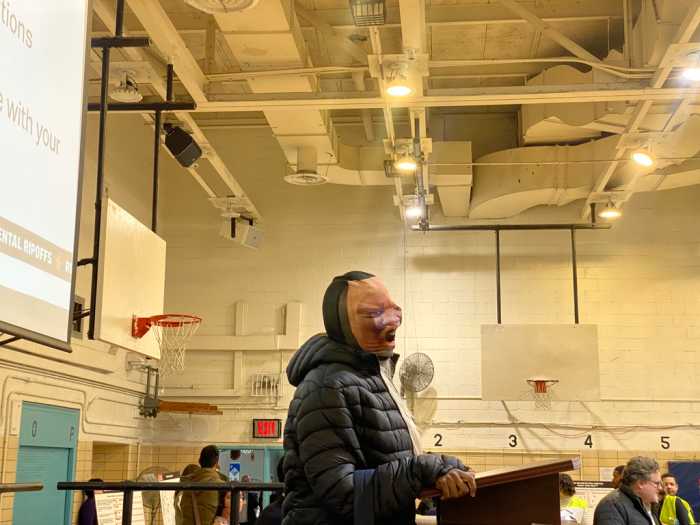
Inside, Weaver clarified during her opening remarks that NYCHA residents were eligible for the same one-on-one sessions as other tenants and that NYCHA representatives were present at the resource fair.
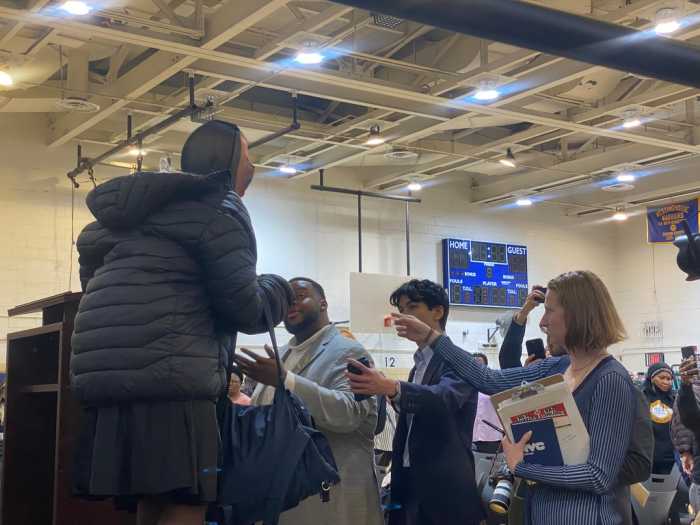
Despite that clarification, a woman wearing a mask of President Donald Trump stormed the stage shortly after Weaver concluded her presentation. She demanded that NYCHA tenants be heard, using several explicit words as she addressed the room.
A voice came over the speakers informing her that, as a NYCHA tenant, she was eligible to testify. Weaver and other city officials rushed to the stage to further explain where she could sign up.
‘We went on a rent strike’
As the sessions began, tenants moved from table to table for their timed meetings.
Jaren Forbes, a steering committee member of HOPE Tenant Union and tenant leader at her Herkimer Street building, used her three minutes to recount a prolonged fight with her landlord.
“Due to the deterioration of the building and neglect … we’ve seen the conditions just deteriorate over time,” Forbes said. “And we also noticed that the respect from the landlord became crappy as well.”
In 2022, Forbes and her neighbors launched a rent strike to push for repairs. After legal proceedings and stalled negotiations, tenants escalated in March 2025 by organizing outside their landlord’s office in Great Neck, Long Island. Days later, she said, they reached a settlement and are now in the repair phase.
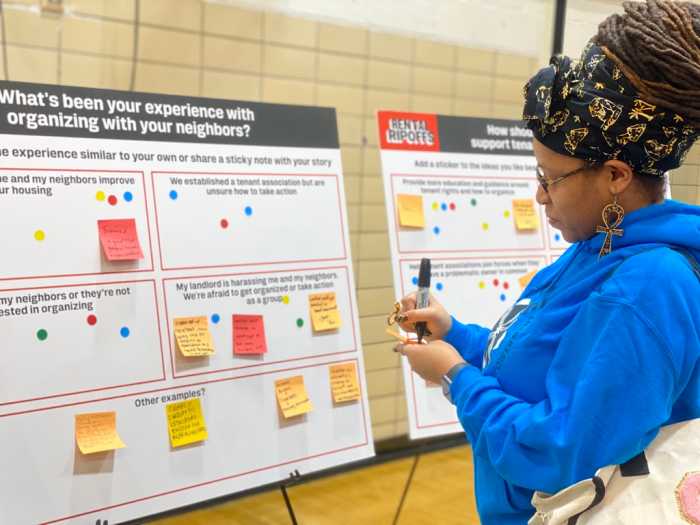
At the hearing, she advocated for changes to the landlord inspection system. Her suggestion to the administration called for creating a booking system that would allow tenants to schedule inspections.
“There are times when inspectors are actually very rude,” Forbes said, calling for the scheduling system so inspectors don’t “just pop up” and for additional sensitivity training.
“I have a realistic view that things can go in either direction,” she added. “I am hopeful for the positive.”
A face-to-face with the tenant chief
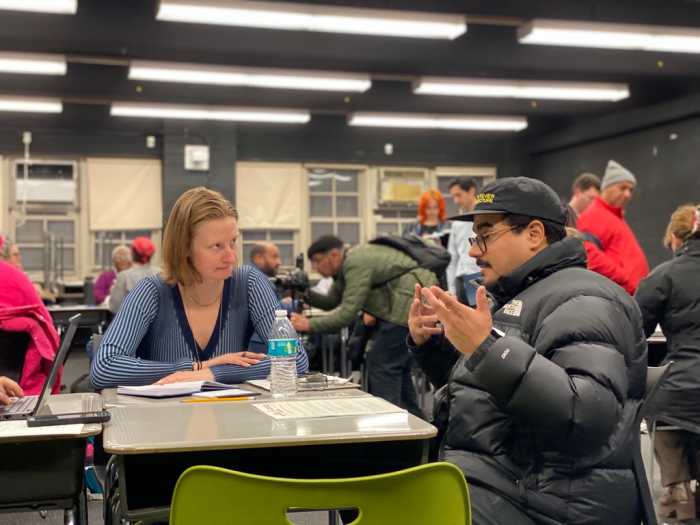
Joshua Rodigues, a lifelong Red Hook resident, said the company that purchased his building roughly three years ago has repeatedly contacted tenants about moving out while failing to address repairs.
“I’ve been fighting my landlord for the past year and a half,” Rodigues told amNY.
During his session, Rodigues sat down directly with Weaver.
“I didn’t expect to speak to anybody,” he said after his one-on-one session, noting that he thought from the event description that it would be an open mic format – though he was not complaining.
Despite the direct access, he said he remains cautious about whether conditions will change after years of feeling unheard. “I’m skeptical, but hopeful.”
Kelly Cook, who lives in a rent-stabilized building in Crown Heights, showed up to testify with the hopes that her voice could bring about meaningful change in her neighborhood, rather than immediate fixes.
“Between 2016 and 2017 … they upped the rent illegally by 128% at the time,” she said, adding that the work cited would have amounted to more than $75,000 per apartment in units under 1,000 square feet.
Cook described drafty windows and leaky pipes that she said were supposed to have been replaced.
“We filed a rent overcharge complaint,” she said, but the process can take years.
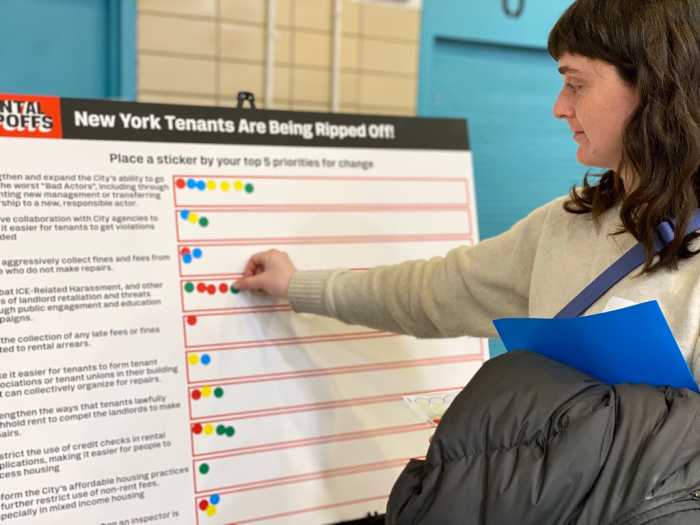
She said she worries not just about her own apartment but about others in her neighborhood.
“I live in a neighborhood with people that don’t have that same ability,” she said. “They’ve lived there their entire lives. They do not deserve to be priced out of their neighborhoods.”
Whether the stories shared on Thursday will translate into enforcement changes or new protections remains to be seen. But for tenants like Forbes, Rodigues, Cook, and Colon, the hearing marked at least a moment of being heard.
“I’m hopeful,” Forbes said. “I’m just hoping that this sets the tone going forward.”
Additional hearings are expected in other boroughs in the coming weeks, with sessions in Long Island City on March 5; Fordham in the Bronx on March 11; East Harlem on March 28; and Staten Island’s North Shore on April 7, each offering multiple time slots for tenants to testify.