



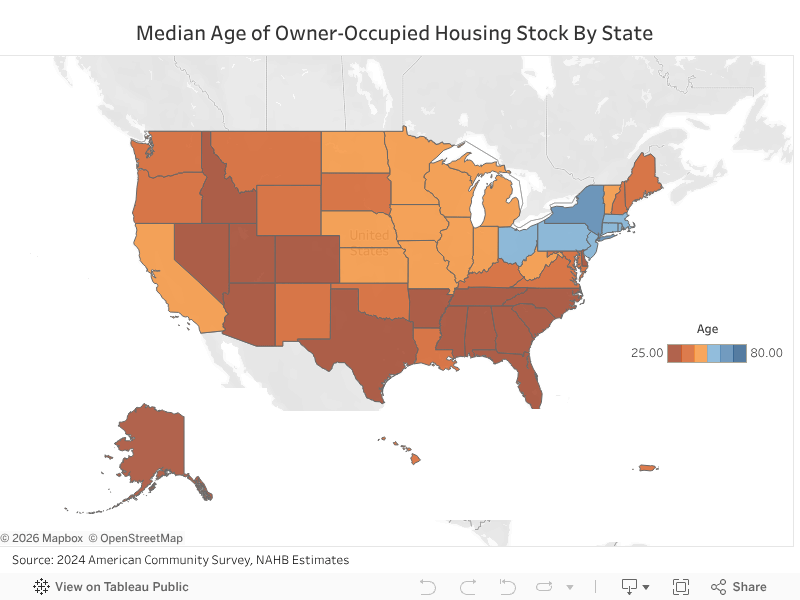
According to the latest data from the 2024 American Community Survey (ACS), the median age of owner-occupied homes has reached 42 years old. The age of the housing stock is an important remodeling market indicator. Older homes tend to be less energy-efficient than newly built homes and are more likely to require repairs, upgrades, and renovations in the future. At the same time, as people increasingly use their homes for multiple purposes and demand additional space, older housing represents an investment opportunity for homeowners.
The age of the owner-occupied housing stock varies greatly across 50 states. New York has the oldest owner-occupied homes with a median age of 64 years, followed by Massachusetts (59), and Rhode Island (59). Half of all owner-occupied houses in the District of Columbia were built more than 80 years ago. However, D.C. is generally not a representative market, given its smaller size and highly urbanized environment.
In contrast, newer owner-occupied housing is particularly concentrated in the Sun Belt states where 14 out of 15 states, the exception being California (45), have a median owner-occupied housing stock age below the national median (42 years). The median age of owner-occupied homes in Nevada is only 25 years, followed by Texas at 28 years. South Carolina, Georgia and Arizona also rank among the states with the newer homes, where half of owner-occupied homes have been built within the past 29 years.

The geographic distribution of owner-occupied housing stock age reflects underlying population changes. Population growth, including both natural growth and net migration, signals rising demands for housing and typically leads to more new construction. As a result, the rapid population growth states, like Idaho, Nevada, South Carolina, Texas Florida, tend to have newer owner-occupied housing stock. However, states experiencing slower or even negative population growth tend to have older housing. In states such as Pennsylvania, Vermont, and New York, the owner-occupied housing stock is older than the national median.