



Evictions are stressful, time-consuming, and expensive, especially when you’re a landlord stuck paying court costs, attorney fees, and enforcement out of pocket. While facing such financial burden, you might wonder, “Can a landlord charge for eviction fees?” Yes, landlords can charge tenants for eviction fees, but it heavily depends on the lease agreement, state and local laws, and whether a court actually awards those costs after a judgment.
Some eviction-related costs may be recoverable if they are clearly allowed under the lease and recognized by local law, while others may be limited, regulated, or completely prohibited depending on the circumstances.
In this blog, I will explain what eviction fees actually include, when landlords are legally allowed to charge tenants, what costs are generally considered reasonable, and when landlords are not allowed to recover those fees from tenants. With my 20+years experience helping landlords, I will also share with you practical tips on how to properly document your expenses and maximize your chances of a full financial recovery to protect your rental income and avoid costly legal mistakes.
What Are Eviction Fees?
Eviction fees refer to the various costs landlords incur when legally removing a tenant from a rental property due to lease violations, nonpayment of rent, or other qualifying reasons. These fees typically arise once the formal eviction process begins and may include expenses like court filing fees, notice service fees, attorney fees, and enforcement costs associated with carrying out the eviction order. In some cases, landlords may also experience indirect costs such as lost rental income during the eviction process or expenses related to preparing the property for new tenants after the eviction is completed.
These are actual expenses directly tied to forcing the tenants out based on legal reasons, and the big question is whether your lease agreement and the judge’s ruling let you pass them back to the tenant who caused all the trouble in the first place.
When Can a Landlord Legally Charge a Tenant for Eviction Fees?

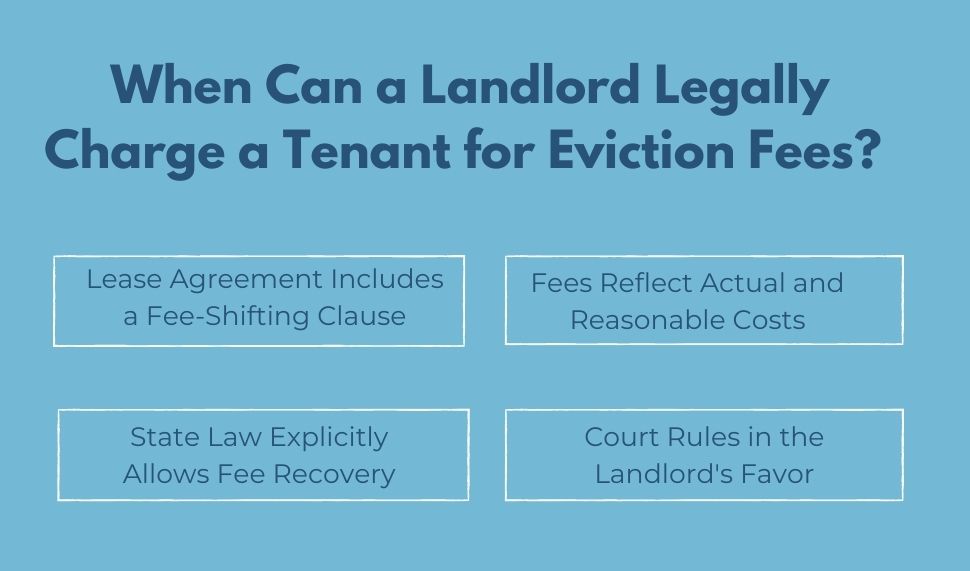
Not every landlord who goes through an eviction is automatically entitled to recover their cost from the tenants; it depends on a very specific set of legal conditions that need to be met. Here are the four situations where charging tenants for eviction fees is legally justified:
1. Lease Agreement Includes a Fee-Shifting Clause
One of the most important factors that determines whether eviction fees can be charged is the language in the lease agreement. Many leases include a fee-shifting clause or a prevailing party clause, which states that if the landlord has taken legal action to enforce the lease, tenants are responsible for legal bills if they are found to be at fault.
Without this clause, you as a landlord cannot automatically bill tenants for attorney fees or court costs because the legal system follows the “American Rule”, meaning each party pays its own legal expenses unless a contract or law says otherwise. Hence, if the rental agreement has a clear clause like “Tenant agrees to reimburse landlord for all eviction-related costs, including legal fees and court expenses”, landlords can successfully recover legal costs after an eviction judgment.
2. Fees Reflect Actual and Reasonable Costs
Even when a fee-shifting clause exists in the lease, the landlord can only attempt to recover the fees that reflect actual, documented, and reasonable costs. You cannot inflate numbers or charge for hypothetical losses that you can’t back up with receipts or records because the court will reduce or dismiss the fees entirely during the judgment process. Landlords must keep detailed records throughout the eviction process, including invoices, receipts, attorney billing statements, and court filings confirmations.
For example, charging the actual court filing fee in Oklahoma County (which is approximately $58 to $154) is legal and reasonable. However, trying to charge $500 for “administrative time” spent at the courthouse might be rejected by a judge if it doesn’t represent a direct, documented out-of-pocket expense.
3. State Law Explicitly Allows Fee Recovery
Landlords can legally charge tenants for eviction fees when state laws permit recovering reasonable expenses after completing a proper eviction process through the courts. The landlord-tenant law in each state has its own rules regarding what landlords can charge tenants, and some states place strict limits on which eviction expenses can be recovered. In many jurisdictions, landlords can recover court costs or attorney fees only if the lease allows it and the law specifically permits it.
For instance, in landlord-friendly states like Oklahoma, with Title 41 O.S. §41-52, you can get judgments for actual costs without extra clauses for basics like filings, though attorney fees still need a lease backup. Because laws vary so much depending on the state, landlords need to check the laws that apply to their rental property’s location before attempting to charge tenants for eviction-related expenses.
4. Court Rules in the Landlord’s Favor
As a landlord, you can legally charge eviction fees to a tenant when you win the case in court, and the judge awards those costs as part of the judgment. Even if the landlord initially pays the filing fees, service fees, and attorney costs, the tenant typically becomes responsible for those expenses only after the court rules that the tenant violated the lease.
It is important to remember that just because you win the case doesn’t mean the money automatically appears in your account; you must ensure that every fee is explicitly listed and approved by the judge during the hearing. Once these costs are part of a signed court order, they become an official record that can be used for future collection efforts, such as garnishing wages or reporting the debt to credit bureaus. Landlords should follow the state’s eviction laws and proper legal process, present clear documentation, and allow the court to determine whether those eviction costs can legally be recovered from the tenant.
What Are Reasonable Eviction Costs for a Landlord to Charge?

While every case is different, “reasonableness” is the standard that judges use to determine which costs can be passed from the landlord to the tenant. Eviction can cost thousands of dollars after accounting for different expenses, but as a landlord, you can only attempt to recover the costs directly related to the eviction process, documented with receipts or invoices, and considered reasonable in amount. The following reasonable costs are considered legitimate and commonly recognized during eviction proceedings:
Court Filing Fees
Court filing fees are the fees paid to the local court when a landlord files an eviction or Forcible Entry and Detainer action against a non-compliant tenant. These costs count as reasonable because they are the basic charge to start a case in the district court, and come with an official court receipt, which makes it easy to recover when the court rules in your favor. The average court filing fee for an eviction in the United States ranges between $50 and $400, depending on the state and the court where the case is filed ($85 – $150 in Oklahoma).
Notice Service Fees
Before a landlord can file an eviction lawsuit, you are legally required to serve the tenant with a formal written notice through a process server, sheriff’s department, or other authorized individual. The service typically comes with a fee, generally ranging from $50 and $100, depending on the number of delivery attempts and the local service provider. These costs are commonly recognized as reasonable eviction expenses because landlords are legally required to provide official notice before filing or continuing an eviction case, like the 5-day Notice to Quit in Oklahoma.
Attorney Fees
Many landlords hire an attorney to handle the eviction process because eviction laws, court procedures, and tenant protection can be complicated, who charge $500 to several thousand dollars if the eviction becomes contested. Attorney fees qualify as reasonable if the lease agreement includes a fee-shifting clause while aligning with local market rates and the complexity of the work performed. Keeping clear billing records and legal invoices demonstrates that the charges were legitimate and directly related to resolving the eviction.
Sheriff/Enforcement Fees
Once the court grants an eviction judgment, landlords cannot remove the tenant themselves; instead, law enforcement officers, often the sheriff, physically remove a tenant lawfully and safely and restore property control. These fees typically range from $75 to $400, depending on the jurisdiction, scheduling requirements, and the complexity of removal. Because the eviction cannot be completed without official enforcement, courts commonly recognize these charges as legitimate eviction expenses.
Lost Rent & Turnover Costs
Lost rental income is the biggest financial impact of an eviction, which is very difficult to recover because courts treat it differently depending on the circumstances and lease language. If a tenant stops paying rent but remains in the property during the eviction proceedings, landlords may lose several months of income. You may face turnover costs once the tenant leaves, which can include cleaning, repainting, and marketing the property. Documenting your rental rate, the exact vacancy dates, and all turnover-related invoices is essential if you plan to include these costs in a post-judgment recovery claim.
Property Damage Repairs
When a tenant leaves a rental property in worse condition than when they moved in, beyond normal wear and tear, the cost of those repairs is a legitimate eviction-related charge that landlords can pursue for recovery. Depending on the lease agreement and local laws, these repair costs may be recovered through security deposit deductions or separate legal claims against the tenant.
Locksmith Fees
As a landlord, you need to change or rekey the lock to secure your rental property once the eviction has been completed, which can cost $100 to $200, depending on the number of locks and hardware installed. Because securing the property is a standard step after an eviction enforcement, courts may consider locksmith costs to be reasonable post-eviction expenses in certain cases.
Can You Deduct Eviction Fees from the Security Deposit?
In some situations, landlords may be able to deduct certain eviction-related costs from a tenant’s security deposit, but this is only allowed under specific conditions and usually depends on state landlord-tenant laws and the terms outlined in the lease agreement. Security deposits are primarily intended to cover unpaid rent, property damage beyond normal wear and tear, and other financial obligations clearly defined in the lease, which means eviction fees themselves are not always automatically deductible.
In many states, including Oklahoma, landlords are required to return the security deposit or provide an itemized written statement of deductions within 45 days after the tenant vacates the property, and any deductions made must be clearly documented with supporting receipts or invoices to be legally defensible. If eviction-related costs are deducted improperly or without clear justification, tenants may challenge those deductions and potentially pursue legal action to recover the funds.
When a Landlord Cannot Charge Eviction Fees?
While, as a landlord, you may be able to recover certain eviction-related costs in some situations, there are some circumstances where charging a tenant for eviction fees is not legally allowed. Here are the specific situations you need to understand to avoid disputes and legal penalties, or delays in the eviction case itself:
No Valid Lease Clause or Agreement
If the lease agreement doesn’t include a clause that allows the landlord to recover eviction-related costs, it may be difficult or impossible to charge those fees to the tenants. Without that written lease language explicitly authorizing fee recovery, most courts will default to each party bearing their own costs, meaning you absorb every dollar of the eviction expense yourself, regardless of the outcome.
Illegal Self-Help Evictions
Landlords are prohibited from using self-help methods to remove tenants from a property, such as changing locks, shutting off utilities, or physically forcing tenants to move out without a court order. If you attempt to evict a tenant using these illegal eviction methods, courts see it as a violation of tenant rights, and landlords who attempt them may face fines, lawsuits, or additional legal penalties instead of recovering eviction costs.
No Court Order
Without a formal court order or judgment awarding the fees, landlords cannot legally charge tenants for eviction costs because only the judge’s ruling makes those expenses enforceable. Even if your lease includes a fee-shifting clause and documented everything, you generally cannot unilaterally decide to charge a tenant for eviction costs without a judge formally ruling in your favor and including those amounts in the judgment.
Disallowed by Local Law
Some states or local laws restrict or completely prohibit certain types of eviction-related fees, blocking recovery even with a strong lease. For example, certain jurisdictions limit administrative fees, cap recoverable legal costs, or require specific disclosures before fees can be charged. Hence, before pursuing any eviction fee recovery, it’s worth verifying that your intended charges don’t conflict with any applicable local ordinances currently in effect.
Procedural Errors and Improper Notice
If a landlord makes mistakes during the eviction process, such as serving the wrong notice or failing to follow proper timelines, the court may dismiss the eviction case entirely. When a case is dismissed due to a landlord’s procedural error, you generally cannot recover eviction costs because the legal process was not completed according to the rules required by landlord-tenant law.
Retaliatory or Discriminatory Evictions
As a landlord, you are prohibited from evicting tenants for retaliatory or discriminatory reasons, such as punishing a tenant for reporting a housing code violation, or targeting a tenant based on a protected characteristic under the Fair Housing Act. If the court determines that an eviction was filed for retaliatory or discriminatory purposes, the landlord will not be able to recover the eviction costs and may face additional legal consequences.
Practical Tips for Landlords to Maximize the Chances of Recovery
Recovering eviction fees is not always guaranteed, but landlords can significantly improve the chances by following legal procedures, maintaining accurate records, and using a well-structured lease agreement. The following practical tips can help you as a landlord to strengthen your position when seeking to recover eviction costs:
- Include a clear fee-shifting clause in the lease agreement. Ensure the lease explicitly states that the tenant may be responsible for legal costs, court fees, and attorney fees if the landlord must take legal action to enforce the lease terms.
- Document all eviction-related fees carefully. Keep copies of court receipts, process server invoices, attorney billing statements, repair estimates, and any other records to ensure that the costs were legitimate and directly related to the eviction.
- Follow the proper legal eviction process from the start. Always provide the correct notice, meet required waiting periods, and file paperwork accurately to avoid procedural mistakes that can prevent recovery.
- Maintain detailed tenant records and communication history. Keep copies of lease agreements, payment records, notices, move-in inspection, timestamped photos, and written communication to create evidence courts rely on when awarding damages.
- Screen tenants thoroughly before signing a lease through credit history, rental history, and income verification to reduce the likelihood of ending up in an eviction situation altogether. It’s advisable to use local professional tenant services that help you prevent bad tenants early.
- Work with an experienced property manager or attorney. Professional guidance helps ensure compliance with landlord-tenant laws and reduces costly mistakes during eviction proceedings.
Avoid the High Cost of Evictions: Partner with OKC Home Realty Services
Landlords can legally charge for eviction fees such as court filing fees, service fees, or attorney expenses if the lease agreement includes a fee-shifting clause, the charges reflect reasonable, documented costs, the state law allows it, and a court rules in the landlord’s favor. However, you cannot charge arbitrarily and must follow legal procedures, comply with local laws, and avoid illegal eviction practices.
Most eviction-related financial losses are entirely preventable with the right systems, lease language, and a professional property management team like OKC Home Realty Services. We specialize in protecting your investment by finding high-quality tenants and managing the legal complexities of property ownership for you. Stop worrying about legal fees and start collecting consistent rent. Contact us today for a free rental analysis.
FAQs about Landlords Charging for Eviction Fees
Why do some states prohibit landlords from charging administrative eviction fees?
Some states prohibit administrative eviction fees because lawmakers view them as an additional financial burden on tenants who may already be in difficult circumstances. These laws are designed to prevent landlords from profiting beyond their actual documented losses and to ensure that any cost recovery goes through a transparent, court-supervised process rather than being imposed unilaterally by the landlord.
What happens to unpaid eviction fees on a credit report
Unpaid eviction fees that have been converted into a court judgment can be reported to the major credit bureaus and will appear on a tenant’s credit report as an unpaid civil judgment, significantly damaging their credit score. Additionally, eviction records themselves may appear in tenant screening databases, making it considerably harder for that tenant to rent another property in the future.
How are eviction costs calculated in a court judgment?
Eviction costs in a court judgment are calculated based on documented, itemized expenses submitted by the landlord during the hearing, including court filing fees, attorney fees, notice service costs, and any unpaid rent owed. The judge reviews all submitted documentation and determines which costs are reasonable, directly related to the eviction, and recoverable under the lease agreement and applicable state law.
Can a tenant dispute eviction fees if the case was dismissed?
Yes, if an eviction case is dismissed, the tenant has the right to challenge any fees the landlord attempts to collect, and in some states can petition the court to have their own legal costs reimbursed by the landlord. A dismissed eviction case generally means the landlord failed to meet the legal burden of proof, which significantly weakens their ability to pursue any fee recovery against the tenant.
Are eviction legal costs passed to the tenant?
Eviction legal costs can be passed to the tenant only when a fee-shifting clause exists in the lease agreement, state law permits it, and the court rules in the landlord’s favor.
How much does it cost to evict someone in Oklahoma?
Evicting a tenant in Oklahoma typically costs landlords $1,500 to $7,500 total, depending on how complicated the case gets and if you hire help, with direct court fees starting low but lost rent and extras adding up fast.