



The “silver tsunami” refers to the wave of housing inventory expected as older homeowners downsize or transition out of their homes. According to the latest American Community Survey, there are an estimated 61.2 million people in the U.S. aged 65 years or older, representing about 18% of the population. This cohort, which includes the Boomer and Silent generations, is characterized by a high homeownership rate (78.6%), and currently owns 29.6 million homes in the U.S. or 34.1% of all owner-occupied housing units. As a group, they hold an estimated $13.8 trillion dollars in housing value, or roughly one-third of the total residential property value in the country.
Given the outsized share of homes occupied by Baby Boomers, the release of this housing stock will have a significant effect on housing markets. However, the effect across regional markets will vary greatly depending on the prevalence of aging householders, migration patterns, and the severity of affordability constraints. While some markets with aging populations and negligible in-migration may face a surplus, markets that attract younger population, as well as supply-constrained markets with suppressed household formation can easily absorb units released by Baby Boomers.
Mapping Housing Constraints and Potential Supply
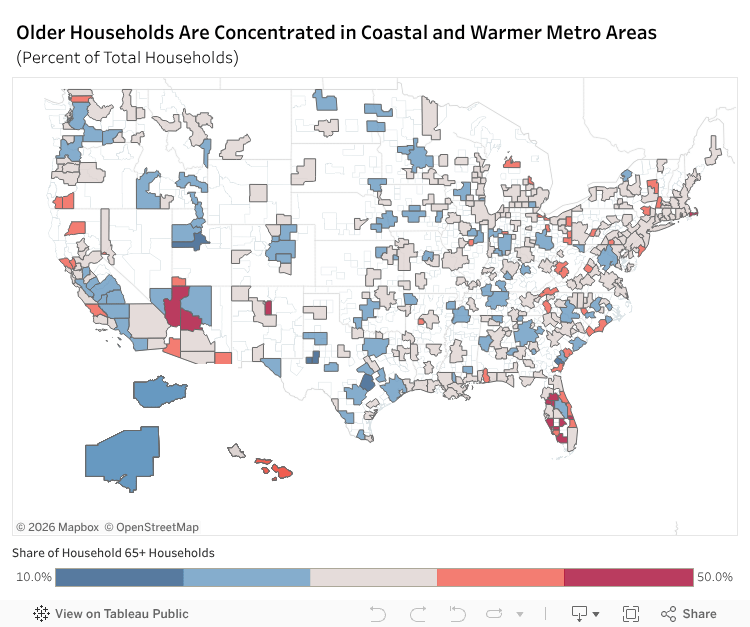
Geographically, coastal and warmer climate areas tend to have the highest share of homes occupied by those aged 65 and above, reflecting retirement preferences and migration patterns. Florida, a popular retirement destination, contains several metro areas with a large share of households headed by someone aged 65+. In fact, seven of the top ten highest shares are in Florida, with Wildwood-The Villages having the largest share (68.2% of total households), followed by its neighboring metro area, Homosassa Springs (52.7%).

To assess how the concentration of older households may translate into housing opportunities, we plot headship rates for individuals aged 25 to 64 against the share of housing occupied by those aged 65 or older by metro areas. The younger age group represents the core demand base of the housing market, encompassing both first-time and repeat buyers. Metro areas are colored by the home price-to-income ratio (HPI), with darker red indicating lower affordability, while bubble size represents five-year population growth (2019–2024). Data for 2020 are unavailable due to the COVID-19 pandemic.
In this analysis, the headship rate is defined as the number of households headed by someone aged 25 to 64 as a share of that population. A lower headship rate may reflect underlying composition of demographics or, in other cases, housing constraints that lead individuals to delay forming independent households and instead double up or live with family.
Across metro areas, there is a negative relationship, in which higher shares of 65+ occupied housing tend to coincide with lower headship rates. This pattern holds even after excluding retirement destination outliers, such as The Villages and Homosassa Springs. In other words, areas with a greater concentration of older homeowners are generally areas with greater housing constraints.

The plot is divided into four quadrants based on the average share of 65+ households (x-axis) and the average headship rate (y-axis), allowing for a comparison of housing conditions across different types of markets:
- Constrained, high-cost metros (lower-left) such as New York, Los Angeles, and San Diego have high pent-up demand but limited exposure to potential supply from older homeowners. These are places where additional supply can help boost household formation, improve affordability, rather than generate supply surplus.
- Senior housing markets (lower-right) have large shares of older homeowners, where housing demand is sustained by the migration of retirees. These markets will likely face the largest influx of available homes but are also some of the most constrained markets as indicated by lower headship rates and suppressed household formation among younger adults. Therefore, the additional supply of homes can boost the formation of younger households in these markets.
- Absorption markets (upper-left) have stronger headship rates, better affordability, and positive population growth, making them more capable of absorbing additional supply.
- Markets at risk for oversupply (upper-right) have large potential supply with weak population growth and little in-migration, raising the risk of localized oversupply.
Population Growth and Prevalence of Older Homeowners in Top 100 Metro Areas
Building on the earlier analysis, we consider markets in the top 100 metro areas (by number of households) with above-average headship rates (52.5%). In these markets, population growth can provide a clearer signal of whether potential supply from older homeowners will be absorbed or outpace demand.

In the Midwest and Rust Belt regions, we can see that the shares of 65+ households are larger (larger bubble size) with strong headship rates and better affordability. However, metros such as Pittsburgh, Cleveland, and Rochester are at risk of oversupply because population growth has been slow or even negative (darker red shading). These markets correspond to the upper-right quadrant of the previous chart.
By contrast, metros with strong headship rates, smaller 65+ households (upper-left quadrant) and are still increasing in population (darker blue shading) are mainly concentrated in the South and interior West. These are some of the metro areas that are better positioned to absorb the additional supply from the housing turnover, and they include Durham-Chapel Hill, NC, Knoxville, TN and Jacksonville, FL. Some markets like Charlotte, Denver, and Austin can especially benefit from additional supply, as strong population growth and small shares of 65+ units could place them at risk of becoming more constrained over time.
Older Households, Older Homes
Another complicating factor to the “silver tsunami” narrative is the age of the housing stock held by this cohort. In the top 100 metro areas, markets with larger shares of 65+ households also tend to have older housing stock. For example, in Pittsburgh, up to 24.3% of homes occupied by those aged 65 and above were built before 1980, making them older than 46 years old. Thus, these homes are unlikely to be direct substitutes for newer construction as when they enter the market, many may require significant renovation, and in some cases, redevelopment.

Preference for Aging in Place
A further limiting factor for the silver tsunami assertion is the set of incentives facing older householders to remain in their homes. Approximately 66% of mortgage-free homeowners fall within this age cohort, reducing the financial pressure to sell. At the same time, rising costs for nursing homes and assisted living further discourage mobility. As a result, this cohort will opt in greater numbers than prior generations to remain in their homes and invest in age-in-place (AIP) modifications. Two NAHB analyses on this topic have shown that applications for home renovations by this age group have increased and that remodelers have seen some to significant increase in AIP requests.
All things considered, while the “silver tsunami” suggests that coming demographic turnover could increase housing supply over the next decade or two, local structural constraints could limit its impact on the housing market. Addressing affordability over the long-run requires expanding the overall housing supply, particularly through the development of medium- to higher-density housing.