


Expedia spent a meaningful chunk of its Q1 2026 earnings call talking about Vrbo — strongest start in years, “trusted pure-play vacation rental brand,” promos now driving a third of bookings. The Vrbo brand has rarely been louder on an Expedia call. Worth asking, four days later, what the news that followed actually means: an Uber distribution deal that adds Vrbo inventory later this year, a Claude integration live now, a new commercial chief running B2B and Supply under one roof. As part of Vrbo Expedia Strategy 2026, Vrbo’s positioning hasn’t moved. Its distribution has.
Q1 2026 at a glance — what the call actually reported:
- Group revenue $3.4 billion, up 15% year over year; gross bookings $35.5 billion, up 13%
- Consumer bookings up 10% — fastest pace in twelve quarters and the strongest growth since Q2 2018 once the COVID period is excluded; Vrbo named directly as a contributor
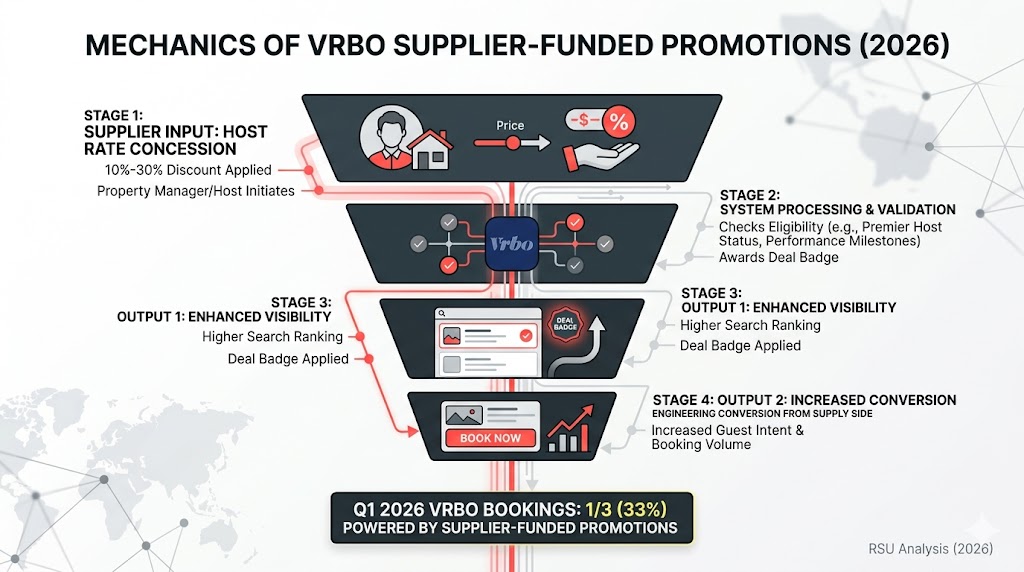
- Supplier-funded promotions drove over a third of Q1 Vrbo bookings
- Vacation rentals on Expedia (a separate surface from Vrbo) crossed $1 billion in annualised bookings for the first time
- B2B bookings up 22% to $10.7 billion; lodging property count up 10%, with fastest growth outside the US
- Adjusted EBITDA $542 million; margin 15.8%, up nearly 6 points year over year — Expedia’s highest Q1 margin in 15 years
- Middle East conflict and Mexico travel advisories cost roughly 2 points of growth for the quarter
- New $5 billion share repurchase authorisation announced; CFO Scott Schenkel exiting, Derek Andersen incoming
Vrbo had its loudest moment on an Expedia call in five quarters
CEO Ariane Gorin opened with consumer bookings up 10% — Expedia’s fastest pace in twelve quarters, and by CFO Scott Schenkel’s count the strongest growth since Q2 2018 once the COVID period is excluded. Both named Vrbo directly. Gorin: “We were particularly good about the performance of Vrbo.” Schenkel: “Vrbo continued to show strong momentum with improvements in traffic, quality and conversion.” The “trusted pure-play vacation rental brand” framing carried over verbatim from the Q4 2025 call, where RSU first traced the reliability pitch against Airbnb.
A third of Vrbo bookings now run through host-funded promotions
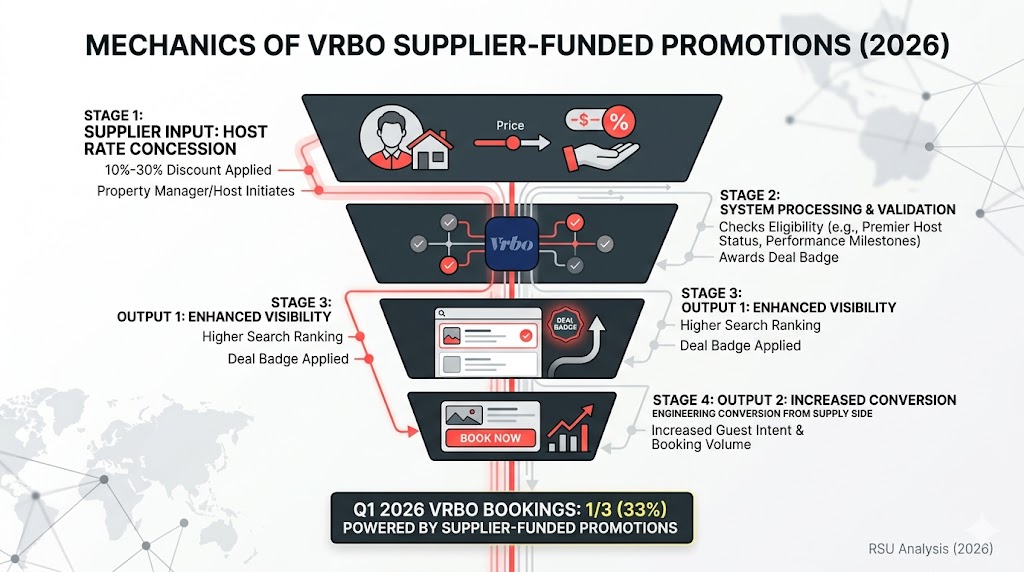
The number with the sharpest operator implication: over a third of Q1 Vrbo bookings came from supplier-funded promotions. The term is Expedia’s; the mechanism is a host-side rate concession — typically a discount of 10 to 30% in exchange for a deal badge and ranking eligibility. RSU has reported the Premier Host 2026 tightening — 99% acceptance, 0% host-initiated cancellations, 4.6+ ratings — alongside the new Performance Milestones ladder and Offer Strength Score.
The promo share at 33% means the supply-side machinery is now scaled. It is also a useful contrast to Airbnb’s Q1 push, where Reserve Now, Pay Later — a demand-side financial-engineering lever — drove roughly 20% of global gross booking value. Both platforms are engineering conversion. They are engineering it from opposite sides of the marketplace.

The $1 billion milestone isn’t Vrbo’s number — and an analyst had to ask
One more clarification worth carrying forward: when Gorin mentioned vacation rentals on Expedia hitting a $1 billion annualised run rate, an analyst had to ask whether the figure was bookings or revenue. Gorin confirmed bookings, and “it’s the VR just on Expedia. Obviously, it excludes Vrbo.” Vrbo’s brand-level growth and the unified-lodging surface are two separate stories now.
Every new distribution channel announced flows through the grid, not the brand
Expedia stacked distribution wins around the call. The Uber deal makes Expedia the exclusive hotel partner for Uber at launch — 700,000 hotel properties — with the Uber press release adding that “vacation rentals from Vrbo will be added later this year.” Uber also gets a slot inside the Expedia app, in a two-way superapp move with a clear parallel to Airbnb’s Welcome Pickups integration.
The Claude integration is live; ChatGPT ads went live in February; answer-engine optimisation, Gorin said, is now “the fastest-growing channel” at Expedia. The TikTok Go travel booking pilot adds a Gen Z funnel, paired with a year-long iShowSpeed partnership for upper-funnel reach.
Read the list together: every new surface is either Brand Expedia or a B2B pipe. Vrbo inventory rides through them. The Vrbo brand isn’t the destination.
The org chart now matches the strategy
Four days after the call, Expedia unified B2B and Supply under Alfonso Paredes, with twenty-year Supply veteran Greg Schulze departing. Paredes’ scope now spans hotels, vacation rentals, air, activities, car rental, and insurance — sold both through Expedia’s consumer brands and the partner network — through, in his own words, “a single integration layer.” The purported CarTrawler acquisition surfacing the same day extends the pattern: more supply categories, one pipe.
Airbnb pulls users in. Expedia sends supply out.
The two platforms are running opposite plays. Airbnb’s strategy is centripetal — pulling guests into one enclosed app and keeping them there. In Q1 2026, 63% of nights booked on Airbnb happened in-app, up from 58% a year earlier; RSU described the shift as a control shift before it had a name. Welcome Pickups, Services, Experiences, and the boutique-hotel pilot are all features added inside the walled garden.
Expedia is running the opposite play
Expedia’s strategy is centrifugal — pushing supply outward, onto whichever surface demand materialises. Vrbo isn’t a destination marketplace in this model. It’s a supply node on a grid that runs through Uber, Claude, ChatGPT, TikTok Go, partner airlines, fintech apps, corporate travel platforms, and Brand Expedia itself. A traveller booking a city break on the Expedia app may now see a professionally managed urban apartment alongside global hotel chains, and apply hotel-level expectations to it.
That is the reframe. The 2026 fight isn’t Vrbo vs. Airbnb. It’s Expedia’s grid vs. Airbnb’s walls, with Vrbo as the supply node the grid runs through.
If Vrbo favours hotel-grade ops and Airbnb favours individual hosts, where does the professional manager fit?

Vrbo’s tightened Premier Host standards — 99% acceptance, zero host-initiated cancellations, 4.6+ ratings — are practical only with the kind of software stack, 24/7 coverage, and standardised SOPs that professional managers tend to have. On the Airbnb side, in the same Q1 2026 call, Brian Chesky told analysts that internal data showed an inverse relationship between portfolio size and guest rating — the more properties a host manages, the lower the rating tends to be.
Neither comment is a policy. Both are signals. Taken together, they suggest the two platforms are diverging on which kind of host they reward — and the question for the professional operator is no longer which marketplace to prioritise, but which platform architecture rewards the way they actually run.
What this changes for the urban pro manager — and the destination host
For urban pro managers, the Uber-and-Vrbo timeline matters: Vrbo inventory joins the Uber surface later in 2026, and the use case — rideshare-to-stay — skews short, urban, and transactional.
For destination and whole-home Vrbo hosts, the harder question is whether the new surfaces will route meaningful demand to your listing at all, or whether the grid is being built around buyers who don’t look like yours. Either way, the place to start is not Vrbo’s growth number. It’s which surface your inventory is actually converting on — and whether your content, pricing, and operational stack are tuned to that buyer or the one you thought you were listing for.
Vrbo’s wins are real. They’re just no longer Vrbo’s alone.

Uvika Wahi is the Editor at RSU by PriceLabs, where she leads news coverage and analysis for professional short-term rental managers. She writes on Airbnb, Booking.com, Vrbo, regulations, and industry trends, helping managers make informed business decisions. Uvika also presents at global industry events such as SCALE, VITUR, and Direct Booking Success Summit.