



Short-term rental ordinances updates this week: Mexico City, England, and Cleveland each moved on rules affecting operators. The week spans a massive digital compliance deadline in LATAM, regulatory limbo in Europe, and a strict neighborhood density cap in the US Midwest.
Mexico City Enforces Mandatory Digital Registration Deadline
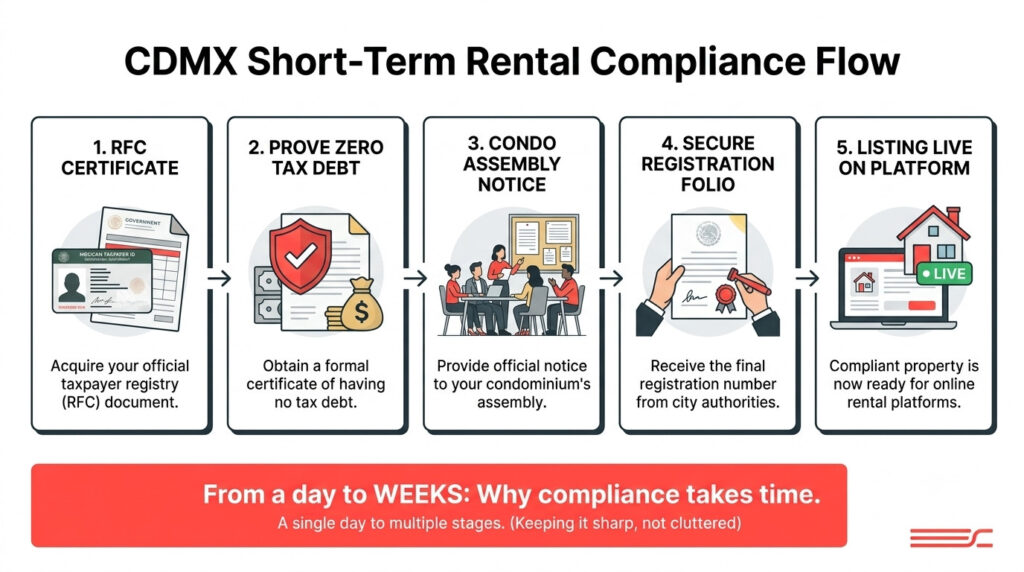
- As of June 21, 2026, the grace period for Mexico City’s mandatory digital registration for short-term rentals officially expired.
- Both hosts and tech platforms must have a valid registration folio to operate legally. Those without a valid folio are now explicitly prohibited from operating.
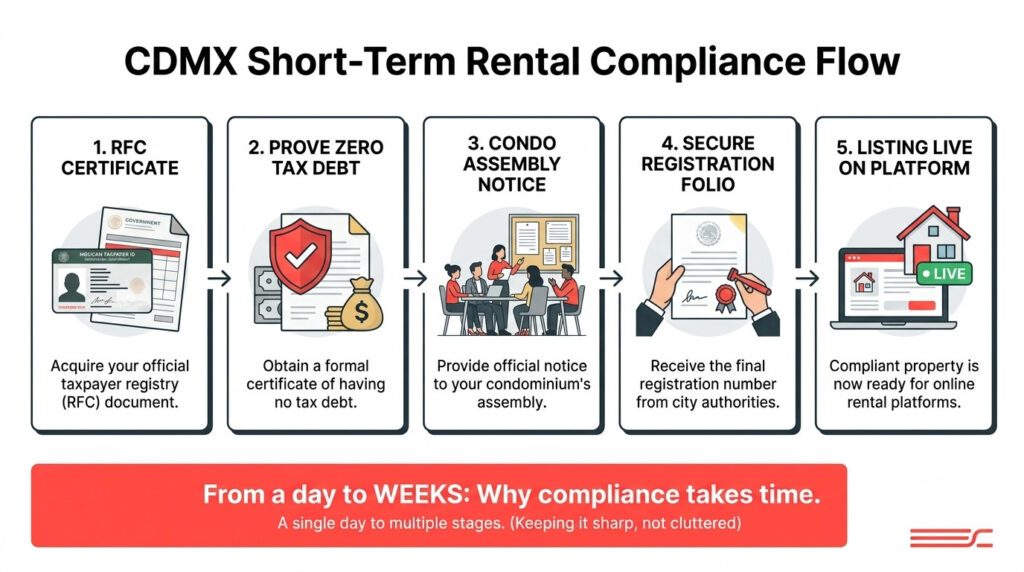
- The compliance burden is high. Hosts must provide a federal taxpayer certificate (RFC), proof of zero property tax debt, and an acknowledgment of notification to the Condominium General Assembly for shared buildings.
- Technology platforms are legally obligated to register and block listings that lack a verified folio. Platforms are effectively acting as the city’s enforcement arm against non-compliant operators.
- The law also carries an annual occupancy cap — widely cited around 180 to 183 nights per property — which hosts are challenging in court through amparos. Property managers should treat any specific figure as provisional pending official clarification.
Uvika’s Views
- The Enforcement Switch Flips: Back in May, we reported that Mexico City officials were “rethinking” their Airbnb law amid concerns about housing shortages ahead of the 2026 World Cup. Despite those earlier concerns, the city has firmly closed the grace period. The June 21 deadline is real. Because the city legally mandates that platforms integrate with this system, the shadow market is being shut off at the algorithm level — operators who missed the window are now locked out of online distribution.
- Bureaucratic Friction: The required documentation creates a massive barrier to entry. Proving zero property tax debt and securing condominium assembly notifications take time. Property managers looking to onboard new inventory in Mexico City must extend their launch timelines — you can no longer set up a listing overnight, you must accommodate these heavy administrative steps first. It’s a friction point we’ve seen play out elsewhere this year too: when Croatia rolled out its own mandatory national registration number, multi-unit operators similarly found themselves needing building-level consent before they could even start the process.
- A Disputed Cap Adds to the Uncertainty: The contested night cap means operators can’t fully model annual revenue yet. This mirrors a pattern we’re tracking globally — when Hawaii’s SB 2919 gave counties sweeping authority to phase out existing short-term rentals, the legal uncertainty around implementation became, in practice, as disruptive to operators as the rule itself.
England Delays National Registration and ‘C5’ Planning Class
- England is moving towards a more regulated framework for short-term lets, based on a compulsory national registration system and a proposed new “C5” planning use class.
- However, there is currently no confirmed implementation date for the C5 planning use class.
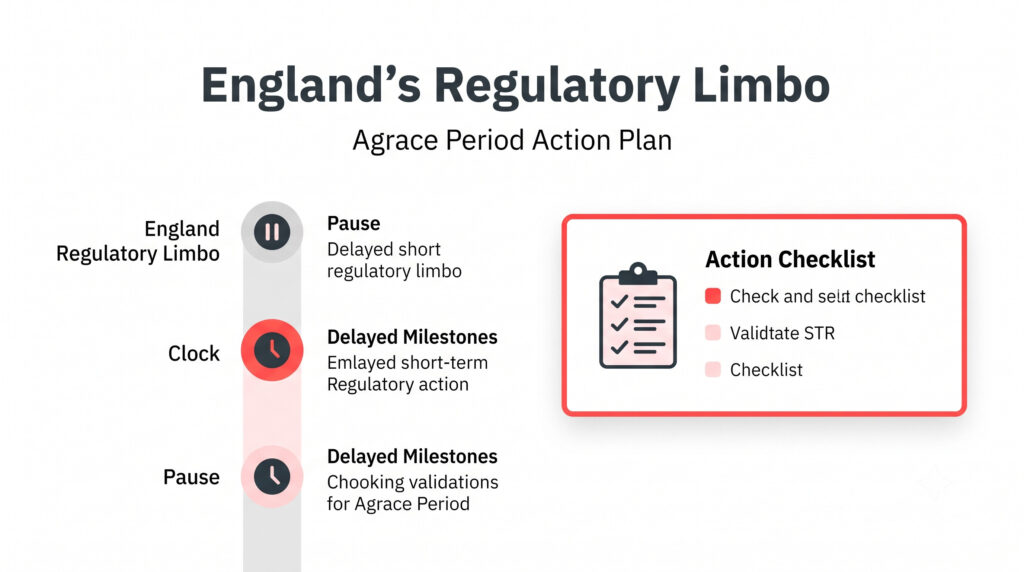
- The rollout of the national registration scheme — originally targeted for Spring 2026 — has also been pushed back, leaving the industry in a phased rollout limbo during 2026.
- Related reforms regarding Energy Performance Certificates (EPC) for short-term rentals have been delayed until at least the second half of 2027, after the government’s original October 2026 target proved unworkable following industry consultation.
Uvika’s Views
- A Stark Contrast to the EU: The UK’s delay sits in stark contrast to the European Union. While the EU aggressively pushed through its standardized data-sharing infrastructure under Regulation 2024/1028 in May — a deadline we broke down in detail as it approached, including the operational steps property managers needed to take to avoid mass delistings — post-Brexit England is faltering, pushing its own national registration and planning requirements into an indefinite limbo.
- The Cost of Uncertainty: This delay offers a temporary reprieve for operators dreading new compliance costs. However, it also extends a paralyzing period of uncertainty. Property managers are stuck waiting for upcoming planning permission requirements, making it incredibly difficult to accurately forecast operating expenses for the second half of the year. It’s a familiar shape: Ireland’s own planning reforms similarly left operators guessing for months before a firm December register date was confirmed.
- Capitalizing on the Grace Period: Savvy operators should use this delay to proactively audit their properties. Ensure your units already meet top-tier safety and energy standards now, particularly given the EPC reform delay doesn’t relax the underlying Minimum Energy Efficiency Standards timeline. Doing this early will prevent a rushed, massive capital expenditure once the UK government finally confirms the C5 and registration timeline.
Cleveland Approves Strict 10% Density Cap
- The Cleveland City Council passed a comprehensive new short-term rental ordinance on June 1, 2026. It will officially go into effect roughly 180 days later, in late November 2026.
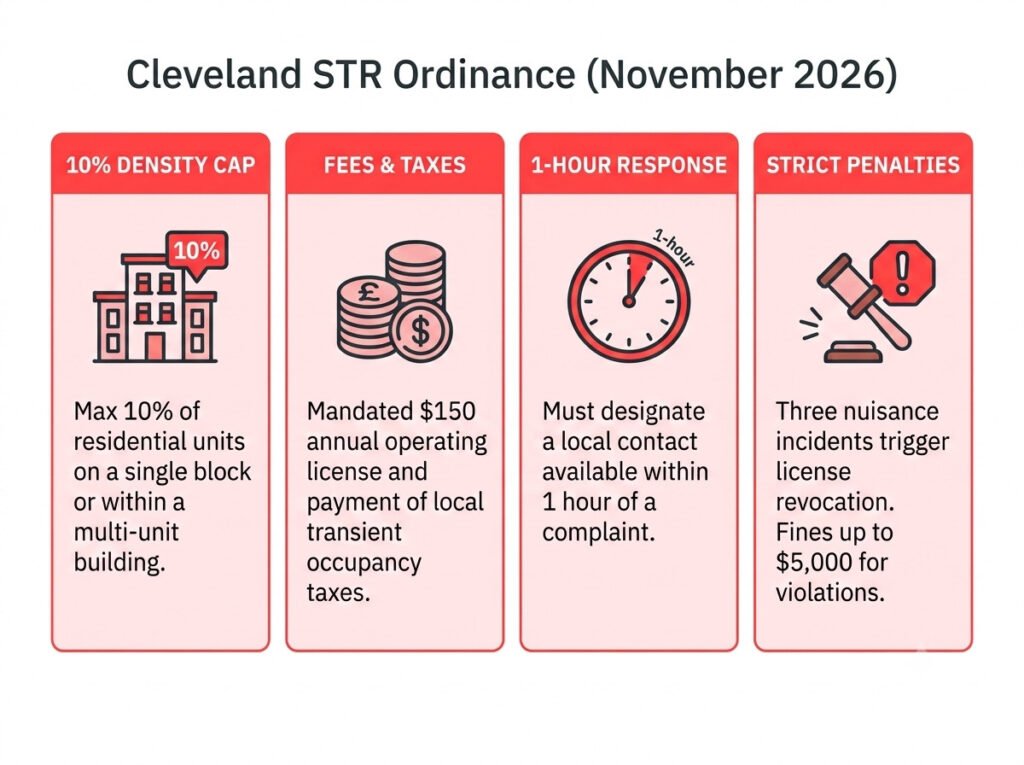
- The ordinance introduces a strict density cap. Short-term rentals are limited to a maximum of 10% of the total residential units on a single block or within a multi-unit building.
- The new rules mandate a $150 annual operating license and the payment of local transient occupancy taxes. Hosts must also designate a local contact who can arrive at the property within one hour of a complaint.
- The city will revoke the license of any property with three or more nuisance incidents over a year. Violations can result in fines of up to $5,000, and in some cases, additional criminal penalties for repeat unlicensed operation.
Uvika’s Views
- The Race Against State Preemption: Earlier this year, we noted that Ohio was among the states with active preemption bills moving through 2026 legislative sessions, pushing to strip municipal authority over short-term rentals. Cleveland is passing this 10% density cap right now to get it on the books before the state can stop them. It is a perfect example of the “race-to-regulate” we’ve tracked playing out in Indiana, where the state sided decisively with landlords and capped municipal power outright.
- A Polarizing Strategy: Cleveland’s strict 10% cap represents the exact type of municipal restriction that other states are actively outlawing. States like Idaho and Indiana have already passed sweeping laws prohibiting local governments from capping rental density, a trend we covered as Idaho’s HB 583 and Indiana’s HEA 1210 went into effect on July 1, stripping local governments of exactly this kind of density authority. The US regulatory landscape is fracturing wildly depending on state borders.
- Portfolio Concentration Risk: A 10% density cap creates immediate, artificial scarcity. Operators in popular Cleveland neighborhoods are racing the clock for permits. Furthermore, this is highly disruptive for managers who cluster units in specific buildings for operational efficiency, the same dynamic that’s made compliance so difficult to verify in markets like New York, where 27% of approved listings are now estimated to be operating outside the rules once initial registration checks fall out of date. Operators must audit their Cleveland portfolios immediately and identify which units are at risk of missing the 10% cutoff before November.
Stay on top of short-term rental regulation trends and what they mean for your operating environment.

Uvika Wahi is the Editor at RSU by PriceLabs, where she leads news coverage and analysis for professional short-term rental managers. She writes on Airbnb, Booking.com, Vrbo, regulations, and industry trends, helping managers make informed business decisions. Uvika also presents at global industry events such as SCALE, VITUR, and Direct Booking Success Summit.