



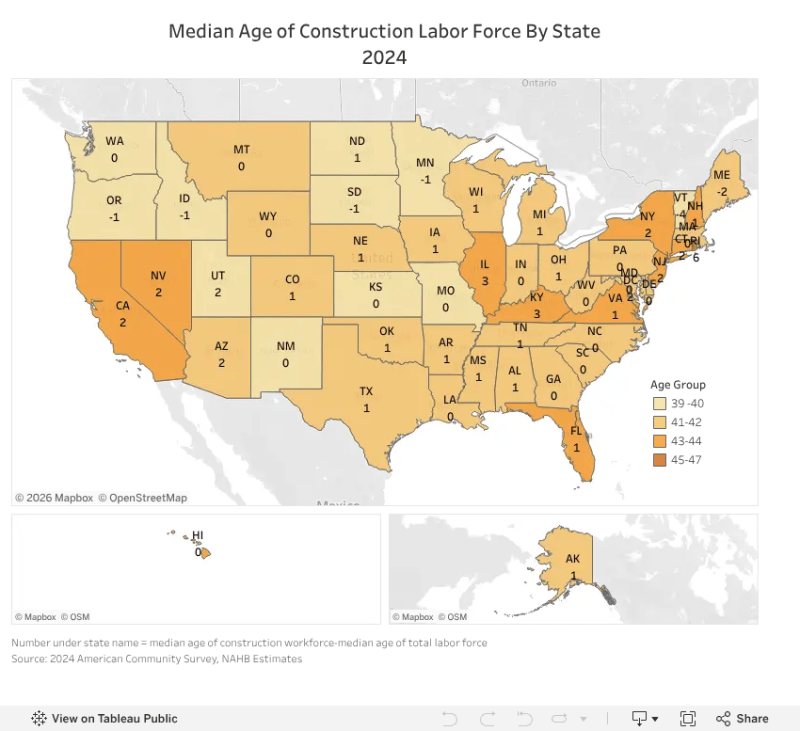
The median age of construction workers is 42, one year older than a typical worker in the national labor force, according to NAHB analysis of the latest 2024 American Community Survey (ACS) data. At the same time, younger workers are becoming a growing part of the construction workforce. Despite some improvements since the peak of the skilled labor shortage in 2021, attracting and retaining skilled labor remains the primary long-term goal for the construction industry.

The median age of construction industry workers varies across states. The color coding in the map above tracks the median age of people working in the construction industry. The state with the oldest median age (47 years old) is Rhode Island, followed by Connecticut, Illinois, New Hampshire and New Jersey, where the median age of construction workers is 44. Construction workers are younger on average in the central part of the nation. For example, half of all construction workers in Utah and Idaho are under 39.
The second data series mapped above is the difference between the median age of construction workers in each state and the median age of all industries. These estimates are reported as the numbers printed on each state. A positive number indicates that on average, construction workers are older than a typical worker in the state labor force. Rhode Island is the state where the median age of construction workers is 7 years higher than the overall median. On the other hand, a negative number indicates construction workers are, in general, younger than the state labor force. In Vermont, the median age of construction workers is 4 years younger than the overall median.
Generational shifts are reshaping the construction labor force. The share of Gen Z in construction workforce has grown rapidly, increasing from 6.4% in 2019 to 16.8% in 2024. This considerable increase over five years reflects a growing pipeline of younger workers. The Millennial generation share also rose from 35.7% to 37.5% over the same period. In contrast, the Gen X share declined from 36.6% to 32.5%, while the Baby Boomer’s share fell sharply from 20.6% to 12.8% as more retired. This shift suggests that Gen Z and Millennial workers are becoming an increasingly important part of the construction workforce.

Compared with the workforce across all industries, construction has a relatively smaller share of younger workers, but a larger proportion of workers in their prime-working age. In 2024, only about 10.7% of construction workers were under age 25, compared with 13.7% of workers across all industries. Around 67.3% of the construction workforce were in the prime working years of 25-54, compared to 63.4% in the overall workforce.
Construction workers were especially concentrated in the 35 to 54 age group. Workers ages 35 to 44 accounted for 24.5% of the construction workforce, compared with 22.1% of workers across all industries; meanwhile, workers ages 45 to 54 represented 21.2% of construction workers, compared with 19.3% overall. At the same time, workers 55 and older made up 22% of the construction workforce. As these older workers approach retirement, attracting more skilled labor remains the primary long-term goal for the construction industry.