



If you’re shopping for a home or thinking about a refinance, the weekly mortgage-rate story this week is quiet — but the year-long story is not. According to Freddie Mac’s Primary Mortgage Market Survey®, the average 30-year fixed-rate mortgage held at 7.40% as of October 15, 2026, unchanged from last week. Compared with a year ago, though, that same rate is up 113 basis points, or 1.13 percentage points, from 6.27%. That yearly jump is the real headline for buyers and anyone locked into a monthly payment.
“The average 30-year fixed-rate mortgage remained unchanged this week,” said Sam Khater, Freddie Mac’s Chief Economist.
In plain terms: the week-to-week move gave borrowers a breather, but the 30-year fixed is still far more expensive than it was last October. Below, I’ll walk through what 113 basis points means for a typical loan, how monthly payments compare with about a month ago and a year ago, and a few practical ways to handle a high-rate market.
30-Year Fixed Mortgage Rate Rises by 113 Basis Points in One Year
What 113 Basis Points Means in Everyday Language
Basis points sound technical, but the idea is simple. One basis point is one-hundredth of a percent. So 113 basis points equals a 1.13% rise in the interest rate. It’s the difference between last year’s 6.27% average and today’s 7.40%.
That gap shows up every month on your bill. It also shows up over 30 years, when small percentage points turn into tens of thousands of dollars in extra interest. If you’re comparing houses, that yearly rate move can shrink how much home you can comfortably afford — or push you to wait, negotiate harder, or look at a temporary rate buy-down.
This Week’s Survey Numbers
Here’s the snapshot from the October 15, 2026 survey:
- 30-year fixed: averaged 7.40%, unchanged from last week. A year ago it averaged 6.27%.
- 15-year fixed: averaged 6.71%, down from 6.73% last week. A year ago it averaged 5.52%.
So the 30-year rate took a week off after recent climbs, while the 15-year edged a touch lower. Zoom out to twelve months, and both products are still sharply higher: 113 basis points on the 30-year and about 119 basis points on the 15-year.
Why Mortgage Rates Move Even When the Fed Isn’t in the Headlines
Mortgage rates don’t come from a single dial at the Federal Reserve. Lenders price 30-year loans off longer-term bond yields, inflation expectations, and how risky they think lending feels right now. When inflation stays sticky or the job market looks strong, investors often demand higher yields on bonds. Mortgage rates usually follow.
Think of it like the cost of ingredients for a bakery. If flour and sugar get more expensive, the loaf costs more even if the baker didn’t change the recipe overnight. Banks face a similar math when the “ingredients” of money — Treasuries, mortgage-backed securities, and credit spreads — get pricier.
That helps explain this week’s flat reading. A single quiet week doesn’t erase a year of higher borrowing costs. It just means the market paused instead of climbing again.
The Real Impact: How Much More Are Monthly Payments?

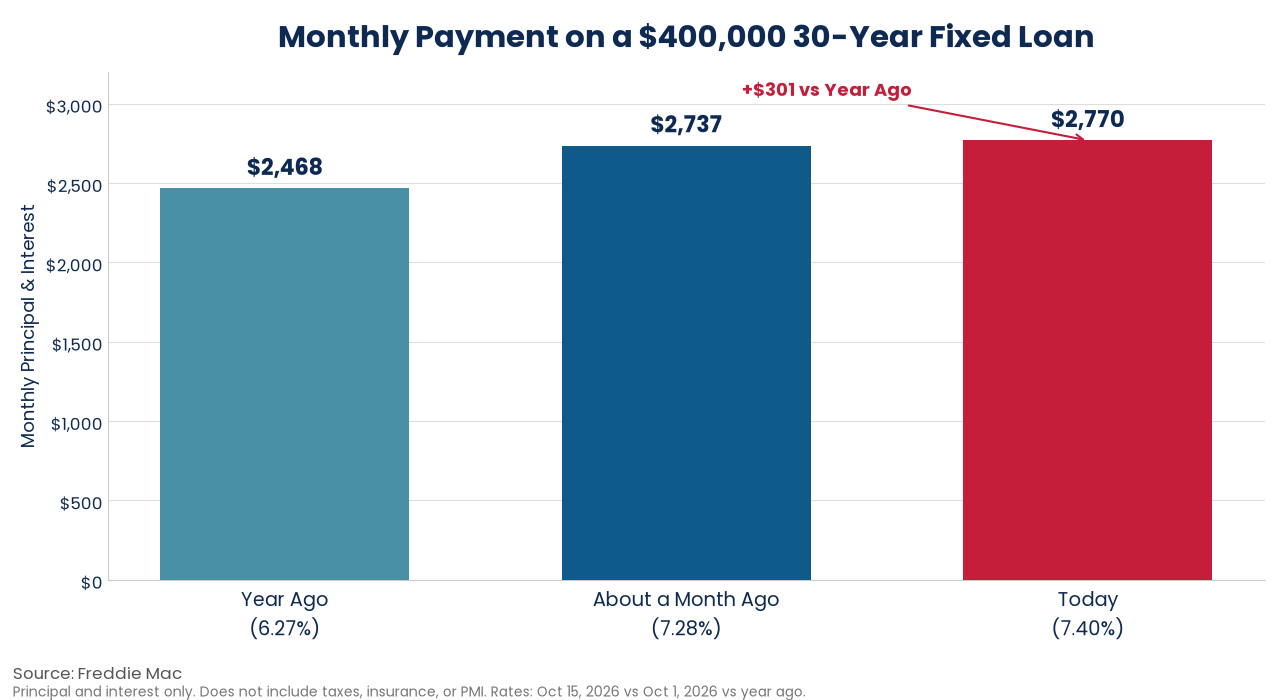
Let’s put the yearly jump on a $400,000 30-year fixed loan (principal and interest only — no taxes, insurance, or PMI):
- Year Ago (6.27%): about $2,468 per month.
- About a Month Ago (7.28% on Oct. 1): about $2,737 per month.
- Today (7.40%): about $2,770 per month.
Versus a year ago, that’s roughly an extra $301 per month, or about $108,500 more in interest over the full 30-year term if rates stayed at these levels the whole time. Versus early October, the bump is smaller — about $33 a month — which is why the year-over-year comparison is the one that hits hardest.
I’ve watched families react to that kind of math in two ways. Some trim the purchase price or widen the search to nearby towns. Others dig in on seller credits, closing-cost help, or a temporary buy-down so the first years feel more manageable.
Here’s how the extra monthly cost scales with loan size at today’s 7.40% versus last year’s 6.27%:
| Loan Amount | Year Ago (6.27%) | Today (7.40%) | Extra Monthly Cost | Extra Lifetime Interest (approx.) |
|---|---|---|---|---|
| $300,000 | $1,851 | $2,077 | +$226 | ~$81,400 |
| $400,000 | $2,468 | $2,770 | +$301 | ~$108,500 |
| $500,000 | $3,085 | $3,462 | +$377 | ~$135,700 |
(These figures are principal and interest only. Property taxes, homeowners insurance, and private mortgage insurance can add a meaningful amount to the total housing payment.)
The 15-Year Fixed Rate: Slightly Lower This Week, Still Higher Than Last Year
The 15-year fixed-rate mortgage averaged 6.71% this week, a small step down from 6.73%. A year ago it sat at 5.52%, so borrowers still face roughly a 1.19% year-over-year increase.
A 15-year loan usually means a higher monthly payment than a 30-year loan for the same amount, but you clear the debt faster and pay less interest overall. At these rates, that tradeoff is tighter. Some buyers who once defaulted to a 15-year loan are sticking with a 30-year term for payment flexibility, then planning to make extra principal payments when cash flow allows.
Smart Moves If You’re Buying or Refinancing Now
Higher rates don’t have to freeze every plan. They do force clearer math. Here’s what I suggest people focus on:
- Get quotes from at least three lenders. Rate sheets differ more than most people expect. Comparing lenders, credit unions, and online brokers can save real money over the life of the loan.
- Date the rate, marry the house. If the home fits your budget at today’s payment, buying can still make sense. If rates fall later, you may be able to refinance. If they don’t, you still own a house you can afford.
- Ask about a rate buy-down. Sellers and builders sometimes pay to temporarily lower your rate for the first year or two (a 2-1 or 1-0 buy-down). That can ease the early months when moving costs are highest.
- Watch points and fees, not just the rate. A slightly lower rate with heavy points isn’t always the better deal. Compare the annual percentage rate and the cash needed at closing.
- If you’re refinancing, run the break-even first. With the 30-year fixed near 7.40%, most homeowners who locked in lower rates earlier won’t benefit from a standard rate-and-term refinance right now. A cash-out refinance or home equity loan can still make sense for a specific goal — just keep your first-mortgage rate in mind.
What to Watch Next for Fixed Mortgage Rates
The next few weeks will hinge on inflation data, the 10-year Treasury yield, and how lenders price risk. A calm week like this one can stick around if bond yields settle. Another jump in yields can push the 30-year fixed higher again even without a new Fed headline.
I wouldn’t treat one unchanged week as a turning point. I would treat the 113 basis point rise over the past year as the number that still shapes affordability. Shop for the best quote you can get, stress-test the payment, and only stretch as far as your budget can handle if rates stay elevated.
Your own timeline matters more than any single Thursday release. If you need to move for work, family, or a home that finally fits, focus on a payment you can live with. If you can wait and your current housing works, keep your paperwork ready so you can move fast when the fixed mortgage rate gives you a clearer opening.