

Can you still get a 6% mortgage rate in 2026? Yes, but most people won’t get it by just walking into a bank and taking the first offer. The average 30-year fixed rate sits at 7.40% right now, so getting to 6% means closing a gap of about 1.4 percentage points. The buyers who get there usually stack a few moves together: a strong credit score, a solid down payment, low monthly debts, some help from points or a seller-paid buydown, and quotes from several lenders.
The good news? Every one of those moves is something you can work on. Here’s where rates stand, what 6% would save you, and the steps that give you the best shot.
How to Get a 6% Mortgage Rate in 2026: A Simple Game Plan
Where Mortgage Rates Stand Right Now
Here’s the latest picture from Freddie Mac’s weekly survey, released October 15, 2026:
- 30-year fixed: 7.40%, unchanged from the week before
- A year ago: 6.27%
- 15-year fixed: 6.71%, down from 6.73% the week before
The Mortgage Bankers Association (MBA) tracks rates on actual loan applications, and its numbers for the week ending October 9 tell a similar story. The 30-year fixed for conforming loans averaged 7.50%, the 30-year FHA averaged 7.19%, and the 5/1 ARM averaged 6.54%.
So 6% is a below-average rate today. That’s why you need a plan, not just luck.
What a 6% Rate Would Save You
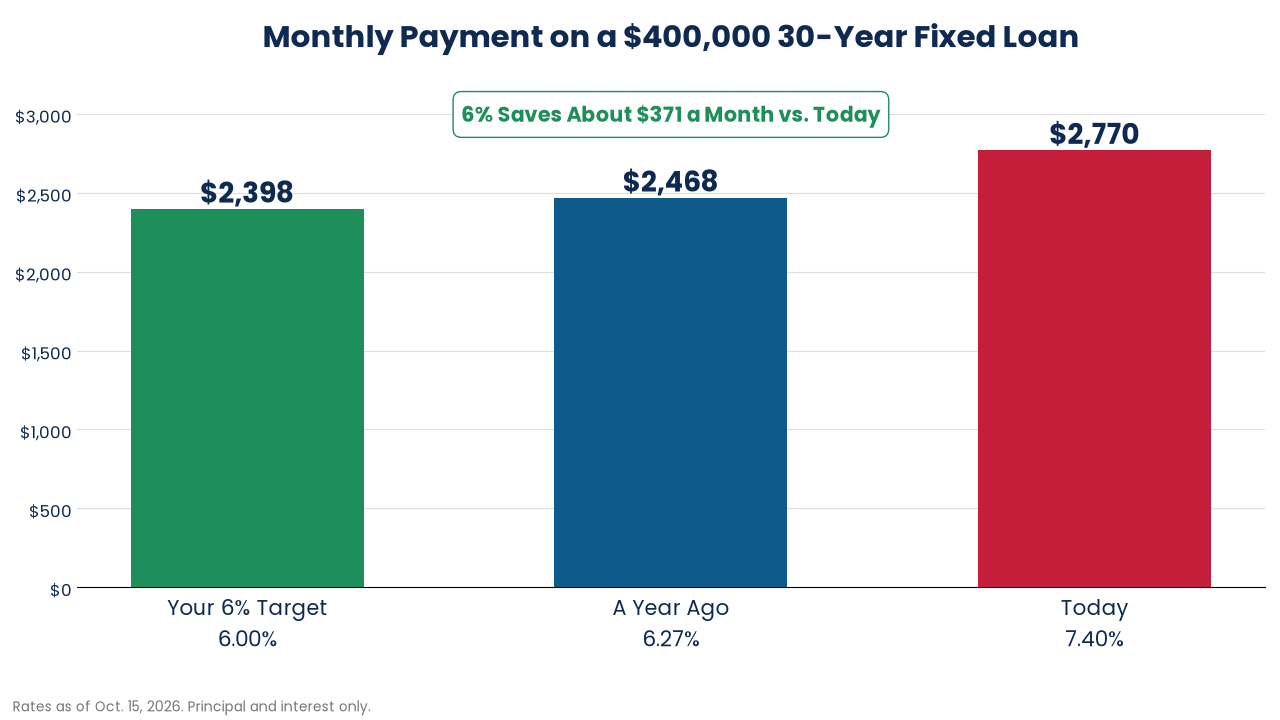
On a $400,000 30-year loan, here’s what principal and interest would cost each month:
- At 6.00%: about $2,398
- At 6.27% (where rates were a year ago): about $2,468
- At 7.40% (today’s average): about $2,770
That 6% rate saves you about $371 a month compared with today’s average. Over a year, that’s roughly $4,456.

Step 1: Get Your Credit Score in Great Shape
Your credit score is like a report card for lenders. The better the grades, the better the rate you’re offered.
Lenders that sell loans to Fannie Mae and Freddie Mac use pricing charts that add costs for lower scores. So even a small jump in your score can move you into a cheaper price tier. Here’s how to give yours a lift:
- Pay every bill on time. Payment history carries the most weight.
- Pay down credit card balances. Using a smaller share of your limits helps your score.
- Check your credit reports for mistakes. You can get free reports at AnnualCreditReport.com and dispute errors.
Step 2: Put Down as Much as You Comfortably Can
A bigger down payment means the lender has less money at risk. With conventional loans, putting 20% down also means no private mortgage insurance (PMI), which can make your total monthly cost lower.
That doesn’t mean you have to wait years to save 20%. Conventional loans can go as low as 3% down, and FHA loans allow 3.5% down for borrowers with a 580 or higher credit score, according to HUD. Just know that a smaller down payment often comes with a higher rate or extra fees. My take: put down enough to get a good price, but don’t drain your emergency fund to do it.
Step 3: Lower Your Debt-to-Income Ratio
Your debt-to-income ratio, or DTI, compares your monthly debt payments with your monthly income before taxes. Car loans, student loans, credit card minimums and your new house payment all count.
A lower DTI tells a lender you can handle the payment without stress. Pay off a small loan or card before you apply, and hold off on buying a car or furniture on credit until after closing.
Step 4: Shop at Least Three or Four Lenders
This is the easiest money you’ll ever save. Lenders don’t all charge the same rate, even for the same borrower on the same day.
Freddie Mac research found that in the high-rate months of late 2022, borrowers who got two rate quotes could have saved as much as $600 a year, and those who got at least four quotes could have saved more than $1,200 a year.
To compare apples to apples, ask each lender for an official Loan Estimate on the same day, for the same loan type, with the same number of points. Check banks, credit unions, online lenders and a mortgage broker within a short window.
Step 5: Use Points or a Seller-Paid Buydown
This is where a lot of buyers close the last part of the gap to 6%.
Discount Points
Points are a fee you pay at closing to get a lower rate for the whole life of the loan. According to the Consumer Financial Protection Bureau (CFPB), one point equals 1% of the loan amount. On a $400,000 loan, that’s $4,000. How much each point lowers your rate depends on the lender, the loan type and the market, so ask every lender to show you their options with and without points.
Points make the most sense if you plan to stay in the home a long time. Ask your lender for the break-even point, which is how many months it takes for the lower payment to pay back what you spent on points.
Temporary 2-1 Buydown
A 2-1 buydown lowers your rate by 2 points in year one and 1 point in year two. Then it goes back to the full rate. It’s often paid by a seller or a builder as a deal sweetener.
Using today’s 7.40% average on a $400,000 loan as an example, you’d pay about $2,246 a month in year one at 5.40%, about $2,502 in year two at 6.40%, and about $2,770 from year three on. It’s a nice cushion while you settle in. Just be sure you can afford the full payment from day one.
Step 6: Pick the Loan Type That Fits You
The 30-year fixed isn’t your only choice. A few others may get you closer to 6%:
- 15-year fixed: Freddie Mac’s average is 6.71%, well below the 30-year. The catch is a much bigger monthly payment, since you pay it off in half the time.
- Adjustable-rate mortgage (ARM): MBA’s 5/1 ARM average was 6.54%. You get a lower fixed rate for the first five years, then it can go up or down. MBA says ARMs made up 10.5% of applications, the highest share since October 2025.
- FHA loans: MBA’s 30-year FHA average was 7.19%. They’re often a good fit if your credit or savings are still a work in progress.
- VA loans: If you’ve served, a VA loan needs no down payment in most cases and is worth checking first.
With an ARM, plan for the worst case. Ask your lender how high the rate could go after the fixed period, and make sure you could still pay it.
Step 7: Lock Your Rate at the Right Time
Once you have a home under contract and a rate you like, ask about a rate lock. A lock holds your rate for a set time, often 30 to 60 days, while your loan is processed. If rates jump during that time, you’re protected.
Get the lock in writing, note the end date, and ask what happens if closing runs late.
Is a 6% Rate Realistic for You?
Here’s a quick way to size it up.
YES, aim for 6% if:
- Your credit score is strong and your DTI is low.
- You have cash for a solid down payment plus some points.
- The seller or builder is willing to pay for a buydown.
NO, set a more realistic goal if:
- You’d have to empty your savings to pay points.
- Your credit needs a few months of work first.
If 6% isn’t in reach yet, a rate of 6.5% or 6.75% is still a big win against a 7.40% average. Don’t let the perfect number stop you from buying a home you love at a payment you can handle.
My Final Take
A 6% mortgage rate in 2026 isn’t handed out. It’s earned, one step at a time. Clean up your credit, save what you can, trim your debts, and shop lenders like you’d shop for a car. Then use points or a buydown to close the last gap.
Rates move every week, so run your own numbers with a couple of lenders and pick the plan that lets you sleep well at night.