


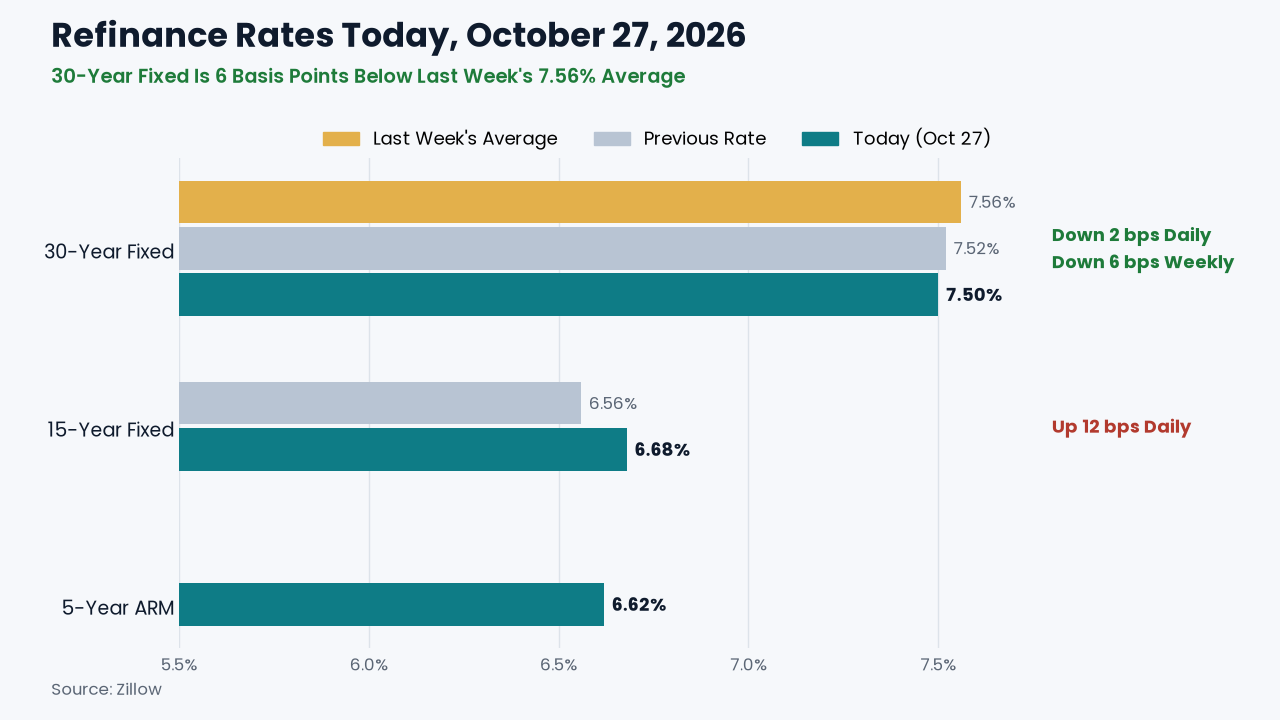
Good news if you have been waiting on a refinance: rates are a bit lower than they were a week ago. According to Zillow, the national average 30-year fixed refinance rate is 7.50% on Tuesday, October 27, 2026. That is 6 basis points below the previous week’s average of 7.56%. Compared with Monday, the move is smaller, as the rate slipped 2 basis points from 7.52% to 7.50%.
Not every loan joined the drop, though. The 15-year fixed refinance rate went the other way, rising 12 basis points from 6.56% to 6.68%. The 5-year ARM refinance rate sits at 6.62%, which puts it slightly under the 15-year fixed today. So the 30-year borrower gets a small break this week, while anyone eyeing a shorter fixed loan is paying a little more than yesterday.
Mortgage Rates Today, October 27, 2026: 30-Year Refinance Rate Drops by 6 Basis Points
Below are Zillow’s latest national averages for the three main refinance loans:
| Loan Product | Previous Rate | Today (Oct 27) | Daily Change | vs. Last Week’s Average |
|---|---|---|---|---|
| 30-Year Fixed Refi | 7.52% | 7.50% | Down 2 bps | Down 6 bps (from 7.56%) |
| 15-Year Fixed Refi | 6.56% | 6.68% | Up 12 bps | — |
| 5-Year ARM Refi | — | 6.62% | — | — |
These are Zillow‘s national average refinance rates as last updated on the morning of Tuesday, October 27, 2026. Live figures can change during the day, so the rate you see later may be a little different.
The short version for today:
- 30-year fixed refinance: 7.50%, down 6 basis points from last week’s 7.56% average and down 2 basis points from Monday’s 7.52%.
- 15-year fixed refinance: 6.68%, up 12 basis points from 6.56%.
- 5-year ARM refinance: 6.62%, a touch below the 15-year fixed.

Source: Zillow
What a 6 Basis Point Drop Saves on a $300,000 Loan
Six basis points equals 0.06%. On its own, that sounds tiny, so let’s put it in dollars. Take a $300,000 refinance on a 30-year fixed loan, principal and interest only:
- Last week’s 7.56% average: about $2,110 a month
- Monday’s 7.52%: roughly $2,102
- Today’s 7.50%: close to $2,098
So compared with last week, you would save around $12 a month. Kept for the full 30 years, that adds up to roughly $4,400 less interest. Against Monday alone, the saving is closer to $4 a month. It won’t change anyone’s life, but a week of small declines is a better direction than a week of small climbs.
Why the 15-Year Rate Went the Other Way
Rates on different loans don’t always move together. Lenders price each product on its own, so one can dip while another rises on the same morning. Today is one of those days.
The 15-year fixed jumped 12 basis points, from 6.56% to 6.68%. On a $300,000 refinance, that lifts the monthly payment from about $2,623 to about $2,643, an increase of roughly $20 a month. Total interest over 15 years would come to about $175,800, which is still far below the roughly $455,200 you would pay over the life of a 30-year loan at 7.50%.
In other words, the 15-year is a bit pricier than yesterday, but it is still the cheapest way to pay off a home loan over time, as long as the bigger payment fits your budget.
The 5-Year ARM Now Sits Just Below the 15-Year
At 6.62%, the 5-year ARM is now 6 basis points under the 15-year fixed. That’s a very slim edge. An ARM keeps its rate locked for the first five years, then it can reset up or down with the market.
Because a 5-year ARM is usually paid off over 30 years, its payment is much lower. Here is how the three loans look side by side:
| $300,000 Refinance | Rate Today | Monthly Payment | Owed After 5 Years |
|---|---|---|---|
| 30-Year Fixed | 7.50% | $2,098 | $283,900 |
| 5-Year ARM (30-Year Term) | 6.62% | $1,920 | $281,200 |
| 15-Year Fixed | 6.68% | $2,643 | $230,900 |
Norada estimates of principal and interest only, rounded, based on Zillow’s rates for October 27, 2026.
The ARM saves you about $178 a month versus today’s 30-year fixed. The 15-year costs about $545 more a month than the 30-year, but after five years you would owe roughly $53,000 less. That trade between cash flow now and equity later is the real choice in front of you.
Is a Refinance Worth It at 7.50%? Run a Break-Even Check
A lower rate only helps if the savings beat the cost of getting it. Zillow says refinance closing costs usually run 2% to 6% of the loan balance. On $300,000, that is about $6,000 to $18,000.
Here’s the simple test. Divide your closing costs by your monthly savings. For example, if a new loan would cut your payment by $150 a month and closing costs are $6,000, you would need about 40 months to break even. If you expect to stay in the home longer than that, the refinance can make sense. If you might move sooner, it may not.
A Quick Checklist Before You Apply
- Know your score: Zillow notes that borrowers with credit scores of 740 or higher usually see the best rates, so your quote could land above or below today’s averages.
- Get several quotes: Ask at least three lenders for a rate and a full list of fees. The lowest rate is not always the cheapest loan once costs are added in.
- Match the loan to your timeline: Staying for decades points toward a fixed rate. Planning a move within about five years makes an ARM worth a look.
My take? A 6 basis point weekly dip is a nice nudge, not a stampede signal. If your break-even math works and the payment fits, today’s slightly lower 30-year rate is a fair moment to start collecting quotes.
Read More:
Explore these related articles for even more insights: