


Mortgage rates dropped again this week, and that means your money goes a little further when you shop for a home. The average 30-year fixed mortgage rate fell to 7.24%, down from 7.32% a week earlier, according to Freddie Mac. It’s the second weekly decline in a row, and it leaves the rate at its lowest point this month.
So what does that mean in real life? Say you can handle a mortgage payment of $2,500 a month. At this week’s rate, that same payment can cover a loan about $2,900 bigger than it could last week, and about $5,800 bigger than it could in early October, when rates peaked. It’s not a giant jump, but it’s real buying power you didn’t have a few weeks ago.
Mortgage Rates Drop Again and Give Homebuyers More Purchasing Power
Freddie Mac released its weekly mortgage survey on Thursday, October 29, 2026. Both of the main loan types moved lower:
- 30-year fixed: 7.24%, down 8 basis points from 7.32% the week before.
- 15-year fixed: 6.60%, down 8 basis points from 6.68%.
Sam Khater, Freddie Mac’s Chief Economist, put it plainly. He said the 30-year rate “declined again this week, reaching its lowest level this month and modestly boosting purchasing power for prospective buyers.”
Most headlines focused on the rate itself. The Associated Press, for example, noted that rates are now at their lowest level since late September. But for you as a buyer, the better question is simple: how much more home can I afford now?
What “Purchasing Power” Really Means for You
Purchasing power is just a fancy way of saying how much house your budget can buy. Most of us shop by monthly payment first, then see what price range that payment supports.
Think of your monthly budget as a fixed-size grocery bag. When rates are high, the interest takes up more room in the bag, so there’s less space left for the loan itself. When rates fall, interest shrinks a bit, and you can fit a little more loan into the same bag.
How Much More Home Your Budget Buys Now
Let’s run the numbers. These are Norada’s own calculations, meant as simple examples. They cover principal and interest on a 30-year fixed loan. Property taxes, homeowners insurance, and any HOA dues would come on top.
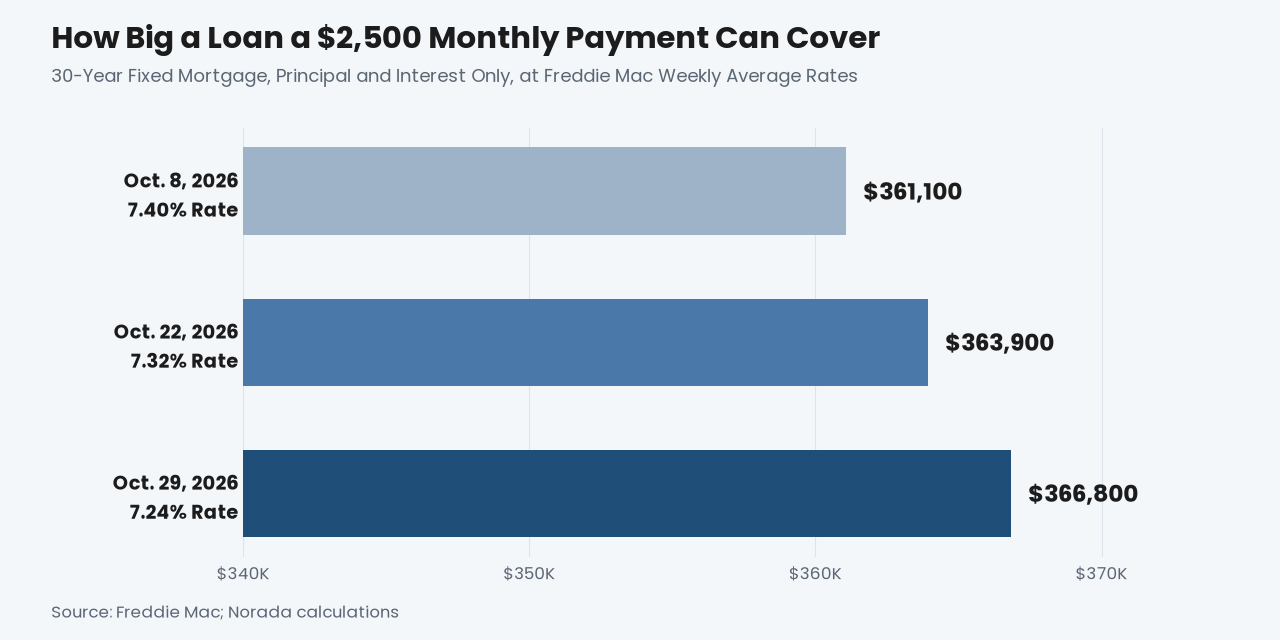
With a $2,500 monthly payment, here’s how big a loan you could cover at each recent Freddie Mac rate:
- October 8 (7.40%, this fall’s high): about $361,100
- October 22 (7.32%): about $363,900
- October 29 (7.24%): about $366,800

Source: Freddie Mac; Norada calculations
If you put 20% down, that $2,500 payment now lines up with a home price of roughly $458,500. Last week, the same payment pointed to about $454,900. So the price range you can shop in crept up by around $3,600 in just seven days, without you earning a single extra dollar.
At a $3,000 monthly payment, the loan you could cover rose from about $436,700 last week to about $440,200 this week. That’s roughly $3,500 more.
Looking at It From the Payment Side
You can also flip the math around. Say you already know you need to borrow $400,000. At 7.24%, the monthly principal and interest comes to about $2,726. At last week’s 7.32%, it was about $2,748.
That’s a savings of roughly $22 a month, or about $261 a year. If you kept the loan for the full 30 years, it would add up to about $7,800 in lower interest. Most people sell or refinance sooner, so treat that as an upper limit.
What About the 15-Year Fixed Loan?
The 15-year loan dropped by the same 8 basis points. On a $300,000 loan, the payment fell from about $2,643 to about $2,630. That’s roughly $13 a month. It looks smaller because the loan is paid off so fast, and you pay far less total interest.
Why This Boost Is Real but Small
Mr. Khater used the word “modestly,” and that’s the honest way to see it. Rates are still higher than they were at this time last year, when the 30-year loan averaged 6.17%. At that rate, a $2,500 payment could have covered a loan of roughly $409,500. That’s about $42,600 more than the same payment covers today.
So buyers have won back a little ground, but nowhere near all of it. (If you want the full year-over-year story, we covered it in our look at how the 30-year rate compares with last year.)
Think of it as a thaw, not a heat wave. You’ll still want your coat for a while.
One more thing to keep in mind. Freddie Mac’s survey tracks loans for borrowers who put 20% down and have excellent credit. Your own rate could be higher or lower depending on your credit score, down payment, and loan type.
Who Benefits Most From Lower Rates Right Now
A small drop helps some buyers more than others. Here’s who should pay closest attention:
- Buyers right on the edge. Lenders compare your monthly debts to your income. If you were just barely missing approval for the home you wanted, a lower payment might be what gets you over the line.
- Buyers under contract who haven’t locked yet. If you’re in the middle of a purchase, this is a good moment to talk to your lender about locking your rate.
- First-time buyers. When you’re saving every dollar for a down payment and closing costs, a lower monthly payment can make the whole plan feel more doable.
Should You Buy Now or Wait for Lower Rates?
YES, it may make sense to move now if:
- You’ve found a home you love, and the payment fits your budget today.
- You plan to stay in the home for at least several years.
- Your job feels steady and you have an emergency fund set aside.
NO, it may be smarter to wait if:
- The payment only works if rates fall a lot more later.
- Your credit score could improve in a few months with some cleanup.
- You’d have to drain your savings to cover closing costs.
I’ve watched plenty of buyers try to time the bottom of the rate market. It almost never works. Buy when the house, the payment, and your life all line up.
Simple Ways to Stretch Your Buying Power Even More
You can’t control rates, but you can control how you shop for a loan:
- Get quotes from at least three lenders. Rates and fees can differ from one lender to the next on the very same day.
- Polish your credit before you apply. Paying down credit card balances and fixing errors on your report can help you qualify for a better rate.
- Ask about discount points. Paying a bit more upfront can lower your rate. Ask your lender to show you the break-even point in months.
- Ask the seller for credits. In many markets, sellers are willing to help with closing costs or pay to buy down your rate.
My Take on Where Mortgage Rates Go From Here
Two drops in a row is encouraging, but I wouldn’t call it a trend just yet. Rates climbed quickly this fall, and they’ve only given back a small piece of that climb so far.
My view is that the 30-year rate will likely stay somewhere in the low 7% range in the near term, with small ups and downs from week to week. Cooler inflation reports or softer job numbers could help push rates lower. Hotter economic data could push them back up just as quickly.
You don’t need to guess right to make a smart move. Get pre-approved now so you know where you stand, and you’ll be ready to act if rates keep easing.
The Bottom Line for Homebuyers
Mortgage rates dropped again this week, with the 30-year fixed rate sliding to 7.24% and the 15-year rate to 6.60%. For a buyer with a $2,500 monthly budget, that adds up to nearly $3,000 more borrowing room than last week, and close to $6,000 more than at the October high.
It’s a modest gain, but it’s moving in the right direction. Take a fresh look at your numbers, talk with a couple of lenders, and see what this week’s rates can do for your own plans. Sometimes a small boost is just enough to turn “maybe next year” into “let’s go see that house.”