


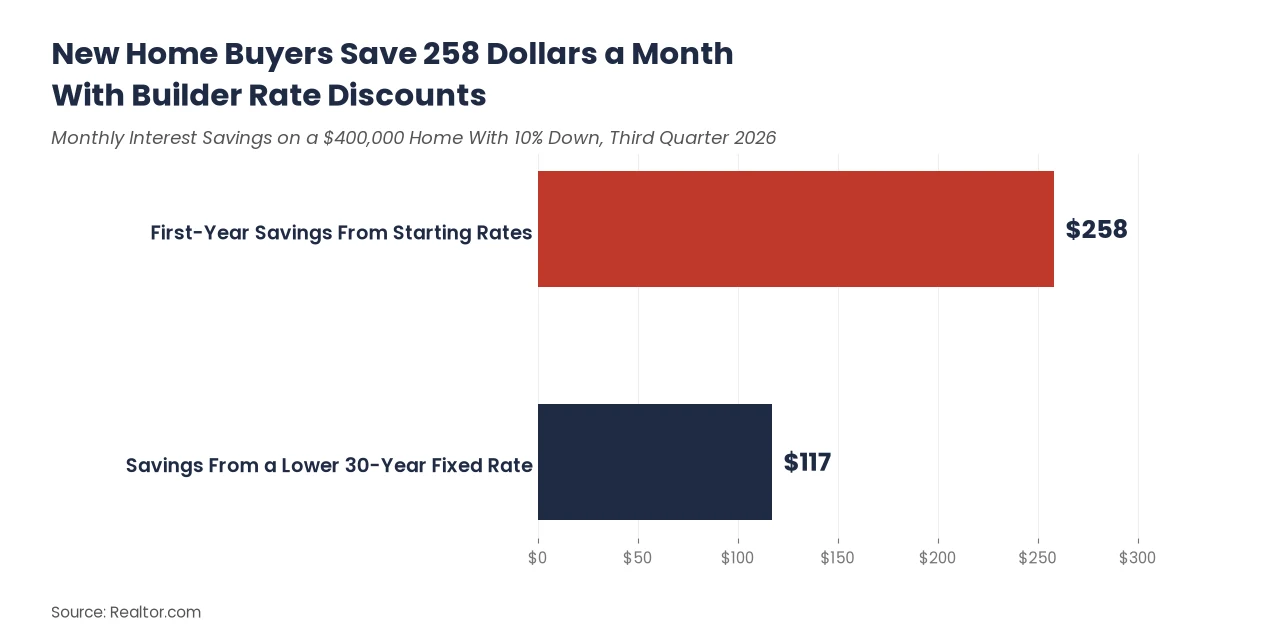
New home buyers are saving about $258 a month on interest in the first year of homeownership, according to Realtor.com. That break comes from builder rate discounts, not from a big cut in the sticker price. Builders are holding list prices fairly steady and using cheaper mortgage rates to get deals done.
New Home Buyers Save 258 Dollars a Month With Builder Rate Discounts

Source: Realtor.com.
Realtor.com published its third-quarter New-Construction Insights report on November 17, 2026. According to Realtor.com, the average starting mortgage rate for new-home buyers was 5.01% in the third quarter, compared with 6.15% for buyers of existing homes. That 114-basis-point gap is worth about $258 a month in interest on a $400,000 purchase with 10% down.
This is a financing story as much as a housing story. The median list price for a new home has barely moved in three years. What has changed is the rate a builder can offer you. If you only compare asking prices, you can miss the real discount. Builders would rather protect the advertised price of a community and sweeten the loan than mark every house down in public. For you, that can still mean a lower monthly bill. You just have to read the financing as carefully as you read the brochure.
The Savings Come From Rates Rather Than Lower List Prices
The median listing price for newly built homes rose slightly in the third quarter, to $451,071. That is right in line with the third quarter of 2025 and the third quarter of 2024. Existing-home list prices, by contrast, came in at $402,883, down 1.5% from 2025. There is still a gap of nearly $50,000 between the two medians, but new homes are also larger. The typical new listing was 2,056 square feet, compared with 1,790 square feet for existing homes. Once you adjust for size, the median price per square foot was $218 for new homes and $219 for existing homes.
“Builders have adjusted to a market where affordability is still a major hurdle, but that adjustment isn’t always visible in the listing price,” said Joel Berner, senior economist at Realtor.com. “Reduced mortgage rates can help make a new home more affordable for buyers while allowing builders to hold asking prices relatively steady.”
Reduced rates are the most common buyer incentive builders are offering in 2026. Builders often have close ties to lenders and can secure below-market rates because they send those lenders a steady stream of loans. In other cases, the builder simply pays to buy the rate down for you, either for a few years or for the life of the loan.
Temporary Buydowns Versus a Lower Rate for 30 Years
The $258 figure is based on starting rates, and some of those starting rates will not last. A popular example is a 3/2/1 buydown. The rate is 3 percentage points below the note rate in year one, 2 points below in year two, and 1 point below in year three. After that, you pay the full rate for the rest of the loan. The early savings can be real. So can the payment shock when the teaser period ends.
Even when Realtor.com looks only at rates fixed for the full 30-year term, new-home buyers still come out ahead. The average 30-year fixed rate for new-home buyers was 6.19% in the third quarter, compared with 6.68% for existing-home buyers. That smaller gap is worth about $117 a month in interest on the same $400,000 purchase with 10% down, and it lasts for all 360 payments. If that first-year gap holds, $258 a month is about $3,100 over 12 months. The $117 monthly gap, if it stays in place for the full term, adds up to about $42,000 over 30 years. Those are illustrations based on Realtor.com’s examples, not a guarantee for every floor plan or every lender.
“Mortgage-rate incentives can make a meaningful difference in what a buyer pays each month, but it’s important to understand how long the lower rate lasts,” Berner said. “A temporary buydown can provide relief early on, while a lower rate fixed for the life of the loan offers a different kind of savings.”
New Homes Are Not Automatically the Cheaper House
Since April, the median sales price of newly built homes has been lower than the median sales price of existing homes. In September, new homes sold for a median of $400,400, while existing homes sold for $417,500. That can sound like a bargain, but Realtor.com says it is mostly about location. The Northeast, where prices are higher and new construction is thinner, accounts for 11.8% of existing-home sales and only 4.7% of new-home sales. The South, where many new communities are being built, accounts for 61.1% of new-home sales and 46.6% of existing-home sales.
A lower national median does not mean a new house in your neighborhood costs less than a similar older house down the street. In 30 of the 100 largest metro areas, the new-home price per square foot is lower than the existing-home figure, but many of those new homes sit in more affordable suburbs. Compare the same area, the same size, and the full monthly payment, including taxes and insurance.
Inventory Is Growing Slowly and Price Cuts Are Back
Builders have also slowed construction. The number of new homes for sale was basically unchanged from a year earlier, with inventory up just 0.1% in the third quarter. Existing-home inventory grew faster, at 3.1%. Completions of new single-family homes were down 11.0% year over year in September. The new-construction share of listings slipped from 17.2% a year ago to 16.7%, and the price premium for new listings rose from 10.3% to 12.0%. Buyers are finding slightly fewer new homes, and the ones they do find are a bit more expensive relative to resale listings.
Price cuts tell a similar story of a softer market. Resale sellers cut the price on 21.6% of homes for sale, and builders did the same on 20.9% of new listings. Both shares are higher than they were a year earlier. So you may be able to negotiate on the price and still ask about a rate buydown. One does not cancel out the other.
This mix helps explain why new-home list prices have been so sticky. If a builder can keep the sign out front at $451,071 and still help you start at 5.01%, the community’s advertised prices can stay firm even while the effective cost to you comes down. Existing-home sellers cannot usually offer the same rate package, which is one reason their list prices have given more ground this year, falling 1.5% from 2025 levels.
What Buyers Should Check Before They Sign
If you are considering a new home, ask three questions before you fall in love with the monthly payment. First, is the low rate temporary or fixed for 30 years? Second, what will the payment be when a buydown ends? Third, is the builder cutting the price as well, or only buying down the rate? A lower rate on a higher price can still leave you with a large loan. A slightly lower price can shrink the loan itself.
If you are comparing a new home with an existing one, do not stop at the list price. Add the rate, the term, taxes, insurance, and any homeowners association fees. A new home that lists for more can still be cheaper each month if the builder’s rate is real and lasting. An existing home that lists for less can still cost more each month at today’s market rate. The 30-year purchase rate was 7.40% on November 18, 2026, which is why a discounted builder rate can look so attractive on paper.
The $258 first-year savings is a useful benchmark, not a promise that every new-home deal will look the same. The $117 figure is the more conservative one if you want a benefit that lasts. Your next step is to get the rate in writing, compare it with a regular 30-year quote, and make sure the payment still works after any teaser period ends. Use the calculator below to see how the payment changes when the rate changes.
Estimate Your Monthly Mortgage Payment
- Principal & interest$0
- Property tax$0
- Home insurance$0
- PMI$0
- HOA fees$0
$0Loan amount
$0Total interest
$0Total of payments
Yearly amortization schedule
| Year | Principal | Interest | Balance |
|---|
Estimates only. Your actual payment depends on your lender, taxes and insurance. PMI applies only when the down payment is under 20%.