


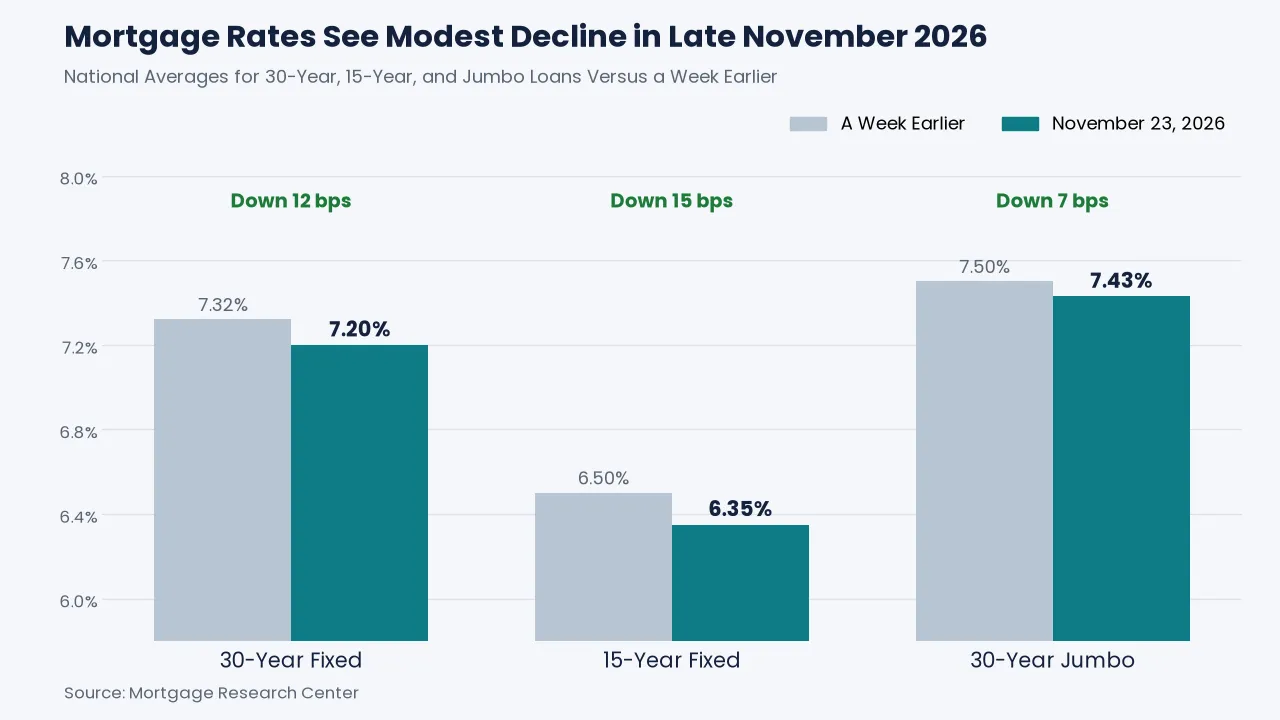
Mortgage rates have taken a modest step down in late November 2026, but they have not broken out of the high range squeezing buyers all fall. The average 30-year fixed loan stood at 7.20% on November 23, down 0.12 percentage points from 7.32% a week earlier, according to Mortgage Research Center data. Rates are still above 7%, and they sit roughly a percentage point higher than a year ago.
A 12-basis-point dip can trim a new monthly payment a little, but it does not close the much larger gap with last year. On a $400,000 30-year loan, today’s 7.20% average is about $33 a month less than last week’s 7.32%. A year ago, Freddie Mac’s weekly survey put the 30-year rate at 6.26%. The same loan would have cost about $250 less per month than it does at 7.20%.
Other popular loan types eased as well. The 15-year fixed averaged 6.35% on November 23, down 15 basis points from 6.50% the week before. The 30-year jumbo averaged 7.43%, down 7 basis points from 7.50%. Those are helpful moves, not a sudden break lower.
It also helps to know that not every survey prints the same number on the same day. Zillow’s purchase-rate data, reported by Yahoo Finance, listed the 30-year fixed at 7.18% on November 23, down 9 basis points from 7.27% last week. Freddie Mac’s official weekly average, released on November 19, was 7.28%, up 17 basis points from 7.11% the week before. The sources differ, but the broad picture is the same: recent daily averages have slipped a little, and a typical loan is still expensive.
If you already have a mortgage, a dip this small rarely opens a refinance window on its own. If you are buying, it is a bit of breathing room. Get fresh quotes, and remember that a modest decline can fade.
Mortgage Rates See a Modest Decline to 7.20% in November 2026
A Late-November Snapshot of Today’s Rates
Here is how the main national averages looked on November 23, 2026, compared with a week earlier. These Mortgage Research Center figures are rounded to two decimal places, which is how most shoppers see them:
- 30-year fixed: 7.20%, down 12 basis points from 7.32%
- 15-year fixed: 6.35%, down 15 basis points from 6.50%
- 30-year jumbo: 7.43%, down 7 basis points from 7.50%
A basis point is one one-hundredth of a percentage point, so a drop of 0.12 percentage points equals 12 basis points. The 15-year loan had the largest weekly decline of the three. The jumbo loan, used for amounts above the conforming limit of $832,750 in most of the country in 2026, moved the least.

Source: Mortgage Research Center.
Government-backed loans also eased. The 30-year FHA average was 6.66%, down 6 basis points from 6.71% a week earlier. The 30-year VA average was 6.75%, down 7 basis points from 6.82%. Those options can matter if you qualify, though your actual quote will still depend on your credit, down payment, and fees.
Why Rates Dipped, and Why the Relief May Be Temporary
Mortgage rates do not move because a lender suddenly feels generous. They tend to follow the bond market, especially the yield on the 10-year Treasury note. When investors get nervous about stocks, they often buy Treasuries. That pushes bond prices up and yields down, which can give mortgage rates a little room to fall.
That is a big part of what happened in the second half of November. A pullback in equities, including a sharp slide in technology and artificial intelligence stocks, sent some investors toward the safety of government bonds. The 10-year yield eased toward 5% during that flight to safety, and daily mortgage averages softened with it.
The catch is that this kind of move can reverse just as fast. By Monday, November 23, stocks were bouncing and some of that safe-haven demand was fading. The 10-year yield had edged back up near 4.96% after falling late last week. When yields rise again, lenders often lift mortgage quotes within a day or two.
Inflation and Federal Reserve policy can also undo a short-term dip. The Federal Open Market Committee left the federal funds rate at 3.75% to 4.00% at its October 27-28 meeting, and its next meeting is December 8-9. After a hotter-than-expected inflation reading in mid-November, markets began treating another rate hike in December as likely. The Mortgage Bankers Association has already shown how quickly shoppers react: applications fell 2.3% in the week ending November 13, as yields rose and mortgage rates climbed.
What a 12-Basis-Point Drop Means for Your Payment
Let’s keep the math simple and stick to principal and interest on a $400,000 30-year fixed loan. At last week’s 7.32%, the payment is about $2,748 a month. At this week’s 7.20%, it is about $2,715. That is a savings of roughly $33 a month, or about $391 over a year.
That is not nothing if you are stretching to buy, but it is a small change next to the year-ago gap. At 6.26%, the same $400,000 loan would have cost about $2,465 a month. Today’s 7.20% average adds about $250 a month, or roughly $3,000 a year, before taxes, insurance, or mortgage insurance. On a $300,000 loan, the 7.20% payment is about $2,036 a month, and the weekly improvement is only about $24.
The 15-year loan is a different tradeoff. At 6.35%, a $400,000 15-year mortgage runs about $3,452 a month, much higher than the 30-year payment even though the rate is lower. You pay the loan off sooner and spend far less on interest, but only if that higher bill still leaves room for repairs and savings. The 15-basis-point weekly drop trims that payment by only about $33, so the term itself matters more than this week’s move.
Freddie Mac’s Weekly Survey Is Still Running Higher
The daily averages above should not be mixed up with Freddie Mac’s Primary Mortgage Market Survey, the official weekly benchmark many headlines use. On Thursday, November 19, Freddie Mac said the 30-year fixed averaged 7.28%, up from 7.11% the week before. That ended a four-week slide. A year earlier, on November 20, 2025, it averaged 6.26%. The 15-year official average rose even more that week, climbing 21 basis points to 6.66% from 6.45%.
That survey has not moved in a straight line this fall. The 30-year average reached 7.40% on October 8 and October 15, then eased to 7.32%, 7.24%, 7.18%, and 7.11% over the next four weeks. The November 19 reading of 7.28% took back a large part of that relief in a single week.
Daily figures can show a decline to 7.20% while the official weekly survey still sits at 7.28% because they measure slightly different things and are published on different schedules. Freddie Mac releases a weekly average every Thursday. The Mortgage Research Center figures are a later daily snapshot. Neither one is the rate a lender will guarantee you. On that same $400,000 loan, Freddie Mac’s 7.28% average works out to about $2,737 a month, which is $271 more than the year-ago payment at 6.26%.
Other Rate Surveys Do Not All Match
Zillow’s numbers, reported by Yahoo Finance on November 23, came in a little below the Mortgage Research Center 30-year print. The 30-year purchase average was 7.18%, unchanged from Sunday and 9 basis points below last week’s 7.27%. The 15-year purchase average was 6.57%, down 5 basis points from last week. The 5/1 ARM was 7.11%, down 34 basis points, and the 20-year fixed was 7.06%, down 9 basis points.
Refinance averages are priced as their own product. Zillow’s November 23 refinance snapshot put the 30-year fixed refinance rate at 7.46%, down 10 basis points from last week’s 7.56%, with the 15-year refinance rate at 6.50%. Bankrate’s November 23 average was higher still, at 7.40% for the 30-year fixed, up 12 basis points from 7.28% a week earlier, with the 15-year fixed at 6.75%. When surveys disagree on the level or even the direction of a one-week change, use the averages as a guide and collect written quotes the same day.
What Forecasts Say Comes Next
Most forecasts still point to rates staying elevated, not plunging quickly. Fannie Mae’s November economic forecast now sees the 30-year rate averaging 7.2% in 2027 and again in 2028, lower than the 7.5% path it published in October, but still right around where official weekly rates sit today.
A five-year outlook published by Yahoo Finance reaches a similar conclusion, even as it allows for gradual easing. In its base case, 30-year rates moderate over several years but remain above 6%: about 6.95% in 2027, 6.60% in 2028, 6.35% in 2029, 6.20% in 2030, and 6.18% in 2031. That would be welcome after a year spent above 7%, and it is still a long way from pandemic-era lows. A modest November dip does not, on its own, mean the expensive part of this cycle is over.
What Buyers and Homeowners Can Do Now
If you are shopping for a home, treat this week’s move as a reason to get updated quotes, not as a reason to wait for a much bigger drop. A house that already fits your budget does not become a bad idea just because rates might wiggle again next week. Many buyers do better when they “date the rate and marry the house,” then refinance later if rates fall enough to make the fees worthwhile.
Shop more than one lender. Freddie Mac research has found that in a high-rate market, buyers who apply with multiple lenders may save $600 to $1,200 a year. Ask each lender for the interest rate, the annual percentage rate, any points, and a full monthly payment that includes taxes and insurance. Compare those written estimates side by side.
If you already have a mortgage, start with your current rate and your closing costs, not with today’s headline. A move from 7.32% to 7.20% is too small to justify a new loan for most people once fees are included. A refinance makes more sense when the new payment, after costs, clearly improves something you care about, such as a lower bill, a shorter term you can still afford, or a switch from an adjustable rate to a fixed one.
Sellers are feeling the same rate pressure, and that can work in a patient’s favor. Inventory is higher than it was a year ago in many markets, and some sellers are more open to a price cut or a closing-cost credit. Get that help in writing, and do not count on a future rate drop to rescue a tight payment.
My Take on This Modest Decline
This is a real dip, and it is fair to call it modest. The 30-year average came down 12 basis points to 7.20%, and the 15-year and jumbo averages eased too. I would not confuse that with a turning point. Rates are still above 7%, and a year-ago comparison still shows a payment gap of a couple of hundred dollars a month on a typical loan.
If you need a home and the payment works today, keep shopping and lock a rate you can live with. If the payment only works if rates fall another half a point or more, wait or look at a less expensive house. Keep your quotes current, watch the next inflation report and the Fed’s December meeting, and let the math, not the headline, decide your next step.
Estimate Your Monthly Mortgage Payment
- Principal & interest$0
- Property tax$0
- Home insurance$0
- PMI$0
- HOA fees$0
$0Loan amount
$0Total interest
$0Total of payments
Yearly amortization schedule
| Year | Principal | Interest | Balance |
|---|
Estimates only. Your actual payment depends on your lender, taxes and insurance. PMI applies only when the down payment is under 20%.