



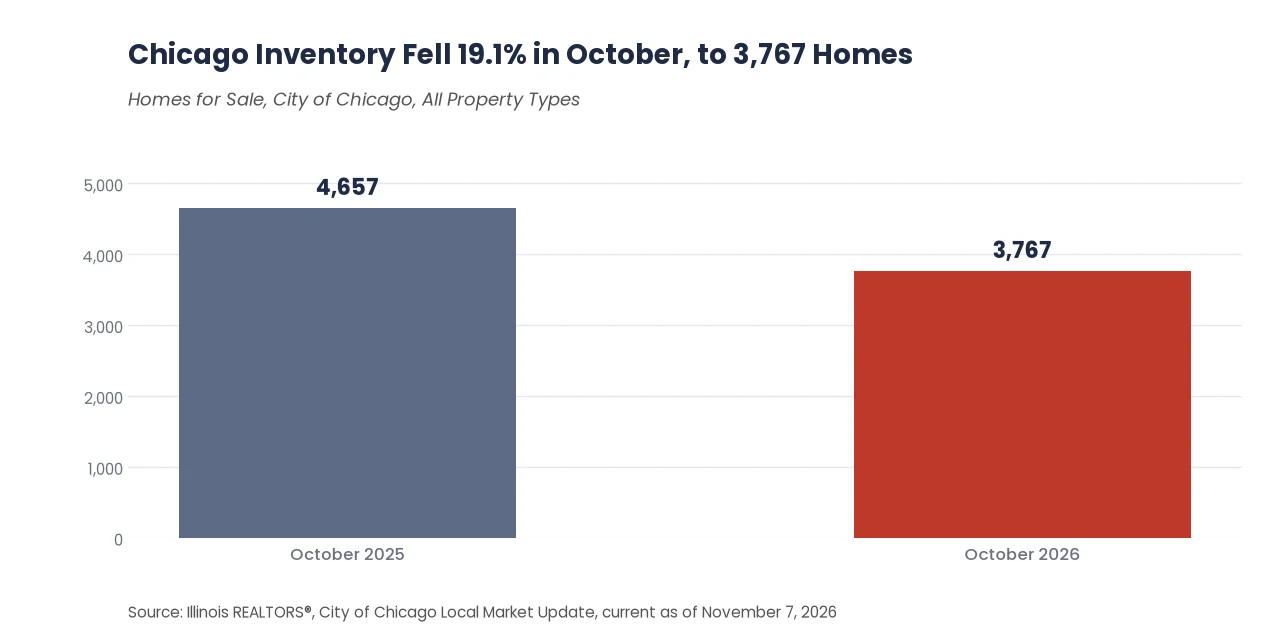
Chicago home prices kept climbing in October, even as the number of homes for sale shrank. The median sales price in the city rose 5.4%, to $390,000 from $370,000 in October 2025, according to the Illinois REALTORS® October report, current as of November 7, 2026, and built from MLS data that includes Midwest Real Estate Data. At the same time, inventory fell 19.1%, to 3,767 homes from 4,657, and sales dropped 11.7%, to 1,612 from 1,826.
That is a tight market, not a slump. Fewer homes came on the market, fewer deals closed, and the typical sale still brought more money than it did a year ago. If you are buying, the hard part is finding something to bid on, not watching prices collapse. If you are selling, a thinner listing count is on your side, as long as you price the home for today’s buyers.
Chicago Home Prices in October 2026: Up 5.4% as Listings Stay Tight
October’s Sales and Price Snapshot
The city figures cover all property types inside Chicago’s 77 community areas. Illinois REALTORS® also published a City of Chicago Local Market Update with the full scorecard. Here is the official recap:
| Metric | October 2026 | October 2025 | Change |
|---|---|---|---|
| Closed sales | 1,612 | 1,826 | -11.7% |
| Median sales price | $390,000 | $370,000 | +5.4% |
| Homes for sale | 3,767 | 4,657 | -19.1% |
| Days on market | 26 | 29 | -10.3% |
| Year-to-date sales | 18,450 | 19,137 | -3.6% |
| Year-to-date median | $401,000 | $375,000 | +6.9% |
The median is the middle sale, so half of Chicago homes sold for less than $390,000 and half sold for more. The year-to-date median is even higher, at $401,000, which tells you October’s typical price sits a little below the pace of the full year, as fall often does. Homes also sold faster, in 26 days instead of 29. This is not a market where listings pile up and shoppers leisurely pick them off. The ones that are priced right are still moving.
Sales eased from September as well. The same report shows 1,706 closings in September 2026, so October’s 1,612 sales were 5.5% lower month over month. The median, though, barely budged from September’s $389,000. The slowdown is in activity, not in the price level. Vicky Silvano, president of the Chicago Association of REALTORS®, said the city continues to face a shortage of homes for sale, and that this is why fewer homes were sold.
Inventory Is the Tightest Part of This Market
The 19.1% drop in listings is the number that should jump off the page. A year ago, buyers could shop among 4,657 homes. In October, they had 3,767. That is 890 fewer homes on the market in a city this large, and it helps explain why prices are still rising even though sales are down. When the shelf is thinner, the remaining items do not automatically get cheaper.
That tighter supply also shows up in the nine-county Chicago Metro Area, though the metro is not quite as tight as the city. Metro sales fell 10.4%, to 6,994 from 7,803, and the metro median rose 3.5%, to $380,000 from $367,000. Inventory in the metro declined 5.3%, to 15,399 from 16,263. The city lost listings faster than the suburbs, and city prices rose a little more, too.

Condos Outsold Houses, and They Also Sold for More
Chicago’s mix is different from many other cities, because condos make up a large share of sales. In October, 979 condos closed, down 11.2%, and 633 single-family homes closed, down 12.4%. The condo median was $410,000, up 6.2%. The single-family median was $375,000, up 7.1%. In other words, the typical condo sold for more than the typical house, and both were higher than last year.
That can surprise people who think of a house as the more expensive option. In Chicago, a lot of the single-family stock sits in neighborhoods where prices are lower than downtown and North Side condos, so the citywide house median can come in below the condo median. The lesson is simple: do not treat the $390,000 all-property median as the price of “a Chicago home.” A condo in one neighborhood and a house in another can be tens of thousands of dollars apart, even in the same month.
The Year-to-Date Market Is Still Ahead on Price
October should be read against the first ten months of the year, not as if it stands alone. Through October, 18,450 homes have sold in the city, only 3.6% fewer than the 19,137 sold through October 2025. The year-to-date median is $401,000, up 6.9% from $375,000, and the year-to-date market time is 27 days, down from 30. The full-year story so far is not a stall. It is a slightly slower sales pace and a clearly higher typical price, with homes still selling in under a month.
That also helps explain why a fall month can feel quiet without being weak. Sales often ease after summer, and October’s 1,612 closings came in below the year-to-date monthly pace. The median eased a little from the $401,000 year-to-date level, to $390,000, which is normal when the most competitive months are already on the books. The warning sign would be a jump in market time or a surge in listings. Neither showed up. Homes sold faster, and inventory was much tighter than last October.
The Broader Illinois Picture, and the Near-Term Forecast
Statewide, the same forces are at work, just in milder form. Illinois sales fell 8.3%, to 10,797 from 11,775, while the statewide median rose 4.4%, to $314,700 from $301,500. Inventory was almost unchanged, at 25,008 homes, up 0.4%. Debbie Prodehl, president of Illinois REALTORS®, said fewer sales are typical as the fall season deepens, but prices continue to rise, and expanding housing options remains important.
Looking ahead, Geoff Smith, executive director of the Institute for Housing Studies at DePaul University, said the institute’s three-month forecast projects closed sales from November through January 2027 will be 6.5% lower than during the same period last year, while single-family home prices in January are expected to be nearly 8% higher than a year earlier. Affordability is the tension underneath those numbers. Illinois REALTORS® also noted that the 30-year fixed mortgage rate averaged 7.33% in October, up from 6.86% in September and 6.25% in October 2025, according to Freddie Mac.
What This Means for Buyers
If you are hoping Chicago home prices will slip because sales slowed, October does not support that hope. A 5.4% year-over-year gain, a 6.9% rise in the year-to-date median, and 19.1% fewer listings are the marks of a tight market, not a discount market. You may face less chaos than in the peak frenzy years, and homes are selling in about 26 days, but you should not expect a wide aisle of cheap options.
Be precise about what you are buying. The condo median and the single-family median are telling different stories, and neighborhoods differ even more. Get current comps for the building or the block, and run the payment at today’s mortgage rate, plus taxes, insurance, and any assessment. A $390,000 median is only a starting point. The home you actually want may sit well above or below it.
What This Means for Sellers
Sellers have a stronger setup here than in many other large cities this fall. Inventory is down sharply, prices are up, and well-priced homes are selling three days faster than last October. If you have been thinking about listing, this is a market where a carefully priced home can still attract attention, because shoppers have fewer choices.
That does not mean you can pick a number from last summer and wait for a bidding war. Sales are down 11.7%, so the buyer pool is a little thinner, and mortgage rates are higher than they were a year ago. The listings that work are the ones that come out clean, show well, and line up with recent closed sales. If your home sits, the market is not telling you to panic. It is telling you the price or the presentation needs a look.
What to Watch Next
Watch inventory first. The 3,767-home count is the foundation of this tight market. If listings rebound toward last year’s 4,657, buyers will get more room and price gains may cool. If inventory stays this low, or falls further, prices have room to keep rising. Second, watch the city median around $390,000 and the year-to-date median at $401,000. Third, watch sales into the winter, especially in light of the Institute for Housing Studies forecast for a softer stretch of closings and still-higher single-family prices in January.
My take is straightforward. The Chicago housing market in October was smaller and more expensive, not weaker. Prices are up, listings are down, and homes that sell are still moving quickly. If you buy, be ready to act on a well-priced home and do the payment math at today’s rates. If you sell, you have a real advantage in supply, as long as you respect what buyers can actually afford.