



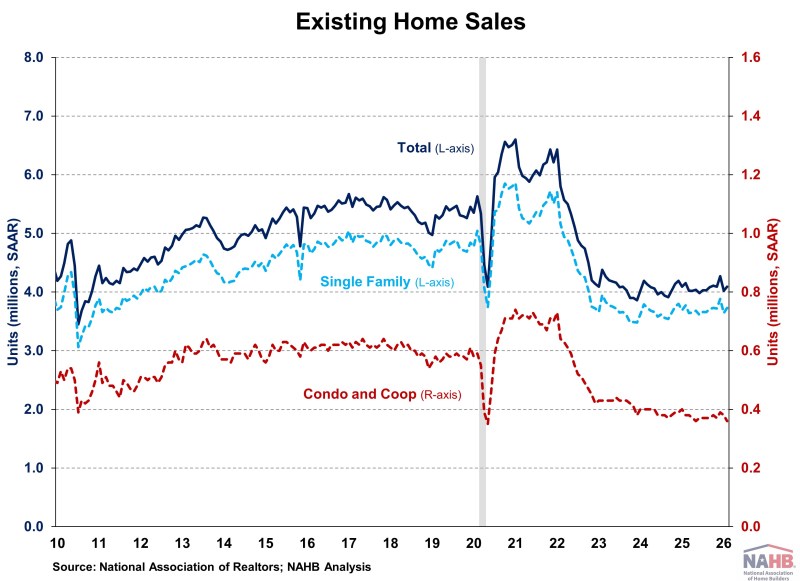
Following the sharp decline last month, existing home sales bounced back in February as housing affordability improved. Lower mortgage rates and moderating home price growth helped pull buyers back to the market. However, tight inventory will likely continue to push home prices higher if demand outpaces supply growth.
Total existing home sales, including single-family homes, townhomes, condominiums, and co-ops, rose 1.7% to a seasonally adjusted annual rate of 4.09 million in February, according to the National Association of Realtors (NAR). On a year-over-year basis, sales were 1.4% lower than a year ago.

The existing home inventory level was 1.3 million units in February, up 2.4% from January and 4.9% from a year ago. At the current sales rate, February unsold inventory sits at a 3.8-months’ supply, unchanged from last month but up from 3.6-months in February. Inventory between 4.5 to 6 months’ supply is generally considered a balanced market.
Homes stayed on the market for a median of 47 days in February, up from 46 days in the previous month and 42 days in February 2025.
The first-time buyer share was 34% in February, up from 31% in January and one year ago.
The February all-cash sales share was 31% of transactions, up from 27% in January but down from 32% a year ago. All-cash buyers are less affected by changes in interest rates.
The February median sales price of all existing homes was $398,000, up 0.3% from last year. This marks the 32nd consecutive month of year-over-year increases. However, the year-over-year growth has moderated since peaking in December 2024, suggesting that price appreciation may continue to slow. The median condominium/co-op price in February was up 0.9% from a year ago at $358,100. Recent gains for home inventory will put downward pressure on resale home prices in most markets in 2026.
Three of the four major regions saw sales increases in February, ranging from 1.1% in the Midwest to 8.2% in the West. Sales in the Northeast fell 6.0%. On a year-over-year basis, sales rose only in the South (+0.5%), while sales in the West, Midwest, and Northeast all declined (-1.3%, -4.1%, and -4.1%, respectively).

The Pending Home Sales Index (PHSI) is a forward-looking indicator based on signed contracts. The PHSI fell from 71.5 to 70.9 in January. On a year-over-year basis, pending sales were 0.4% lower than a year ago, according to the National Association of Realtors’ data. The decline suggests buyers are holding back due to limited inventory choices.