

U.S. house prices continued to rise at the close of 2025, though the pace of growth has slowed compared with the rapid gains of previous years. Elevated mortgage rates, affordability challenges, and ongoing economic uncertainty have restrained buyer demand, resulting in wide variations in local housing markets. While some states and metropolitan areas continue to post solid price gains, others are experiencing flat or declining prices.
Nationally, according to the quarterly purchase-only House Price Index (HPI)1 released by the Federal Housing Finance Agency (FHFA), U.S. house prices rose 1.8% in the fourth quarter of 2025, compared to the same period in 2024. This represents the slowest year-over-year (YoY) appreciation since the second quarter of 2012, indicating a cooling in the housing market following more than a decade of robust price growth. On a quarterly basis, appreciation was modest, increasing 0.8% from the third quarter.
The FHFA’s purchase-only HPI tracks average price changes based on more than six million repeat sales transactions on the same single-family properties. It offers insights about house price changes not only at the national level but also across states and metropolitan areas.

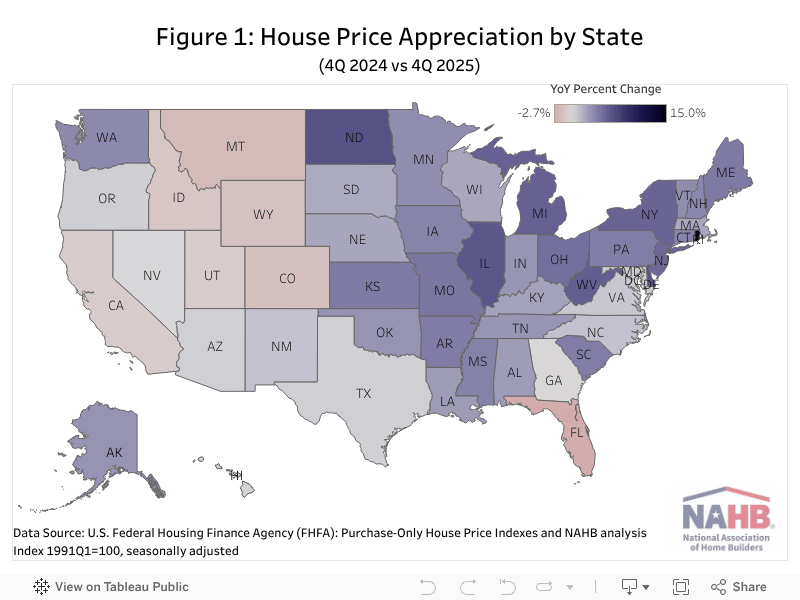
At the state level, 43 states experienced positive YoY price growth between the fourth quarter of 2024 and the fourth quarter of 2025, with gains ranging from 0.1% to 6.4%. North Dakota led the nation with a 6.4% gain, followed by Delaware with a 6.3% gain and Illinois with a 6.1% gain. On the opposite end, nine states and the District of Columbia reported negative YoY house price appreciation. Florida posted the most significant price decline at 2.7%. Notably, 33 states exceeded or matched the national YoY growth rate of 1.8%. On a quarterly basis, home prices declined in five states compared to the third quarter of 2025, highlighting softening momentum in select regional markets.

At the metro level, the divergence is even more pronounced. Among the 100 largest U.S. metro areas tracked by FHFA, YoY house price appreciation ranged from a 9.1% decline to an 8.9% increase. Cape Coral-Fort Myers, FL recorded the steepest annual decline, while Allentown-Bethlehem-Easton, PA-NJ posted the strongest annual gains over the previous four quarters. In total, 34 out of the 100 largest metro areas experienced annual price declines in the fourth quarter, while 66 metro areas posted gains. Many of the strongest performers were concentrated in the Midwest and Northeast, where inventory remains limited and price levels are comparatively affordable. In contrast, several Sun Belt and Mountain West metro areas that saw outsized appreciation earlier in 2021-2022 are now facing flatter or negative growth as affordability pressures weigh on demand.