

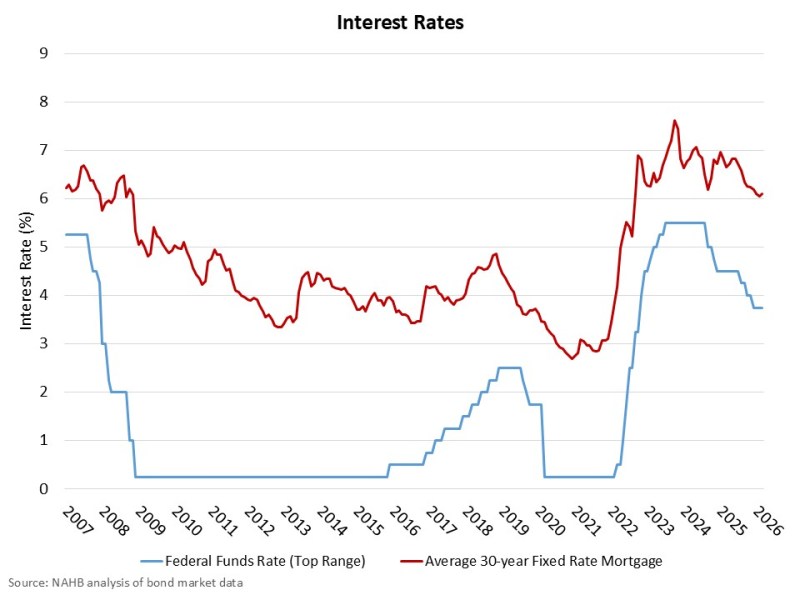
The Fed continued its current pause for rate reductions at the conclusion of the March meeting of the Federal Open Market Committee, the central bank’s monetary policy body. The Fed held the short-term federal funds rate at a top rate of 3.75%, the level set in December of last year. This marked the second policy pause since the Fed resumed easing in September of 2025.

Characterizing current economic conditions, the Fed stated that “uncertainty about the economic outlook remains elevated.” The central bank also noted that “the implications of developments in the Middle East for the U.S. economy are uncertain.” The March statement noted:
Available indicators suggest that economic activity has been expanding at a solid pace. Job gains have remained low, and the unemployment rate has been little changed in recent months. Inflation remains somewhat elevated.
Chair Powell noted during his press conference that activity in the housing sector remains “weak.” Despite elevated uncertainty, Chair Powell noted there is expectation of ongoing progress for inflation, describing policy as mildly restrictive.
The Fed’s statement noted the central bank will continue to consider risks associated with both sides of its dual mandate, to maintain maximum employment and stable prices.
There was only one dissenting vote (Miran), who voted for a quarter point cut. Governor Miran has previously made the argument for more dovish monetary policy due to limited tariff effects and an improving productivity outlook that would mute future inflation pressure. During the press conference there was discussion about the uncertain scale effects from higher oil prices and the merit of looking through supply-side shocks that can have offsetting effects on inflation (higher) and growth (lower).
Chair Powell has one remaining meeting at the helm at the Fed. President Trump has nominated former Federal Reserve Governor Kevin Warsh as the next Chair of the Federal Reserve. Powell said today he will stay on as Chair pro tem until Warsh is confirmed. Powell has not made a decision regarding whether he will remain as a Governor after his term as Chair ends. Powell can remain a Governor until the end of January, 2028.
NAHB had forecasted two additional rate cuts for 2026, based on the expectation of modest easing of inflation and a cool labor market. However, consistent with market expectations, our forecast will reduce this to just one rate cut for 2026 due to higher inflation pressure related to headline issues, including increased oil prices due to the Iran war. A longer conflict will have a relatively greater impact on the delay for future Fed rate cuts.
While reductions for the federal funds rate do not have a direct effect on mortgage interest rates, which remain slightly above 6%, federal funds rate reductions do lower interest rates on builder and developer loans, helping the supply-side of the housing market. Supplying more housing and at lower cost is key to solving the ongoing housing affordability challenge. Lower financing costs are part of the overall solution.
Looking forward, the Fed’s outlook for the economy and monetary policy is mixed. Estimates from the central bank’s updated Summary of Economic Projections (SEP) indicate an improved economic growth outlook, with a 2.4% fourth quarter year-over-year growth rate for 2026 (revised up from 2.3% as projected in December) and 2.3% for 2027 (revised up from 2%).
The SEP estimates also reveal an expectation of a 4.4% unemployment rate in 2026 and higher expectation for inflation (core PCE) of 2.7%, revised higher from 2.4% in December. The revised SEP does not anticipate the economy reaching the Fed’s target inflation rate of 2% until 2028.
With respect to policy, the SEP outlook suggests one rate cut in 2026 and one final rate cut in 2027. The “dot plot” of individual responses suggests one member expecting four rate cuts in 2026.