


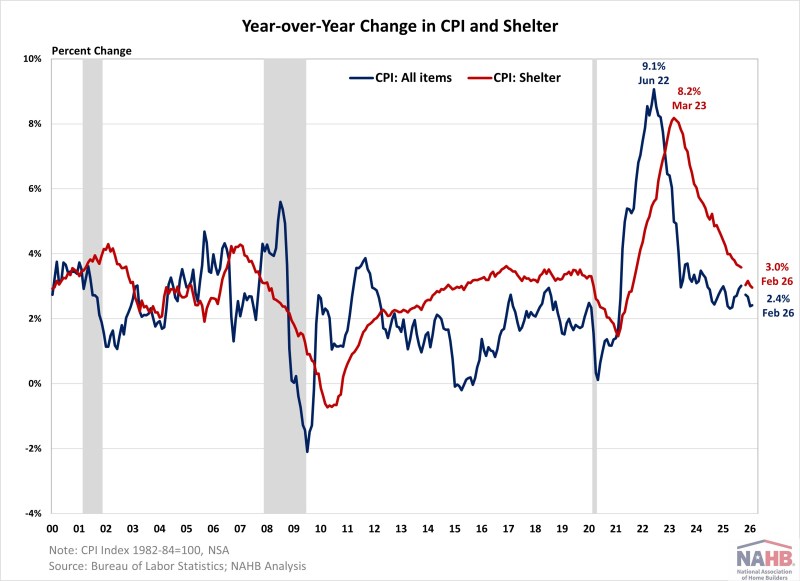
After months of downward trend, inflation held steady at an eight-month low in February. This report does not reflect the recent surge in oil prices due to Iran conflict beginning February 28. Higher oil prices will likely translate into higher gasoline costs and impact other sectors associated with transportation including airline tickets. This renewed inflation concern would complicate Fed policy especially given the recent weaker-than-expected job report. Additionally, lingering effects from government shutdown will continue to suppress the shelter index through April.
On a non-seasonally adjusted basis, the Consumer Price Index (CPI) rose by 2.4% in February from a year ago, unchanged from January and matching the lowest level since May 2025, according to the Bureau of Labor Statistics (BLS) latest report. The “core” CPI, excluding the volatile food and energy components, increased by 2.5% over the past twelve months, also unchanged from January. The housing shelter index, which makes up a large portion of “core” CPI, rose 3.0% over the year, holding steady from last month. Meanwhile, the component index of food rose by 3.1%, and the energy component index increased by 0.5%.

On a monthly basis, the CPI rose by 0.3% in February (seasonally adjusted), and the “core” CPI increased by 0.2%.
The price index for a broad set of energy sources rose by 0.6% in February, with the decline in electricity (-0.7%) offset by increases in gasoline (+0.8%), natural gas (+3.1%) and fuel oil (+11.1%). Meanwhile, the food at home index rose by 0.4%, while the food away from home index increased by 0.3% in February.
The index for shelter continued to be the largest contributor to the overall monthly increase in all items index. Other top contributors that rose in February included indexes for medical care (+0.5%), apparel (+1.3%), household furnishings and operations (+0.3%), airline fares (+1.4%), and education (+0.2%). Meanwhile, the index for communication (-0.5%), used cars and trucks (-0.4%), motor vehicle insurance (-0.3%) and personal care (-0.2%) were among the few major indexes that decreased over the month.
The index for shelter, which makes up more than 40% of the “core” CPI, rose by 0.2% in February. The index for owners’ equivalent rent (OER) rose by 0.2% while and the index for rent of primary residence (RPR) increased by 0.1% over the month. NAHB constructs a “real” rent index to indicate whether inflation in rents is faster or slower than core inflation. It provides insight into the supply and demand conditions for rental housing. When inflation in rents is rising faster than core inflation, the real rent index rises and vice versa. The real rent index is calculated by dividing the price index for rent by the core CPI (to exclude the volatile food and energy components). In February, the Real Rent Index fell by 0.1%, the first monthly decline after remaining virtually flat since August 2025, except for data quality issues in October and November.