

Thinking about buying or selling a home in Vegas? The Las Vegas housing market is a wild ride right now, and understanding the current trends is crucial. So, What’s the Buzz About Las Vegas Real Estate? The Las Vegas housing market is definitely showing some interesting shifts. While prices haven’t completely crashed, things aren’t as hot as they once were.
We’re seeing more homes on the market, and they’re taking longer to sell. This leads to a lot of questions: Is the market cooling down? Are we heading for a correction? Let’s explore these questions, focusing on the latest data and giving you my own perspective, based on my experience in this market.
Las Vegas Housing Market Trends: What’s Really Happening?
Single-Family Home Sales: A Closer Look
September 2024 painted a pretty clear picture: sales are slowing down. A total of 1,791 single-family homes changed hands, a 16.2% drop from August and a slight 1.6% dip from September 2023. While this might seem alarming, let’s not panic just yet.
- Median Home Price in Las Vegas: Despite the slower sales, the median price for single-family homes climbed to $479,900, a 0.6% increase from August and a significant 6.6% increase year-over-year. This shows that even though fewer homes are selling, the demand for the available inventory remains relatively strong, helping to keep prices up.
Here’s a quick look at the median price trend:
| Year | Month | Median Price (Single-Family Homes) |
|---|---|---|
| 2021 | September | $406,500 |
| 2022 | September | $450,000 |
| 2023 | September | $450,000 |
| 2024 | September | $479,900 |
Condos and Townhomes: A Different Story?
The condo and townhome market is telling a slightly different tale. While the number of sales isn’t included in my data, the median price rose to $299,500 in September, up 2.6% from August and a solid 10.9% year-over-year jump. This is a healthy increase, signaling continued demand in this segment of the Las Vegas market.
Here’s a summary of the median price trend for condos and townhomes:
| Year | Month | Median Price (Condos/Townhomes) |
|---|---|---|
| 2021 | September | $230,000 |
| 2022 | September | $270,000 |
| 2023 | September | $270,000 |
| 2024 | September | $299,500 |
Luxury Market: Still Strong?
The luxury market ($1 million+) is also experiencing a shift. While 127 homes sold in September – a slight decrease from August’s 138 – the median price jumped to a whopping $1,475,791, a significant increase of $175,791 from August. This suggests that high-end buyers are still active, even if the overall volume is down.
Inventory: The Elephant in the Room
One of the most significant changes in the Las Vegas housing market is the rising inventory. In September, there were 5,458 single-family homes listed without offers – a 34.2% increase year-over-year! This is a considerable jump from the relatively tight inventory we saw in previous years. A report from Redfin confirmed that Las Vegas had the highest increase in new listings of major metropolitan areas at 12.8% year over year. This surplus is a major factor in the slower sales pace.
Months of Inventory: A Key Indicator
We’re seeing a noticeable increase in the months of inventory – a key metric indicating market conditions. We’ve gone from a low inventory scenario (2.2 months in September 2023) to a more balanced 3 months in September 2024. While this isn’t an oversupplied market, it does signal a shift from the seller’s market we’ve seen for a while. It also suggests that buyers now have more options and negotiating power, while sellers might need to be more realistic about pricing.
Days on Market: Another Important Factor
Only 61.5% of homes sold in September were on the market for 30 days or less, compared to 68% in September 2023. This indicates homes are sitting on the market longer. A longer time on the market signifies less buyer demand.
Is a Crash Coming in the Las Vegas Housing Market? My Take
Now, the million-dollar question: are we heading for a crash? My honest opinion, based on my experience in the Las Vegas housing market, is “probably not”. While we’re definitely seeing a shift, this is more of a correction than a full-blown crash. The market is cooling down after years of intense growth, which is healthy and expected.
However, this does not mean there are no challenges. The increase in inventory suggests that sellers might need to adjust their pricing expectations. Buyers, on the other hand, now have more choices. It’s a more balanced market than the seller’s market we were experiencing before.
Las Vegas Real Estate Market Appreciation
Las Vegas, the dazzling city of lights and entertainment, has seen more than just its share of growth over the years. This vibrant desert metropolis has also become a hotspot for real estate investors and homeowners seeking a solid market with consistent appreciation.
Over the last decade, Las Vegas real estate has experienced a remarkable boom, boasting an impressive 167.42% appreciation. This translates to an average annual growth rate of 10.34%, placing Las Vegas among the top 10% performers in the nation (Neighborhoodscout).
A Decade of Growth: Las Vegas Real Estate Soars
The past ten years have been a period of significant growth for Las Vegas real estate. The city’s economic diversification, thriving tourism industry, and increasing population have all contributed to a strong housing market.
Here’s a breakdown of appreciation rates for different timeframes:
- Latest Quarter (2023 Q3 – 2023 Q4): While the most recent quarter saw a modest increase of 1.80%, it’s important to consider this within a broader context.
- Last 12 Months (2022 Q4 – 2023 Q4): Similarly, the past year reflects a minimal gain of 0.23%.
- Last 5 Years (2018 Q4 – 2023 Q4): Zooming out to a five-year window, appreciation reaches a more substantial 48.48%, averaging at 8.23% annually.
- Last 10 Years (2013 Q4 – 2023 Q4): This timeframe showcases the true strength of the Las Vegas market, with a staggering 167.42% appreciation, averaging 10.34% per year.
Las Vegas vs. The National Market
How does Las Vegas stack up against the national average? When compared to Nevada and the United States as a whole, Las Vegas consistently ranks highly in terms of appreciation.
- Over the Last 10 Years: Las Vegas comes in at 9th nationally and 10th within Nevada.
- Since 2000: While appreciation since the turn of the century remains impressive at 178.38%, the average annual rate dips to 4.36%. Las Vegas maintains a respectable position at 5th in Nevada and 8th nationally.
Looking Forward: What to Expect in Las Vegas Real Estate
The Las Vegas real estate market continues to show promise. While the breakneck pace of the past decade might moderate, long-term growth is still anticipated. Factors like continued economic diversification, a growing population, and a limited housing supply are likely to contribute to sustained appreciation.
Are You Ready to Invest in Las Vegas Real Estate?
Las Vegas’ track record speaks for itself. With consistent appreciation and a promising future, the city offers a compelling opportunity for both homeownership and real estate investment. However, it’s crucial to conduct thorough research, consider your individual circumstances, and consult with a qualified real estate professional before making any decisions.
Predictions: Las Vegas Housing Market Forecast 2024-2025
The Las Vegas housing market has experienced remarkable fluctuations over the past few years, responding to a myriad of economic indicators and changing consumer preferences. As we approach the close of 2024 and look into 2025, key metrics reveal both challenges and opportunities for buyers, sellers, and investors in this dynamic market.
Average Home Values and Pricing Trends
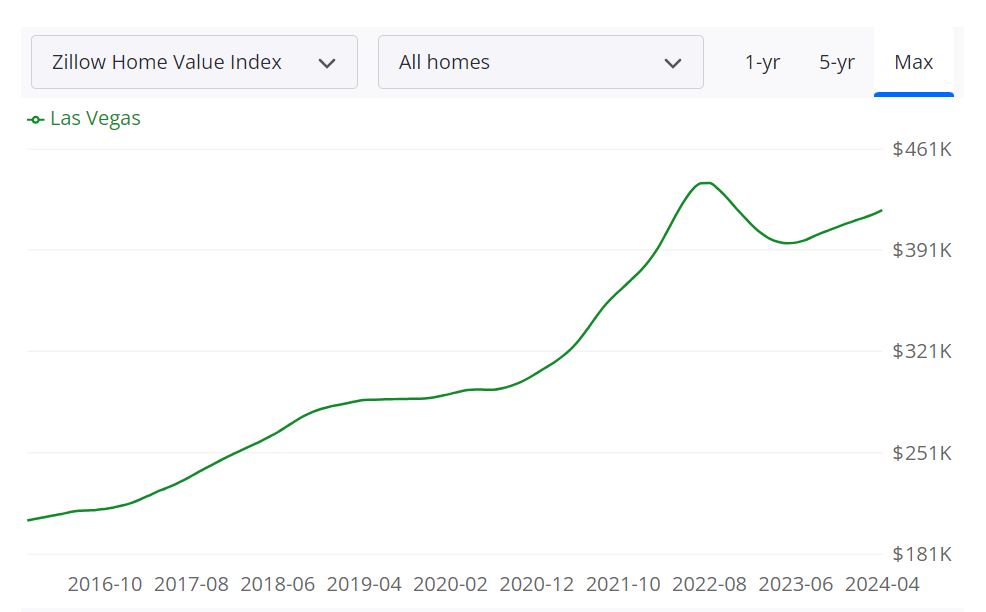
As of late 2024, the average home value in Las Vegas stands at $428,770 (Zillow), reflecting a robust year-over-year increase of 7.1%. However, the situation is nuanced. The median sale price, recorded at approximately $421,667 as of June 30, 2024, indicates a growing divide between list prices and sale prices, prompting sellers to reassess their pricing strategies.
In the Las Vegas-Henderson-Paradise MSA, the average home value is slightly higher at $433,042, marking a notable 6.6% increase despite signs of a softening market. These values illustrate a consistent demand within certain localities, underscoring the allure of Las Vegas as a desirable location for both new homeowners and investors alike.
Market Activity: Days on Market
Homes in the Las Vegas housing market are currently pending in an average of 15 to 16 days. This rapid turnover reflects a strong demand, suggesting that homes that are well-priced and well-maintained are still attracting buyers quickly. However, the average days on market can fluctuate based on the pricing strategy and condition of the homes, as well as the overall economic landscape.
Signs of Cooling
Despite the positive growth in home values, there are emerging signs of a cooling market. The recent discrepancy between median sale prices and list prices—most notably, the median list price rising to $459,600—suggests that sellers may be overestimating what buyers are willing to pay. This recalibration indicates a potential shift, as both buyers and sellers adjust to changing market expectations.
Forecast for 2025 Shows Balancing Act Ahead
Looking ahead into 2025, Zillow anticipates a modest decline in Las Vegas-Henderson-Paradise home prices, projecting a 0.3% decrease by the end of 2024, followed by stabilization in 2025. This forecast signals a pivotal shift from the explosive growth seen in previous years towards a more sustainable market dynamic.
Forecasts suggest that while home prices may level off, any future appreciation will be modest—predicted to be in the range of 1% to 2% annually. This reflects a deceleration of growth influenced largely by macroeconomic factors such as persistent inflation and rising mortgage interest rates. These elements are fundamental to understanding the cost structures and financial feasibility for potential homebuyers.
Influence of Mortgage Rates
The impact of mortgage rates remains a crucial factor. Predictions indicate that the average interest rate for 30-year fixed mortgages will moderate to around 6.2% in 2025, down from 6.7% in 2024. While this reduction is a positive development, rates will still be high enough to deter many potential buyers. The combination of elevated mortgage rates and a stabilizing market environment may lead to a slowdown in the actual number of sales.
Sales Volume Expectations
Given the current economic climate, transactions in the Las Vegas housing market may continue to be constrained as long as mortgage rates remain elevated. First-time buyers and lower-income families may find it increasingly difficult to enter the market, further contributing to slower sales volumes. The focus for many current homeowners is likely to shift toward optimizing their existing investments rather than pursuing new purchases.
So, Will the Market Crash?
The short answer is unlikely. Las Vegas has a healthy economy with a strong job market, which are key factors that prevent housing market crashes. Additionally, the inventory of homes for sale remains low, which helps to keep prices from plummeting.
What to Expect for Homebuyers in the New Market Landscape
While homebuyers may not see the bidding wars of the past, they can expect some more breathing room when making offers. However, due to the still-competitive market, be prepared to act quickly on homes that meet your needs. It’s also crucial to get pre-approved for a mortgage to strengthen your offer and potentially avoid competing with cash buyers.
What to Expect for Sellers in the New Market Landscape
Sellers may need to be more realistic with pricing strategies in the coming months. Gone are the days of homes selling significantly above asking price. However, with low inventory, sellers shouldn’t expect a fire sale either. It’s important to price your home competitively to attract buyers in a market where they have more options.
Final Thoughts
The Las Vegas housing market is in a state of transition. While the breakneck speed of appreciation may be over, the market is likely to experience continued growth, albeit at a slower pace. This presents a good opportunity for both buyers and sellers to navigate the market with a more balanced approach. Buyers will benefit from a less frenetic buying environment, while sellers should still find a ready pool of interested buyers, though they may need to be flexible on pricing.
This graph (Zillow) illustrates the growth of home values in the region over the past year, along with a forecast suggesting this trend will likely continue for the next year.

Should You Invest in the Las Vegas Real Estate Market?
Las Vegas, known for its glitz and glamour, also offers intriguing possibilities for real estate investors. This section explores the current Las Vegas housing market to help you decide if it aligns with your investment goals.
The Las Vegas real estate market has seen significant movement. While sales activity slowed last year, new listings also declined, creating a more balanced market compared to prior periods. This doesn’t necessarily signify a downturn; it suggests a shift from a seller’s market to a more neutral environment.
While some price moderation might have occurred, affordability remains a challenge due to limited inventory. So, competition can be intense, particularly for desirable properties.
Reasons to Invest in Las Vegas Real Estate
Las Vegas offers potential advantages for long-term investors:
1. Steady Growth
The Las Vegas metro area boasts impressive growth, attracting new residents thanks to its diversified economy. Tourism, entertainment, gaming, along with technology, healthcare, and education contribute to a stable income base for the population.
2. Rental Market Strength
Las Vegas enjoys a robust rental market, with many residents choosing to rent. This presents opportunities for investors to generate consistent rental income, especially in popular neighborhoods and areas near employment hubs.
3. Proven Resilience
Las Vegas has a history of bouncing back from economic downturns, as evidenced by its recovery from the 2008 recession and the COVID-19 pandemic. The city continues to see revitalization efforts through new projects and initiatives.
4. Strong Economy and Population Growth
Las Vegas has been experiencing consistent population growth due to its economic opportunities, affordable cost of living, and desirable lifestyle. A growing population creates sustained demand for housing, making it an attractive option for long-term investors.
Las Vegas is a shining beacon in the desert for those fleeing California or simply hoping to make it big. Many others simply come to earn a living serving the many tourists who visit here each year or work at the firms relocating to this tax haven. All of this gives the Las Vegas real estate market a bright future.
The Las Vegas Valley was the 30th fastest-growing metro in the country last year, according to new data from the U.S. Census Bureau. Last year the valley added 14,038 new residents, a 0.6 percent increase over 2022, according to the census, and has added 71,098 residents since 2020.
5. Infrastructure Development
Las Vegas has ongoing infrastructure development projects, including new roads, public transportation, and community amenities. These investments can enhance the quality of life and property values, making it an appealing choice for long-term real estate investors.
Several significant projects are shaping Las Vegas’s future:
- The Resorts World Las Vegas: A $4.3 billion mega-resort opened in June 2023, offering over 3,500 rooms, a casino, a theater, and more.
- The MSG Sphere at The Venetian: A $1.8 billion entertainment venue expected to open in late 2023 or early 2024, featuring a spherical shape and state-of-the-art technology.
- The Las Vegas Convention Center Expansion: A $980 million project added 1.4 million square feet of space, enhancing the city’s event capabilities.
- The Allegiant Stadium: A $1.9 billion stadium that opened in July 2020 as the home of the NFL’s Las Vegas Raiders and host for events and concerts.
- The Boring Company’s Loop System: A $52 million underground transportation system connects various locations in Las Vegas using autonomous electric vehicles.
6. Economic Diversification
Las Vegas has diversified its economy beyond the entertainment and tourism sectors. The city now boasts thriving industries in technology, healthcare, and manufacturing. Economic diversification contributes to stability and long-term growth potential in the real estate market.
7. Appreciation Potential
The Las Vegas real estate market has historically shown the potential for property appreciation. As the city continues to grow and evolve, property values may increase over time, providing long-term investors with capital gains opportunities.
8. Low Property Taxes
Nevada is known for its favorable tax climate. The state has no personal income tax, and property taxes are relatively low. This can translate into better returns for real estate investors, making long-term ownership more attractive.
9. Tourism and Hospitality
Las Vegas remains a global tourist destination, and the hospitality industry continues to thrive. This ensures a steady flow of short-term rental and vacation rental opportunities, which can be a lucrative segment for long-term investors, especially in the right locations.
10. Education and Workforce
The city has been making investments in education and workforce development. A well-educated and skilled workforce can attract businesses and professionals, leading to increased demand for housing and real estate investment potential in the long term.
11. Wealth of Investment Options
Las Vegas offers a wide range of real estate investment options, from single-family homes to multi-unit properties and commercial real estate. Diversifying your portfolio with different types of properties can provide a solid foundation for long-term financial growth.
Before investing in Las Vegas real estate for the long term, it’s crucial to conduct thorough research, understand market conditions, and consult with local real estate experts to make well-informed investment decisions. Long-term real estate investment can be a promising path to building wealth and financial security in this dynamic and growing city.