



Just a few years ago, investing in short term rental properties was touted as an easy, passive income strategy. College students were renting out spare bedrooms and raking in cash.
So naturally, the short term rental market caught the attention of more real estate investors than ever before, specifically during the post-pandemic travel boom of 2021-2022. It seemed that you could buy a rental property almost anywhere, rent it out on Airbnb, and just like that, have added a cash-flow asset to your portfolio.
And the data backed this idea up. Looking at market averages during that time, you would often find that short term rentals out-performed long term rentals in many locations across the US.
Fast forward to 2026 and things have shifted. In many markets, Airbnb occupancy and revenue growth have slowed while regulations have increased. Owning a vacation rental property is no longer passive income, it’s a business.
And while becoming an Airbnb host is no longer synonymous with quick, easy cash, the alternative – traditional, long term rental properties – comes with its own difficulties. And now a third type of rental property has emerged on the scene thanks to growing popularity: the mid term rental. There simply isn’t a clear winner like before.
What this means is that, now more than ever, real estate investors really have to weigh their options for rental strategy.
Let’s take a closer look at what real estate investors are re-evaluating when choosing between short term vs long term rentals in 2026.
Short Term vs Long Term Rentals: Everything Investors Need to Re-Evaluate
1.The Laws
Typically, it takes a while for the law to catch up with any new product or business strategy. So when it came to the short term vs long term rental market, it was much easier to enter the former because most locations simply had no regulations in place.
Today, however, most housing markets, especially popular tourist destinations, have short term rental regulations in place. Some cities like New York City, Honolulu, Santa Monica, New Orleans, and San Francisco are considered to have “de-facto” bans. The short term rental laws are so strict here that they may as well be outright banned.
Regulations cover so many aspects of owning a vacation rental including:
- Minimum stays
- Maximum number of guests
- Owner occupied vs non-owner occupied
- Registration, permits, and licenses
- Taxes
- Zoning
- Safety standards
The list goes on depending on the location. In 2026, any real estate investor considering buying a vacation rental property has to re-evaluate whether he/she has the capacity to be legally compliant.
Want to quickly find out if running a short term rental is legal in a certain market? Visit Mashvisor’s portal to US-wide short term rental regulations.
For many, these strict regulations and the local pushback against Airbnb in many areas have made the choice easy between short term vs long term rentals. But the reality is that the legal landscape for the traditional rental market is also changing in many major cities.
Landlords have had to follow location-specific rental laws in the US housing market as early as the 1920s that include:
- Rent control and stabilization
- Vacancy control/decontrol
- Eviction
- Security deposit
- Safety standards
- Fair housing laws
- Zoning
- Licences
- Taxes
- And more
But in 2026, new laws are popping up that favor tenants while making things more costly and difficult for landlords. Here are just a few examples:
California:
- Landlords in the California real estate market will now have to provide a working refrigerator and stove.
- The use of pricing algorithms to set rents has been banned.
- Tenants now have the option to opt-out of bundle internet or cable packages.
- Tenants can use delayed or interrupted social security payments as a legal defense against eviction.
- Rent collection must be paused during natural disasters and landlords have to clean up debris.
Washington:
- A new rent cap limits increases to the lesser of 10% or 7% of the Consumer Price Index, with the max now being 9.683%
- Notice periods for rent or fee increases have been extended.
You may be thinking that as long as your rental property isn’t in any of these US states, then there’s nothing to re-evaluate about becoming a landlord. But once a law passes in one major state and finds success there, it’s common for other states to follow.
Real estate investors need to review and comprehensively understand the laws no matter if they choose short term or long term rentals.
2.The Cost
Typically, when comparing short term vs long term rentals, short term rentals are the more expensive real estate investment. This hasn’t really changed as of 2026.
What has changed is that costs have increased for both rental strategies. Not only are US home prices generally higher, but property taxes, mortgage rates, and insurance premiums are as well.
For short term rental properties, the changing regulations can mean paying annual fees for permits and registration, hefty fines for violations, and additional taxes. And Airbnb introduced new platform fees in 2025, raising costs for hosts.
Beyond those, there’s so much more competition in the market these days. A room to board in is no longer enough. For example, some hosts argue that the baseline for an Airbnb in Gatlinburg, TN is a hot tub and it’s no longer a negotiable amenity. Trying to stand out among the crowd is a cost factor all on its own.
All of this means owning a vacation rental property is much more expensive in 2026 than it was a few years ago.
For long term rental properties, some of the new laws increase overhead costs like needing a working stove and fridge. Tenants are much more energy-conscious than they used to be and making your rental property energy efficient is going to increase costs as well.
Start-up and ongoing costs are simply not what they used to be. Real estate investors need to re-evaluate the costs of both short term and long term rental properties. It’s not enough to have a “general idea.” Rather, you need reliable cost estimates as well as income estimates to determine which one will cash flow the best before making a choice.
3.The Location
We’ve already looked at how some locations have changed for both short term and long term landlords. But if we move beyond the legal side of rental property ownership, there is still a lot real estate investors need to re-evaluate this year when it comes to the choice of market.
Travel trends change often and now you have to throw in the issue of oversaturation into the decision making. For traditional rentals, prospective tenants are moving to the Southeast and the Mountain West (the Sunbelt). A decade ago, larger cities were much more popular.
But understanding where people are moving or visiting is only half the battle; the real question is how to position your asset within those markets. To get clarity on this, we spoke with Daryl Fairweather, the Chief Economist for Redfin, for some guidance.
Mashvisor: “Are there any markets where you expect more short-term rentals to convert to long-term rentals?”
Fairweather: “Conversions are most likely where short-term economics weaken or regulations tighten.
- Quieter vacation towns: Falling sales and bookings push owners toward long-term leases.
- Cities with stricter rules: New permits, caps, or bans make STRs less profitable.
- Rising long-term rent markets: Areas with strong job and rent growth make long-term leasing attractive.
Bottom line: Conversions cluster where STR revenue softens but long-term fundamentals remain solid.”
Mashvisor: “Are there any markets where short-term rentals might outperform long-term rentals in 2026?”
Fairweather: “Yes, some markets will still favor STRs.
- Tourism-driven destinations: Year-round appeal, strong shoulder seasons, and resort areas sustain higher STR yields. Think ski towns or vacation towns without STR limits.
- Emerging lifestyle markets: Secondary markets with increasing travel demand can outperform legacy hubs.
- Event-driven spikes: Large events or global tourism surges can boost STR revenue above long-term averages. Be careful not to price gouge, and check your local laws before raising prices.
Bottom line: STR success depends on professional management, dynamic pricing, and consistent demand. Passive Airbnb investments in random towns are risky.”
Review which locations are more suitable for short term vs long term rentals. Trends change and real estate investors need to keep up.
4.The Occupant
Something that attracted real estate investors to short term rentals was the idea of the temporary guest. Lots of owners and hosts assumed a temporary guest would pose fewer issues. Afterall, you typically don’t have to deal with the common issues of long term tenants such as:
- Security deposits
- Evictions
- Failure to pay rent (as guests typically pay upfront)
- Hoarding
- Deferred maintenance
- Pet damage
It seemed like the Airbnb guest was the ideal occupant for a rental property.
But then the Airbnb horror stories started to come to light online, stories of:
- Guests trashing rentals
- Neighbor complaints over noise and parties leading to hostility towards hosts in those areas
- Unfair charge disputes and platform-enforced refunds
- Squatters
- And much more
Not to mention the reality of the costs of housing a short term guest like high-speed internet, hotel-like amenities, and professional cleaning.
In 2026, it’s not as simple as one type of occupant being better than the other. Both require their own unique management and costs. Real estate investors need to re-evaluate which they can handle and assess risk mitigation and strategies for handling the potential issues with both.
5.The Effort: Active vs Passive
If you’ve taken a look at online communities and forums for Airbnb and short term rental hosts, you’ll find one major complaint. The hosts pulling out of the market didn’t realize how much effort it takes to run a hospitality business. Being an actual host rather than outsourcing property management means your rental is an active investment.
Being a landlord of a long term rental is also considered an active job. Unlike the early perception that short term rentals were passive income, traditional rentals have always been known to require great efforts at certain times (evictions, tenant turnover, emergency maintenance, etc.)
Both types of investment can become passive if you hire a property manager. But that depends on how much you’re earning and whether it will hurt your cash flow significantly. Typically, property management for long term rentals (single family homes) costs 8% to 12% of the monthly rental income. For short term rentals, it’s 15% to 25%.
Neither being a host or a landlord is passive. Real estate investors need to re-evaluate what they can handle in terms of the day-to-day operations and time commitment. Alternatively, factoring in management costs upfront when performing investment property analysis is key for a passive rental.
6.The Third Option: The Mid Term Rental Property
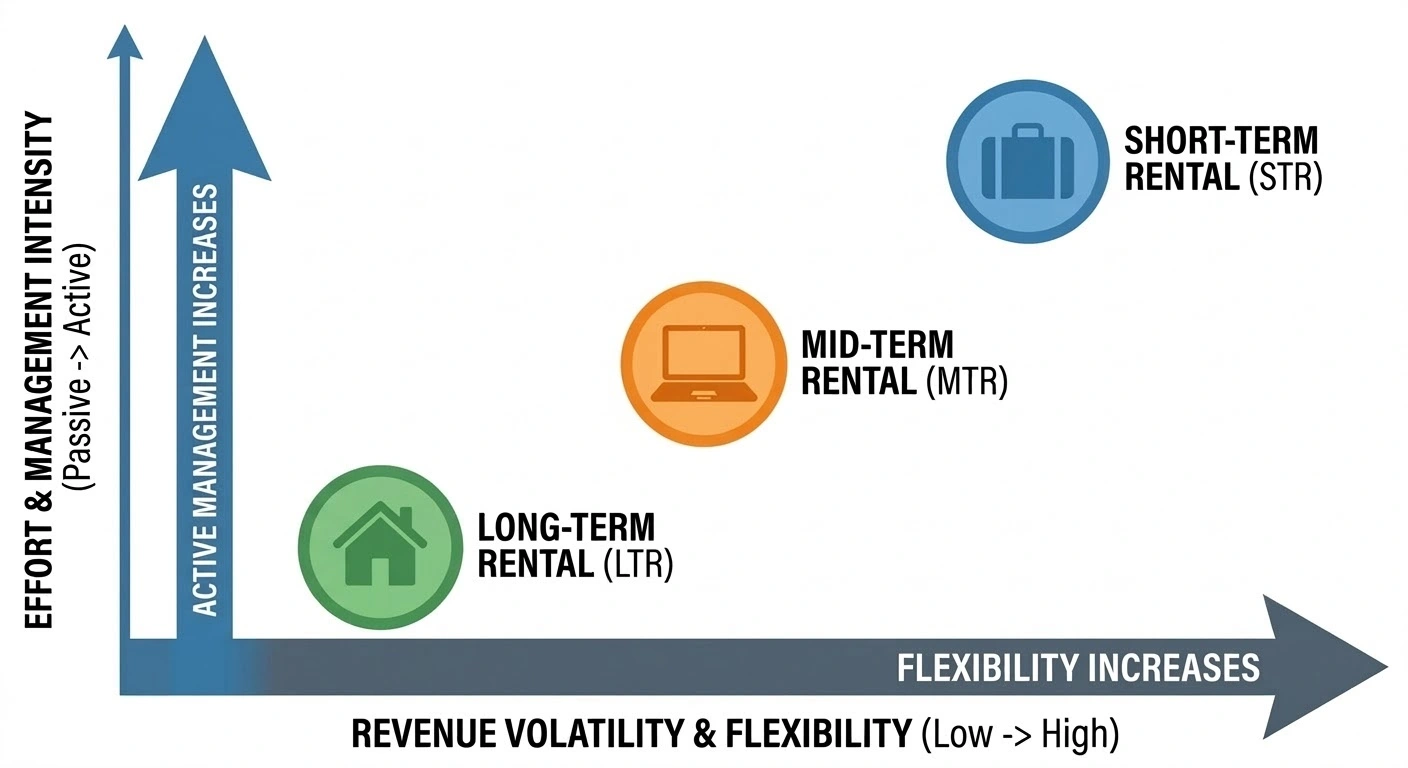
Choosing a rental strategy isn’t just about short term vs long term rental properties anymore. A third option has entered the chat: the mid term rental property.
A mid term rental (also known as a monthly rental) is one that is rented out for 1 month or more, up to 6 months and sometimes closer to 12. It is the middle ground between short term and long term rentals and is usually occupied by traveling nurses and other healthcare officials, people on business or long holidays, digital nomads, or people relocating.
Because of the unique tenants it attracts, a mid term rental finds success in very specific locations:
- University/college towns
- Neighborhoods in close proximity to hospitals
- Cities considered to be bustling corporate centers (ex. Austin, Seattle, Chicago, Dallas)
- Cities that attract digital nomads (ex. Denver, Portland, New York City, Miami)
- Military bases
Because they fall somewhere in between short term and long term rentals, they generally escape the complicated regulations markets have on Airbnbs and short term stays. And while Average Daily Rates for short term rentals are typically higher, mid term rental data shows that they enjoy higher occupancy rates. This along with the lower turnover costs and cleaning fees can mean overall higher profits in the same real estate market.
When compared to long term rental properties, mid term rentals offer more flexibility and are furnished. As such, tenants are usually willing to pay above market prices ($600 to $800 more) for the temp lease compared to a long term lease.
With a third rental strategy that promises cash flow, real estate investors may need to re-evaluate which option works best in markets where the 3 are viable.
Short Term vs Mid Term vs Long Term: How to Choose Your Rental Strategy
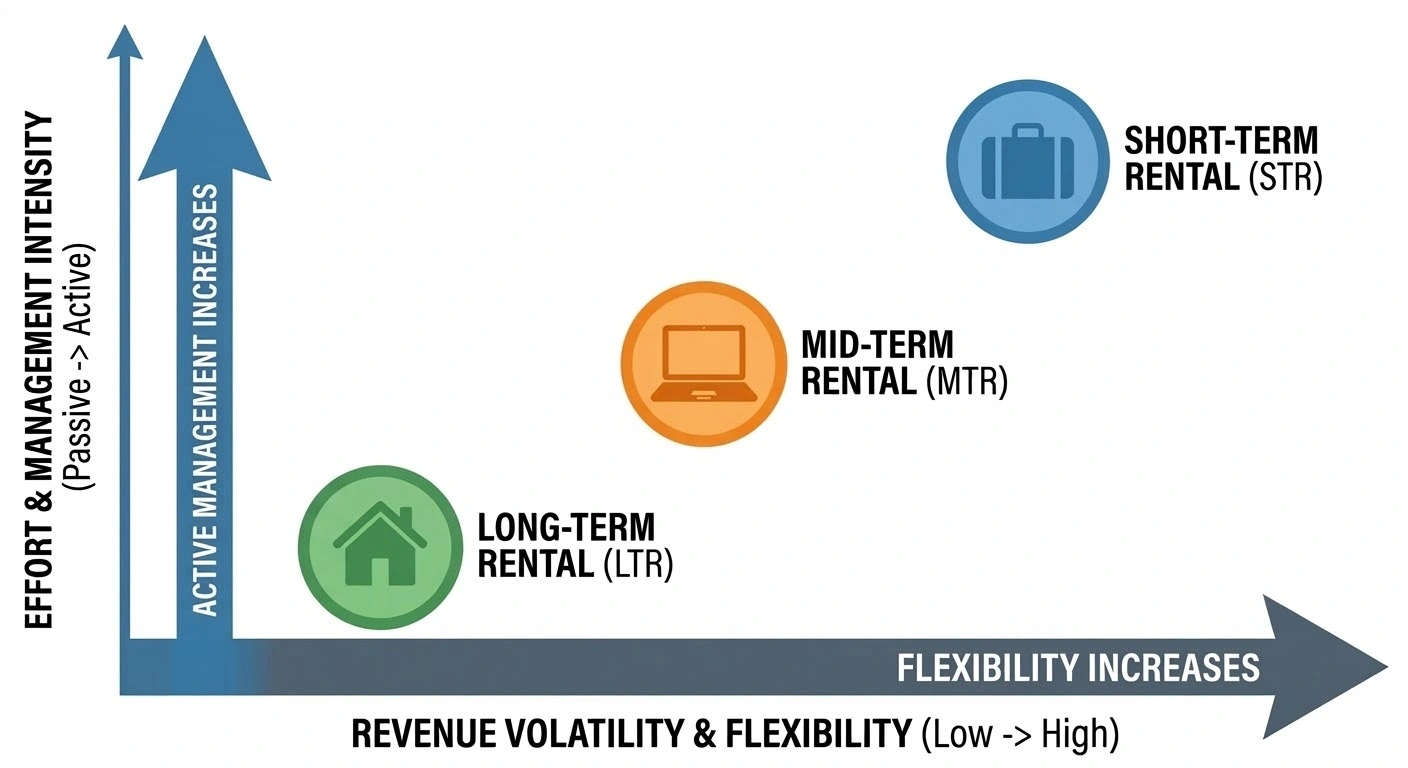
As we’ve discussed, location and risk tolerance are a big part of making this choice. But at the end of the day, choose the rental strategy that is going to provide the highest cash flow and return on investment. Using reliable market data, including Airbnb occupancy rates, long-term rent estimates, and historical performance trends, helps investors determine which strategy is actually profitable before buying.
Check out Mashvisor’s real estate investment tools to help you decide. Our platform is backed by short term and long term rental data to help you immediately see which will perform the best for any listing. As for mid term rentals, using supplemental data along with our tools will help you calculate future earnings.
Sign up today and quickly find out which is the right rental strategy for you.
7.The Next Move
For some real estate investors, 2026 will be the year to re-evaluate their current rental properties altogether. Perhaps your once successful short term rental is now in an oversaturated market and your profit margins have shrunk significantly. Or new regulations have made it impossible to legally run this kind of real estate business.
If you’ve reviewed the situation and decide to exit the short term rental market, you have to figure out your next move: convert to a long term rental or sell.
Convert or Sell Your Rental Property?
This may seem like a simple decision, but it requires a close examination of current real estate market trends and your financial situation. Is it the right time to sell or will you be missing out on profits? Can you hold the property while you wait for a sale or will it cost too much and lead to negative cash flow? How are long term rentals performing in that same housing market?
We asked Fairweather of Redfin to guide our readers through this decision:
Mashvisor: When should an investor consider selling a vacation property instead of converting it to a long-term rental?
Fairweather: “An investor should consider selling when the property no longer justifies the complexity and risk of short-term rentals or when the capital could be better used elsewhere.
- Short term versus long term profits: Selling can provide an investor with a short-term, one-time gain from the sale, but holding can provide long run gains from rents. Right now, vacation-home sales are near multi-year lows in many seasonal markets. Investors can hold out for favorable selling conditions, or they can choose to sell sooner if they want—or need cash.
- Regulatory risk: New taxes, permits, or caps on short-term rentals can cut profitability. Cities like Honolulu and New York are prime examples.
Bottom line: Sell if the property no longer provides strong returns, market prices are favorable, or regulations make your STR strategy unprofitable.”
If the real estate market allows for you to successfully convert a short term rental to a long term rental, here are a few tips from Fairweather:
“If converting makes sense, focus on these four things.
- Run the numbers: Use realistic rent and vacancy assumptions for cash flow projections. Account for vacancy, repairs, and relisting.
- Upgrade for tenants: Add durable finishes, reliable systems, and in-unit amenities.
- Vet Tenants: A long term rental is a long term relationship. Verify that your tenant can afford rental payments and a strong credit history.
- Use tax strategies: Consider a 1031 exchange if selling and reinvesting.
Bottom line: Long-term rentals offer predictability over upside. Treat the conversion as a strategic business decision.”
Final Words
Things have changed in both the short term and long term rental market. But one thing remains constant: there are real estate investment opportunities everywhere you look. You just need to be more selective in 2026 and use data to guide your decisions.
If you’re dead set on one strategy over the other, find the right real estate market and property for that strategy. Look to tools like Mashvisor to help you decide.
FAQs
-
Are short-term rentals still profitable in 2026?
Yes, short-term rentals can still be profitable in 2026, but profitability depends on location, regulations, occupancy rates, and operating costs. In tourism-driven markets with strong demand, Airbnb rentals may generate higher income than traditional leases. However, investors must carefully analyze local laws and competition before investing.
-
Which is more profitable: short-term or long-term rentals?
Short-term rentals often generate higher revenue per night, but long-term rentals provide more stable monthly income and lower management costs. The most profitable strategy depends on factors such as local tourism demand, rental regulations, property prices, and expected occupancy rates.
-
What is the difference between short-term, mid-term, and long-term rentals?
Short-term rentals are typically rented for a few nights or weeks through platforms like Airbnb. Mid-term rentals usually last 1–6 months and are popular with traveling professionals or digital nomads. Long-term rentals are traditional leases lasting 6–12 months or more, providing stable income for landlords.
-
Is Airbnb better than renting long-term?
Airbnb can generate higher income in high-demand markets, especially tourist destinations. However, it also requires more active management, higher operating costs, and compliance with local regulations. Long-term rentals tend to offer predictable cash flow and fewer day-to-day management responsibilities.
-
How do investors choose the best rental strategy?
Investors compare projected rental income, occupancy rates, operating costs, and local regulations before choosing a rental strategy. Analyzing historical rental data and market trends helps determine whether a property performs better as a short-term or long-term rental.