



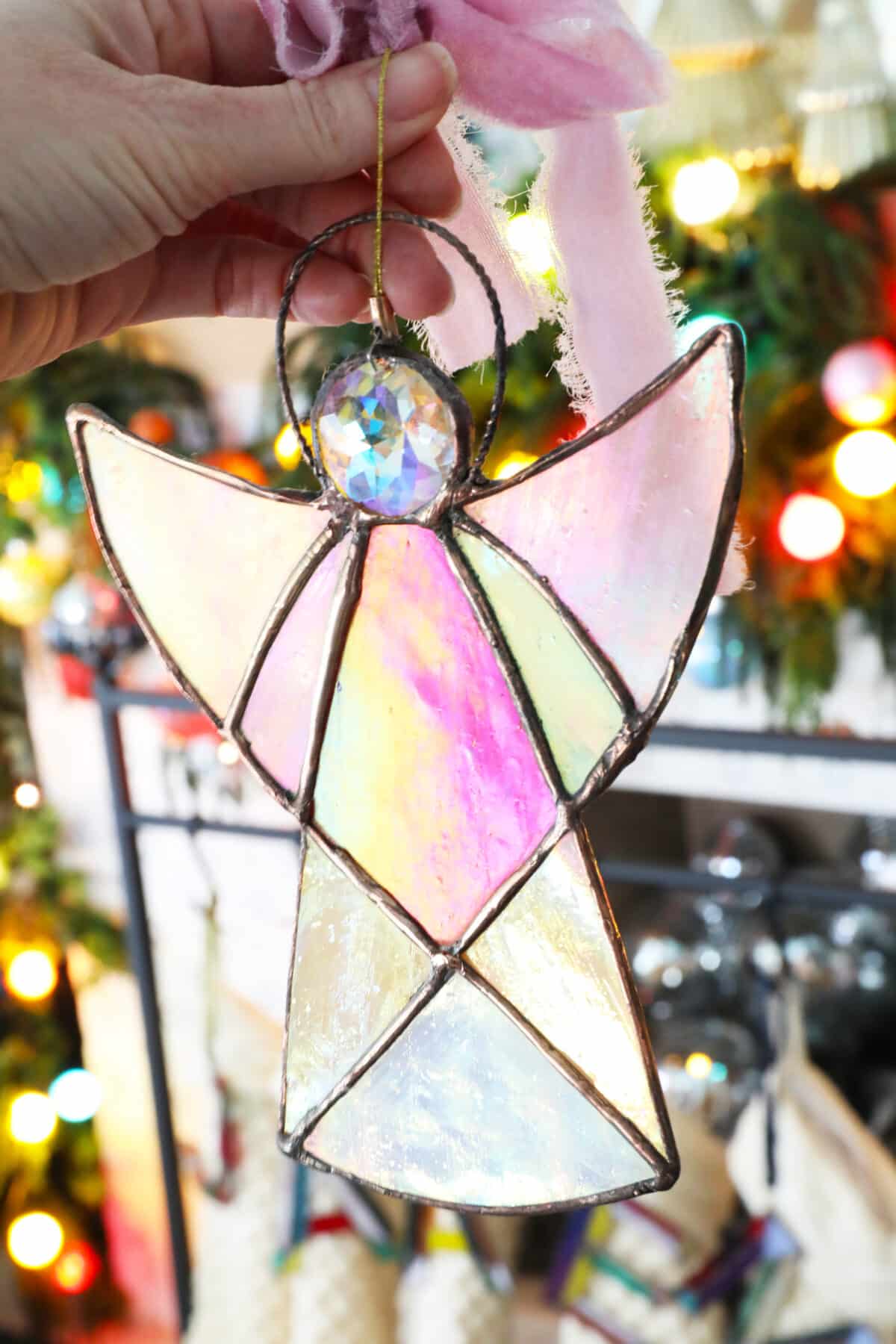
I don’t know what it is about Christmas, but for me it’s the perfect time to create ornaments as gifts for stained glass. And of course, I decided to tackle these. I’m thrilled to be back today with another stained-glass project: stained-glass angel ornaments {and a free pattern!}

Photos really don’t do these beauties justice, because they were a little hard to capture. The curved bottoms made it impossible to sit anywhere, so they definitely need to hang. It was a whole thing. But I’ll shut it and show you because I’m just happy to share this fun idea today!

I may have slightly overcommitted when I decided to take on eight of these, when I’d never made them before. I always tend to add people to the list, and then regret it later when I’m on like, number four. Though there was a big learning curve with each one, it was fun to mix up all the colors and variations. I’m glad to be done after I hit my little debacle… which I’ll share more on below and may help you with making yours. PS. It’s wild how the sunlight hits that one below! I’m obsessed with the sparkle.

But first, a history
{You’ll want to refer back to some of these if you’re just getting your toes wet in the world of stained glass. I highly recommend familiarizing yourself with the entire process so that you know what I’m talking about below. This post will merely serve as an outline form, while the in-depth process can be found in links. I’ve covered them thoroughly in the past, so I’ll be hitting the points briefly in this actual post with the needed links for further reading:

• Check out all the supplies I listed + a little take on getting started, here.
• We covered the basics of stained glass, here.
It’s pretty in-depth with good videos referenced as well, so be sure to check it out.


More projects to check out:


Pattern: So it all started when I decided to draw out a simple, slightly modern pattern. And I cleaned it up, so that you can have your own free version here. Just click + download.

What you’ll need:
• Check out all the supplies + a little take on getting started, here.
Again, linking to this because this is a true stained glass project. It definitely helps to have the intended supplies and I’m pretty thorough with everything here.
• When I list the steps, be sure to check out the basics of stained glass, here.
This is complete with videos and more as a reference to help get you started.
Before we start, please review all safety points here. I think this article covers everything to consider for your safety and stained glass. I also added a fume extractor {seen below} so check that out here.

Specifically for this project, I’ve switched to Tillery Glass Tools.
When they reached out and asked if I’d like to try their tools, I said of course! I had no idea what I was missing out on.
They’re available on Amazon, and be sure to check out their website here!

• Select the glass that you’ll want from this project. I have a plethora left over from that massive door project, so you may recognize a lot of the colors, with a few scraps, too.
Other than the new + improved tools, along with my usual list above {if you’re new to all this} I used:
• this glass – mixed in with all my other pieces I already had
• 3/16 tape – this one is smaller than my usual, since I wanted a more delicate look with the lines.
• Copper reinforcing strip
• This wire for their halos.
• This crystal – but you can also use your own glass for the heads.

• Print and laminate your pattern- this one is small enough to do at home – for larger projects, I run to FedEx. This one prints at 5.5″ x 6.5″
• Tracing – There are three ways to trace your pattern: You can see more of that process in detail, here.
1. Transparency film + sharpie + glue stick – Lay your transparency over your shape, trace + cut. Then lay it over your glass, and repeat to achieve the same shape.
2. You can also just lay your glass on top of the pattern, trace, and cut. Depending on how well you can see through the glass, is what I used
3. The Cricut method: I load the same pattern into my Cricut and cut it on vinyl. –This only works with smaller projects, but once you get the hang of it, it is a nice time saver. Check it out in more detail with this star ornament post, here.

• Cutting + Grinding – Again, I definitely outlined it in more detail, here.
Whichever way you choose, make sure you get that shape as tight as possible. Simply cut and grind it down, fitting each shape into place as you go. As always, when grinding, use protective eyewear, and I’d recommend a mask, too.

This pattern was geometric but also organic. So, I secured each edge with tacks as I went. there was a little adjusting as I went, too. You’ll see more on that below.

Here you can see where I used the vinyl to cut. More work up front when you’re creating the template, but well worth your time too. If you’d like the cricut method, here’s the pattern in cricut.

I usually recommend labeling your pieces as you go. Iridescent glass is a bit of a different beast, and some people hate it for that, as it’s harder to clean and tends to chip easily. I’m a sucker for color, so it won this round. Just don’t write on your glass, but keep up with where the pieces go instead. You’ll thank me later. This took forever to come off.


• Foiling + Burnishing
Once all your pieces are fitting oh-so-perfectly, {It’s okay if they’re not perfect, especially if this is your first time} it’s time to foil and burnish. I’ve always used a table foiler, but I’ve decided they might be more trouble than they’re worth.

Again, you can find all of that outlined as thoroughly as possible, here. Be sure to read up on this post. I tend to clean up and grind each piece again, so that there are no shiny edges. It helps get that fit just right. I was delightfully surprised when I didn’t have any leak-through to the other side during the soldering process.


Once I was finished foiling and burnishing, it was time to solder. But I’ve added an additional step below, since I did hit a bump in the road here. It slowed me down for a few days while I troubleshot and waited for my supplies.
• Soldering
Again, I’ve outlined it all here.
{Please follow all safety precautions from open windows to ventilation systems here.}
Here’s my little fume extractor. I had the windows up {and it was freezing} but that with the filter definitely helps keep fumes out of the way.

On my first ornament, I soldered it all, then I was ready to attach the head. But to no avail. It was definitely a weak link. The head was not meant to support all this weight on its own, and as it turns out, the wings were hinge points.

What’s a hinge point you may ask? Any large part of a design that could snap right off without a little reinforcement. So I called in the experts. I’ve recommended some facebook groups in the past, but this one is one of my faves. I posted a photo and asked for advice. Within five minutes, my problem was solved. I didn’t like their answer, because it added a good bit of work… but they were right.
 So I must say, with each piece, this had a major learning curve.


After tacking my design back down, I pulled out the reinforcement strip. You can snip it down to size, as it is slightly wider than my glass, but I left it as is since I’d never worked with it before. I worked it into the seams and around the piece, including my head.

And pushed it into the design, right past the hand.

Then I moved forward with my soldering, but tacking it as I went… before getting thorough as I usually would. This required a lot of extra finagling, but was worth it in the end.
 Here’s another in-progress shot.


And I’ve mentioned it before, but these trivets with divets are definitely helpful when soldering, to help eliminate waste and get rid of excess without the splash.

So, it took a moment but we were rocking and rolling again.


One more time for the people in the back.

Here’s the usual shape all burnished and ready to go.


Here’s the re-strip being added around the shape, and I tacked it down as I went.


Different colors, same thing. It helped to snip it before it was bent, to wedge it carefully as I went, and tack it down securely. I even used my grozer pliers to help get the sharp crimps around the head before they changed direction. These ornaments are far from perfect, and it was a good learning experience. But I am overall happy with how they turned out. Then solder, as usual.
It’s starting to take shape!
Once I get my initial layer down, I go back over it with my soldering iron to get those lines as pretty as possible. I still need help with the “perfect” part of it, but I was pleased with my first go at this made-up pattern. I have found that the more I do this, the less hesitant I am to actually just dive in. So let this be an encouragement to you, if you’ve always wanted to try.

For the sides, be sure to carefully brush on your ruby fluid, and gently touch the sides to spread the solder as you go. It will probably have built up on the sides, so you can spread it from there after the ruby fluid is brushed on. Careful not to burn yourself by rotating it as you go.
Always check the temperature of your glass often. On smaller sizes like this, it only takes a moment for it to overheat. Your glass could break. Just know that it happens sometimes.
This is the perfect moment to go ahead and polish + wax that first side of your glass just so that it gives the glass a moment to cool down, and you can get all that flux + excess solder off.
• Clean it up {see more detail here}
Breaking it down, the order just goes like this for each side:
1. Flux + Solder {You’ve already done this}
2. Kwik Clean {rub it on and clean the glass / solder
3. Clarity – It’s a stained glass finishing compound {it really makes everything shine – technically it is wax – oh so satisfying}
Flip it over, and you’re ready to do the second side.

• Patina
• Then you’ll break out your Super Brite {finishes in black, copper + just leaving it silver} – I do find that the patina covers a multitude of sins. My piece is clearly imperfect, and the patina, if you choose to do so, really helps that look.
• I use a combo of Q-tips + paper towels to rub it on, making sure to include all the sides. Remember that magic coloring book you had as a kid that had the clear marker, and when you drew on top, it made things change colors? This is that, for adults.
Then, I added the halo by heating each side and putting on the wire.

I ended up lightly touching it with the iron and adding patina here as well.

Clean + polish again: Kwik Clean + Clarity again. Just rub until it shines.
• Flip {carefully} + repeat the exact steps above from that first side. These final steps {soldering + patina + cleaning} can take a full day with a large window on both sides. I’m sure I’ll speed up over time, but just know it takes some time to finish.
• Just a note on seepage: If you have a few little gaps, you may have areas where seepage of the Solder came through. I have yet to have a piece where I haven’t seen just a little on the other side, peeking through those cracks. I am getting better with each piece, though. Don’t freak. It’s usually easy to manipulate with your soldering iron, cover it up, and then move it back into place as you go. Patience is key.


• A note on splatters: Don’t panic if the soldering gets on your glass. It dries and flecks right off. Just make sure you are aware that the second side {because you’re sealing the air into gaps?} tends to splatter a little. Thus the use of gloves for which you will be grateful. I already mentioned this above and clearly I can’t emphasize it enough.

Tada! You’re done!


Curious about more of our fun, free ideas? Be sure to check them all out here! Have an inspired day!