


The sharper move in this week’s mortgage survey showed up on the shorter loan. The 15-year fixed rate fell 12 basis points to 6.54% in Freddie Mac’s latest weekly reading, a larger decline than the 7-point easing on the 30-year average. If you can handle a higher monthly payment in exchange for paying the loan off sooner, this is the figure to look at first.
Freddie Mac put the new averages out on Wednesday, November 25, 2026, a day early for the Thanksgiving holiday. The 15-year rate had climbed 21 basis points last week, to 6.66%. This 12-point retreat gives back a good share of that spike. It is still far above the 5.51% average from November 26, 2025.
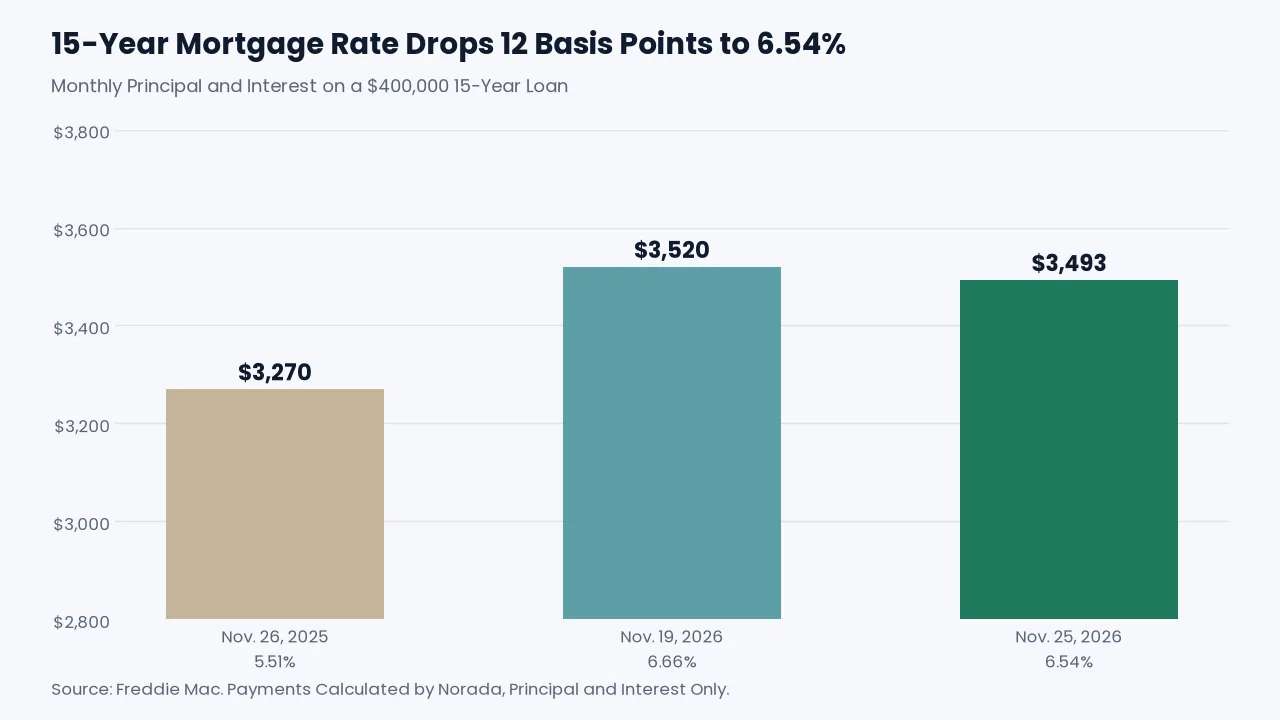
15-Year Mortgage Rate Drops 12 Basis Points to 6.54%
Here is where the two official averages landed. The 15-year fixed-rate mortgage is 6.54%, compared with 6.66% in the November 19 survey. The 30-year fixed-rate mortgage is 7.21%, compared with 7.28% last week and 6.23% a year ago.
The 15-year rate has been jumpy this fall. It peaked at 6.73% on October 8, eased to 6.45% on November 12, then climbed to 6.66% last week before this latest decline.
- October 8: 6.73%
- October 15: 6.71%
- October 22: 6.68%
- October 29: 6.60%
- November 5: 6.57%
- November 12: 6.45%
- November 19: 6.66%
- November 25: 6.54%
A 12-basis-point move is large for a single week in this survey. Most weekly changes this fall have been smaller than that. The shorter loan just took a bigger step down than the more widely quoted 30-year loan.
What a 12-Point Drop Saves on a 15-Year Loan
On a $400,000 15-year fixed loan, counting principal and interest only, 6.54% comes to about $3,493 a month. Last week’s 6.66% came to about $3,520 a month. That is a savings of about $26 a month, or a little more than $300 a year.
On a $500,000 15-year loan, the payment falls to about $4,367 from about $4,400, a savings of about $33 a month. Across the full 15 years, that lower rate saves about $4,800 in combined principal and interest on a $400,000 loan. On a $500,000 loan, the lifetime saving is about $6,000.

How a 15-Year Payment Stacks Up Against a 30-Year Payment
A 15-year loan is cheaper in interest, not cheaper each month. At this week’s averages, a $400,000 30-year loan at 7.21% costs about $2,718 a month. The 15-year loan at 6.54% costs about $3,493 a month, or about $775 more.
The tradeoff is speed and interest. The 15-year loan is paid off in half the time, and the interest bill is much smaller. On that $400,000 example, the 15-year loan’s total interest is about $229,000. The 30-year loan’s total interest is about $578,000. That gap is why some buyers still choose the shorter term, even when the monthly payment is heavier.
The Year-Ago Gap Is Still Wide
A year ago, the 15-year average was 5.51%. That same $400,000 15-year loan would have cost about $3,270 a month. Today’s payment is about $223 higher. On a $500,000 loan, the year-ago gap is about $278 a month.
So the Thanksgiving-week story has two sides. Compared with last week, the shorter loan got cheaper. Compared with last year, it is still expensive. Both facts can be true at the same time, and both should sit in your budget notes.
Who Might Want the 15-Year Loan Right Now
The shorter term can be a good fit if your income can comfortably cover the higher payment and you want the house paid off before retirement, or before kids start college. It can also appeal to buyers who have a solid down payment and do not want to carry a large interest bill for 30 years.
It is a weaker fit if the higher payment would leave you tight each month. In that case, the 30-year loan at 7.21% leaves more room for taxes, insurance, repairs, and savings. You can always make extra principal payments later if your budget allows it. You cannot as easily undo a payment that is too high from day one.
Recent buyers who closed when the 15-year rate was near that 6.73% October peak may also want a fresh quote. A refinance only makes sense if the savings after closing costs are large enough to recoup the fee in a reasonable time.
A simple test helps. Divide the closing costs by the monthly savings. If a refinance costs $4,000 and saves about $26 a month on a $400,000 15-year loan, it would take more than 12 years to break even. On a $500,000 loan, a $33 monthly saving still takes a long time to recoup a typical closing bill. Unless you were quoted a much higher rate recently and the new offer is meaningfully cheaper after fees, refinancing just to chase this 12-point move is usually not worth it.
A Practical Thanksgiving-Weekend Checklist
If you are shopping this weekend or early next week, use the 6.54% average as a starting point, not a guaranteed quote. Ask lenders to price a 15-year loan and a 30-year loan side by side on the same purchase price, down payment, and credit profile.
Then ask two simple questions. First, can you pay the 15-year amount every month without stress? Second, how much interest do you actually save after points and closing costs? If the 15-year payment feels tight, the 30-year loan may be the calmer choice, even though the interest bill is larger over time.
Holiday weeks can be quieter at lenders and title offices, so leave extra time if you hope to lock or close in early December. A good quote still matters more than a rushed one. If a lender cannot explain the fees in plain language, keep shopping.
YES, the 15-year loan is worth a close look if:
- The higher payment still leaves you a healthy cash cushion.
- You plan to stay in the home long enough to benefit from the faster payoff.
- You care more about cutting total interest than keeping the monthly bill as low as possible.
NO, you may want to stick with a 30-year loan, or wait, if:
- The 15-year payment would use up your emergency savings.
- You might move in a few years and would not recoup the higher early payments.
- You are counting on rates to fall a lot more before you can buy at all.
How to Compare Quotes Without Getting Lost
Have each lender quote the same loan amount, term, and points. Write down the interest rate, the monthly principal and interest, and the closing costs. Then add property taxes and insurance so you can see the full monthly bill, not just the loan piece.
The mortgage calculator at the end of this article starts at this week’s 7.21% 30-year average. Change the rate to 6.54% and the term to 15 years if you want to test the shorter loan. Try your actual purchase price and down payment, not just the $400,000 and $500,000 examples used here.
My Take on the 15-Year Drop
I pay the most attention this week to the 15-year loan because it moved more. A 12-basis-point decline is a meaningful weekly change, even if it does not bring the rate back to last year’s level. For the right borrower, it slightly improves the math on a faster payoff.
For most first-time buyers, the 30-year payment will still be the one that fits. That is fine. The shorter loan is a tool, not a test of discipline. Choose the payment you can live with, then decide whether extra principal payments are a better way to speed things up.
The next regular Freddie Mac survey is due Thursday, December 3, 2026. Until then, 6.54% is the official 15-year average, and 7.21% is the official 30-year average. Measure your quotes against those numbers, and let your budget make the final call.
Estimate Your Monthly Mortgage Payment
- Principal & interest$0
- Property tax$0
- Home insurance$0
- PMI$0
- HOA fees$0
$0Loan amount
$0Total interest
$0Total of payments
Yearly amortization schedule
| Year | Principal | Interest | Balance |
|---|
Estimates only. Your actual payment depends on your lender, taxes and insurance. PMI applies only when the down payment is under 20%.