


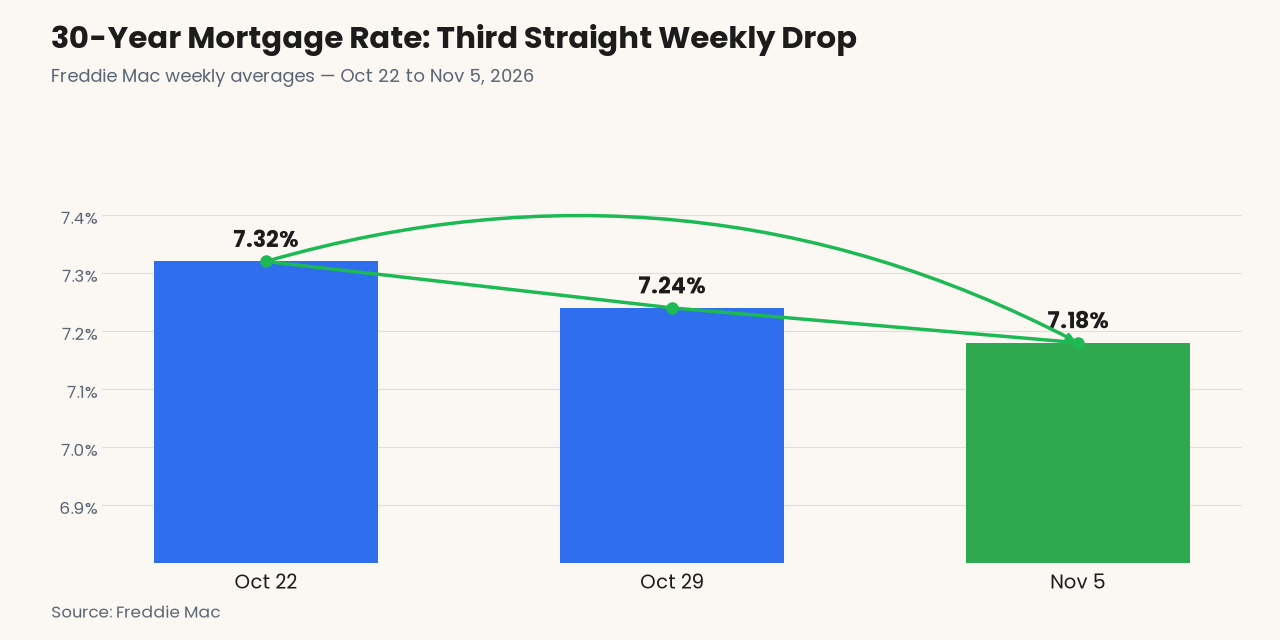
Home shoppers got another break this week. The average 30-year fixed mortgage rate fell again, marking the third consecutive weekly decline, according to Freddie Mac’s Primary Mortgage Market Survey®. The 30-year averaged 7.18%, down from 7.24% last week. That is a six-basis-point drop, and it follows an eight-point drop the week before. In plain words, borrowing costs have been easing for three straight Thursdays.
That streak matters because many buyers spent early fall watching rates climb. Now the path is pointed the other way. The move will not make homes cheap overnight, and payments are still heavier than a year ago. Still, each small step lower trims the monthly bill a little and gives people who were waiting a reason to look again. Freddie Mac’s own note said rates kept moving lower and that helps the environment for prospective buyers even with strong economic growth.
30-Year Fixed Mortgage Rate Drops for the Third Consecutive Week
Freddie Mac released the numbers on Thursday, November 5, 2026. Here is the three-week path for the 30-year fixed rate that buyers keep asking about:
- October 22: 7.32%
- October 29: 7.24%
- November 5: 7.18%
That is a total decline of 14 basis points across three surveys. One basis point equals one one-hundredth of a percent, so 14 points is a real, if modest, cut in the average rate lenders reported to Freddie Mac. The 15-year fixed rate also eased. It averaged 6.57% this week, down three basis points from 6.60% last week.

Source: Freddie Mac.
What Freddie Mac Said About This Week’s Decline
Freddie Mac’s release headline stressed a third straight weekly decline, with the 30-year average at 7.18%. The survey commentary was short and clear: mortgage rates continued their downward trajectory this week, improving the environment for prospective homebuyers against a backdrop of strong economic growth. That is the official take. We are not guessing about why the average moved. We are reading the survey the market uses every Thursday.
For buyers, the useful part is simple. Three weekly drops in a row beat one random dip. Trends give shoppers and loan officers something to plan around. A single soft week can reverse. A three-week slide is harder to shrug off when you are deciding whether to tour homes this weekend.
How Much the Three-Week Drop Can Save on a Payment
Let’s keep the math honest and easy. Picture a $400,000 loan on a 30-year fixed mortgage with no extra fees baked in. At 7.32% (the October 22 average), the principal-and-interest payment is about $2,746 a month. At 7.18% (this week), that payment falls to about $2,710. The difference is roughly $36 per month, or a bit more than $430 a year.
That will not rewrite anyone’s budget by itself. Stacked with a better purchase price or seller credits, though, it starts to feel like real money. On a $500,000 loan, the same rate change saves closer to $45 a month. Your actual quote will differ based on credit score, down payment, points, and the lender you pick. The Freddie Mac figure is a national average of survey rates, not a promise from your local bank.
If you want a quick feel for your own price range, jump down to the mortgage calculator near the end of this post. Plug in 7.18% and see how the payment shifts when you change the loan size.
The 15-Year Fixed Rate Also Softened
The shorter loan did not fall as far, but it still moved the right way. The 15-year fixed averaged 6.57%, down from 6.60%. A year ago it was 5.50%. Buyers who can handle a higher monthly payment sometimes choose the 15-year to cut total interest and build equity faster. The gap between the 30-year and the 15-year this week is 61 basis points (7.18% minus 6.57%). That spread is worth checking with a lender if your income can support the bigger payment.
Most first-time buyers still stick with the 30-year because the payment is lower. That is fine. The point of this week’s survey is not that everyone should switch loan types. It is that both of the main fixed rates eased again.
Why a Third Straight Decline Feels Different From a One-Week Blip
Earlier this fall, rates pushed higher for several weeks. Then October 22 brought the first clear pullback to 7.32%. October 29 followed with 7.24%. Now November 5 lands at 7.18%. Each step was small. Together they form a pattern buyers can see on a chart without squinting.
Loan officers notice streaks too. When the survey falls three times in a row, more shoppers call for pre-approvals. More sellers hear that financing looks a little less scary. That does not guarantee a rush of closed deals next month. It does mean the mood can improve even while prices in many metros stay high.
I like to tell clients to treat weekly rates like a weather report. One cloudy day does not make a season. Three cooler weeks in a row? Pack a light jacket and keep shopping if the house fits your life.
What This Week’s Rate Still Costs Compared With Last Year
Honesty matters here. A year ago, on November 6, 2025, the 30-year averaged 6.22%. Today’s 7.18% is still about 96 basis points higher. On that same $400,000 loan, last year’s rate would have meant a payment near $2,454, roughly $256 less per month than today’s average. So yes, the three-week drop helps. It has not erased the climb from last fall.
Do not let the year-ago gap freeze you if you need a home now. People who must move for work, family, or a lease ending cannot wait for a perfect number. Date the rate and marry the house, as the saying goes: buy the home that works, then refinance later if rates fall further and the math still makes sense after fees.
Who Benefits Most From This Three-Week Slide
- First-time buyers on a tight payment limit: Even $30–$50 a month can keep a condo or townhome inside the lender’s debt-to-income cap.
- Move-up buyers waiting for a lock: A softer average can help when you are selling one home and buying another on a short timeline.
- Investors running rental numbers: Cash flow models improve a little when the purchase rate edges down, though rents and taxes still drive the deal.
- Shoppers who paused in early October: If you stepped back when the average sat near 7.40%, this week’s 7.18% is a friendlier re-entry point.
Who should still wait? Anyone stretching every dollar to qualify, or anyone who plans to move again in under five years and cannot absorb closing costs twice. High rates punish short holds more than long stays.
Practical Next Steps If You Are Shopping This Month
Get fresh quotes from at least two or three lenders. The Freddie Mac average is a guide, not your personal rate. Ask each lender to price the same loan amount, credit profile, and lock period so you can compare apples to apples. Check whether paying one point upfront lowers the rate enough to break even during the time you expect to keep the loan.
Also watch local inventory. A slightly better rate helps more when you have choices and can negotiate. In markets with many listings, sellers may offer credits that buy the rate down for the first years. In tight markets, the rate drop alone may not change how competitive offers feel.
Finally, keep your paperwork ready. Pay stubs, tax returns, and bank statements still win the race when a good house appears. A three-week rate decline means little if your file is not ready to move.
My Take on the Streak
Three weekly drops are welcome news. I would rather see buyers facing 7.18% than 7.40%. I would also rather they remember that 6.22% from a year ago is the longer shadow in the room. Use this week’s relief without pretending the market suddenly turned cheap. Tour homes you can afford at today’s quotes. Run the payment at 7.18% and at a slightly higher stress rate, say 7.50%, so a reverse week does not shock you. If the house still works under both, you are thinking clearly.
The survey will update again next Thursday. Until then, this is the official scoreboard: the 30-year is at 7.18%, the 15-year is at 6.57%, and the three-week streak is real. That is enough reason for serious buyers to stay in the game.
Estimate Your Monthly Mortgage Payment
Estimates only. Your actual payment depends on your lender, taxes and insurance.
Estimated Monthly Payment
$0
- Principal & Interest$0
- Property Tax$0
- Home Insurance$0
- PMI$0
- HOA$0
$0Loan Amount
$0Total Interest
$0Total Cost of Loan
Read More:
Explore these related articles for even more insights: