



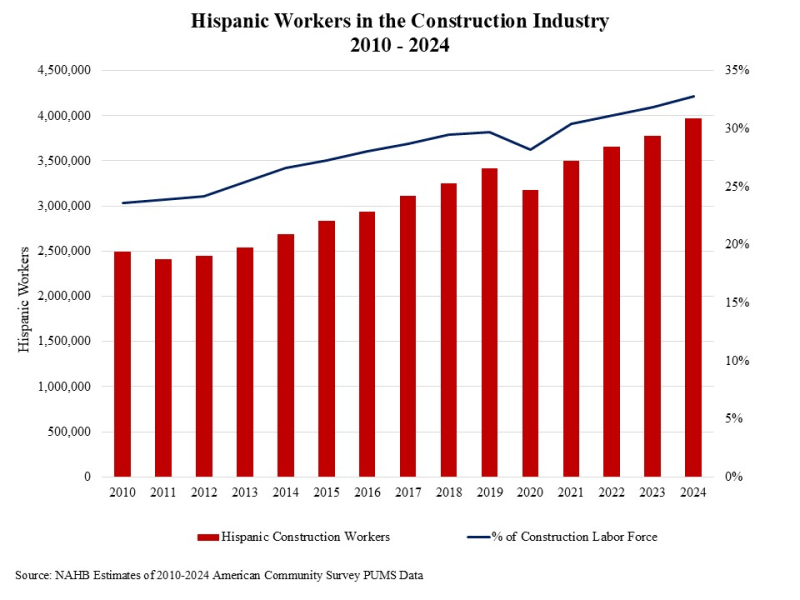
Diversifying the construction labor force remains a key priority amid persistent skilled labor shortages. According to NAHB analysis of the 2024 American Community Survey, non-Hispanic White workers account for the majority of the construction industry at 55.8%. Hispanic workers now represent nearly one-third of the labor force at 32.8%, followed by non-Hispanic Black workers at 5% and non-Hispanic Asian workers at 1.8 %.
One of the most notable trends in the construction labor force has been the steady rise of Hispanic participation. Between 2010 and 2024, the number of Hispanic workers in construction increased from 2.5 million to nearly 4 million. Over the same period, their share of the labor force climbed from 23.6% to 32.8%, meaning that nearly one in three construction workers today is Hispanic.

Hispanic workers comprise a larger share in the construction industry than in the overall U.S. workforce. In 2024, Hispanics accounted for 32.8% of the construction labor force, compared with 19.9% across all industries. Non-Hispanic White workers made up 56.7% of the construction labor force, similar to their share across all industries at 55.8%. Black and Asian workers, by contrast, remain underrepresented in construction.

The share of Hispanic workers varies widely across states. In Vermont, only 3% of workers in construction are Hispanic. While in New Mexico, Texas, and California, more than half the construction labor force are Hispanic. Overall, Hispanic construction workers are generally most concentrated in the South and West where Hispanic populations are larger. Three states alone, Texas with 812,000 workers, California with 780,000, and Florida with 426,000, employ 51% of the nation’s Hispanic construction labor force. New Mexico has the highest Hispanic share of its construction workforce, at 65.6%, followed by Texas at 61.3% and California at 59.7%.
Other racial and ethnic groups also show great variations across states. In the Northeast, the construction industry remains dominated by non-Hispanic White workers. In New Hampshire, Vermont, and Maine, they account for more than 90% of the labor force. Non-Hispanic Black workers make up only 5% of construction labor force nationwide, compared with nearly 12% across all industries, though their shares are much higher in Mississippi at 21.8%, Louisiana at 15.3%, and Maryland at 14.3%. Non-Hispanic Asian workers account for less than 2% of the construction labor force overall, though they are a significant presence in Hawaii, where they comprise 30% of construction labor force.