


Interest rate predictions for October 2026 all point the same way: the Federal Reserve is expected to leave its benchmark rate alone at 3.75% to 4.00% when it wraps up its meeting on Wednesday, October 28. As of October 20, futures traders put the odds of a pause at about 83%, according to CME FedWatch, with roughly a 17% chance of a quarter-point hike and no real chance of a cut. The catch is what comes after. With inflation at 3.7%, most Fed officials expect one more increase before the year is over, and December is where that risk sits.
So if you were hoping for cheaper loans this fall, keep those hopes modest. If you have money in savings, though, this outlook is pretty friendly to you.
Interest Rate Predictions for October 2026: A Pause Now, With December in Focus
Think of the Fed like a driver who just tapped the brakes and is waiting to see how the car responds. Officials raised rates in September for the first time in three years. Now they want more data before pressing again.
How We Got Here
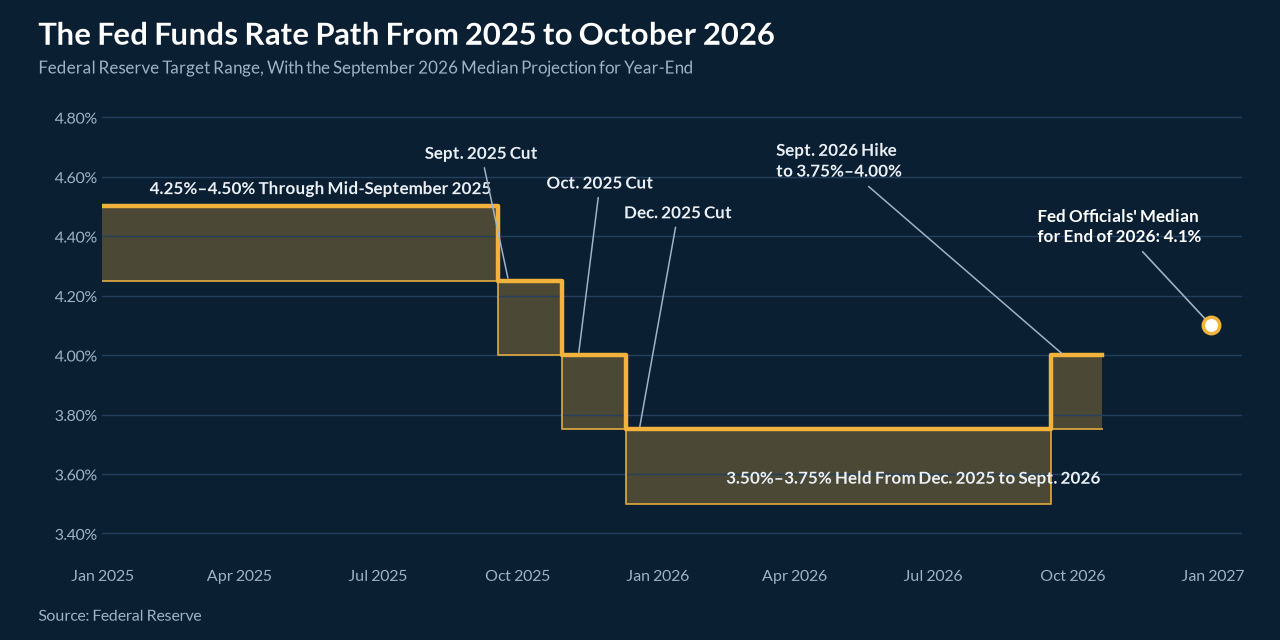
It helps to see the whole road. In late 2025, the Fed was cutting. It lowered its target range three times, in September, October, and December 2025, bringing it down to 3.50% to 3.75%. Then it parked there for most of 2026.
That changed at the September 15–16 meeting. With prices heating up again, the Fed raised its range by a quarter point to 3.75% to 4.00%, effective September 17. The chart below shows that path, plus where Fed officials think the rate will finish this year.

What Traders Expect on October 28
The meeting runs October 27–28, and the decision comes out at 2 p.m. Eastern Time on the 28th. Here’s how the bets stack up as of October 20, based on CME FedWatch:
- Hold at 3.75% to 4.00%: about 83%
- Raise by 0.25 point: about 17%
- Cut: essentially zero
The pause has actually gained support over the past week. Looking further out, the same FedWatch numbers show about a 94% chance that the Fed raises rates at least once more by the end of its December 8–9 meeting. In plain terms, traders aren’t asking “if” anymore. They’re asking “when.”
Inflation Is the Big Reason Rates Aren’t Coming Down
The September inflation report from the Bureau of Labor Statistics explains a lot. Consumer prices rose 0.6% in a single month and 3.7% over the past year. That’s up from 3.4% in August, and it’s far above the Fed’s 2% target.
Gas is the main troublemaker. Gasoline prices jumped 9.1% in September alone and are up 34.2% from a year ago. Energy overall is up 20.4% over 12 months.
Here’s what keeps the Fed patient. Leave out food and energy, and “core” prices rose 2.6% over the year. That’s up from August’s 2.4%, but well below the headline number. Officials want to know if high fuel costs are a passing storm or the start of a wider spread into rents and services. The next inflation report lands on November 10, after the October meeting.
What Fed Leaders Are Saying (and Not Saying)
Fed Chair Kevin Warsh isn’t dropping hints. Speaking in Bangkok on October 16, during the annual IMF and World Bank gathering, he said simply, “I don’t prejudge meetings,” according to Reuters. He added that he won’t say ahead of time what he might do at the two meetings left this year.
He did remind people that the Fed “removed a dose of accommodation about a month ago,” which is a polite way of describing the September hike.
The official record is more revealing. Minutes from the September meeting, released October 7, show that most officials think one more rate increase “would likely be appropriate by year end.” Several of them also described the current rate as “not restrictive or only mildly restrictive.” Put simply, a good number of them don’t think rates are high enough yet to cool prices.
The Fed’s own September projections back that up. The median official expects the federal funds rate to end 2026 at 4.1%, up from 3.8% in the June projections. That number lines up with one more quarter-point hike, to a range of 4.00% to 4.25%.
What It Means for Mortgage Rates
Here’s a key point many buyers miss. The Fed doesn’t set your mortgage rate. Mortgage rates follow the bond market, especially the 10-year Treasury yield, and that yield reacts to inflation and to where investors think the Fed is headed over the next few years.
Right now, that bond market is already braced for higher rates. The 10-year Treasury yield closed at 5.15% on October 19, according to the U.S. Treasury. Freddie Mac’s weekly survey showed the average 30-year fixed mortgage at 7.40% for the week of October 15, with the 15-year at 6.71%. A year ago, the 30-year averaged 6.27%.
Because a pause is already expected, a hold on October 28 probably won’t drop mortgage rates. What could move them is the tone. If Warsh sounds calm about inflation, rates could ease a little. If he sounds worried, they could tick up even without a hike.
Let’s put real dollars on it. On a $350,000 loan, a 30-year fixed at 7.40% costs about $2,423 a month in principal and interest. If rates rose a quarter point to 7.65%, that payment becomes about $2,483. That’s around $60 more each month, or about $720 a year. Compared with last year’s 6.27%, today’s buyer is already paying about $264 more every month on the same loan.
What It Means for Savers and Borrowers
Higher rates are a mixed bag, so here’s a quick breakdown.
Good News for Savers
If you keep cash in a high-yield savings account, money market fund, CD, or Treasury bills, a Fed on hold or hiking works in your favor. Yields on these tend to follow the Fed’s rate. The 3-month Treasury bill yielded 4.27% on October 19, above the latest 3.7% inflation rate. So your cash can grow a bit faster than prices for now.
Tougher Times for Borrowers
Credit cards, home equity lines of credit, and many personal loans are tied to the prime rate, which moves with the Fed. Those rates won’t fall while the Fed is holding, and they’d rise quickly after a December hike. If you carry a card balance, paying it down now is one of the smartest moves you can make. If you have a HELOC with a variable rate, plan for your payment to stay the same or go up.
My Prediction: Hold, Hike, or Cut?
Here’s how I see the odds playing out, based on the data above:
- Hold in October (very likely): I think the Fed stays at 3.75% to 4.00% on October 28. Officials want to see more data, and the chair has given no sign of a surprise.
- Hike in October (unlikely): A surprise is possible, but it would take a real shock in the next few days. I’d put it close to what the market says, under 1 in 5.
- Cut in October (almost no chance): With inflation at 3.7% and rising, a cut isn’t on the table.
The Rest of 2026
For December, I lean toward one more quarter-point hike, taking the range to 4.00% to 4.25%. That matches both the Fed’s own median projection and what traders are betting on. I don’t expect any rate cuts in 2026.
For mortgages, my best guess is that 30-year rates hover around 7% to 7.5% through the end of the year. Rates could slip if gas prices cool off and the November inflation report looks softer. They could climb if price increases start spreading beyond energy.
What I’d Do Right Now
If you’re buying a home soon, don’t wait for the Fed to bail you out. Compare quotes from several lenders, ask about a rate lock that covers your closing date, and keep your credit clean. Savers can enjoy the higher yields while they last. And if you’re carrying debt, chip away at it before December.
Rates go up and down over time, and no one rings a bell at the top. Make the choice that fits your budget and your plans today. If rates come down later, you can always revisit your options then.
Want to Know More?
Explore these related articles for even more insights: