

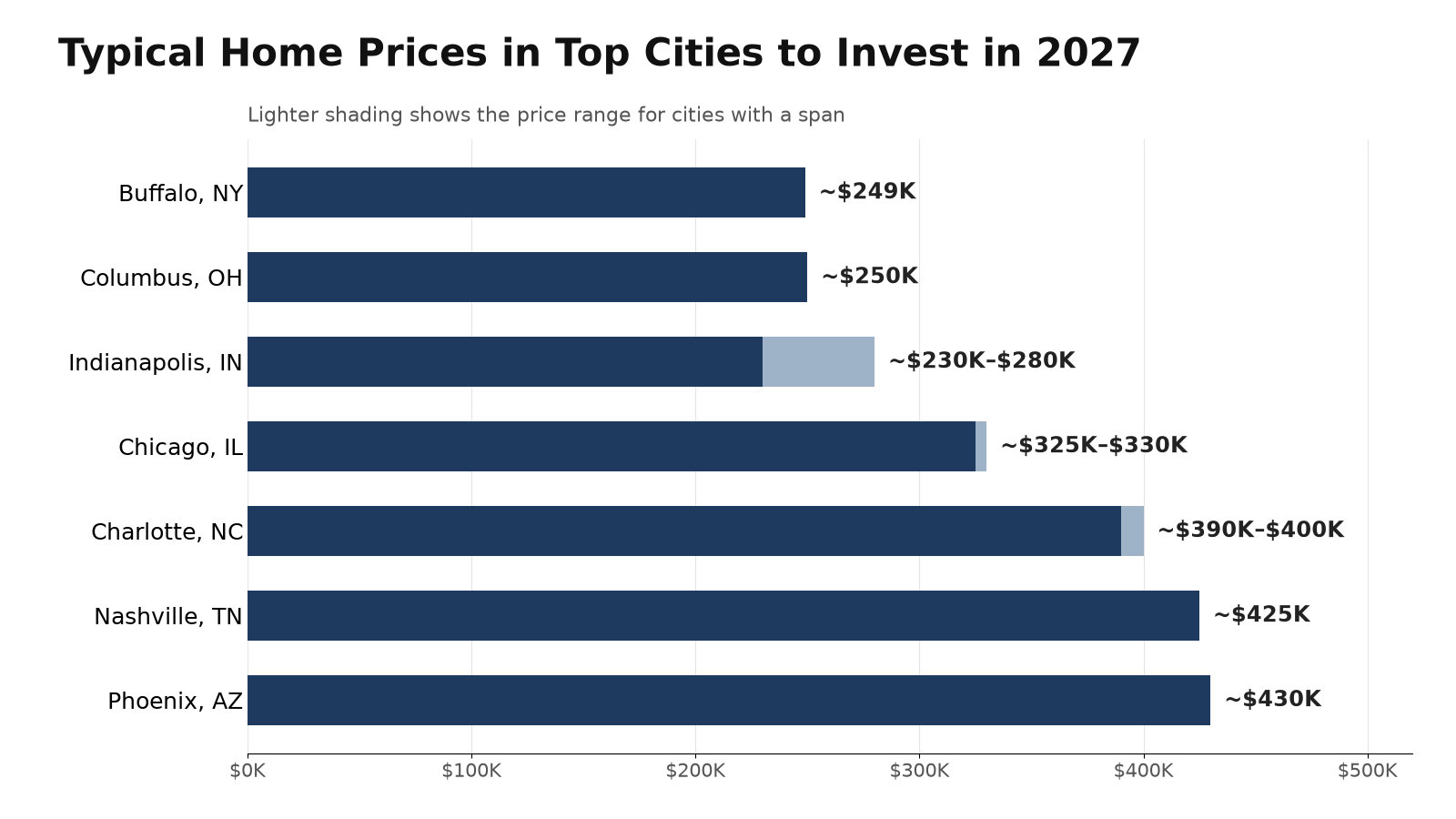
The best cities to invest in real estate in 2027 are Dallas-Fort Worth, Houston, and Indianapolis, offering the best mix of job growth, steady rent, and property value. If you want high rent checks right away, the Midwest is your top pick. If you want your property to grow in value over time, the South is the clear winner.
I have spent years buying rental houses and tracking market trends. The wild home-buying rush from a few years ago is gone. We are now in a market where you must be careful and pick your spots wisely. Mortgage rates sit between 6.5% and 7%, and national home values are only creeping up by about 1% to 3% per year.
To make money today, you cannot count on magic price jumps. You need to buy where people are moving and where businesses are hiring. Based on recent real estate surveys from groups like the Urban Land Institute and PwC, here are the top ten cities where your money can work the hardest.
10 Best Cities to Invest in Real Estate in 2027
| City | Typical Home Price | Main Investing Draw |
|---|---|---|
| 1. Dallas-Fort Worth, TX | ~$380,000 – $385,000 | Huge job growth, no state income tax |
| 2. Houston, TX | ~$328,500 | Low land costs, steady energy jobs |
| 3. Indianapolis, IN | ~$230,000 – $280,000 | High rental yields (7%+), low entry cost |
| 4. Columbus, OH | ~$250,000 | New tech factories, college town stability |
| 5. Nashville, TN | ~$425,000 | Thriving music, healthcare, and tourism |
| 6. Jersey City, NJ | Varies (Mid-to-High) | NYC workers looking for cheaper rent |
| 7. Charlotte, NC | ~$390,000 – $400,000 | Giant banking hub, strong population boom |
| 8. Chicago, IL | ~$325,000 – $330,000 | Reliable tenant pool, lower Midwest prices |
| 9. Buffalo, NY | ~$249,000 | Excellent monthly cash flow |
| 10. Phoenix, AZ | ~$430,000 | Microchip plants, strong sunny migration |

1. Dallas-Fort Worth, Texas
Dallas-Fort Worth holds the number one spot on my list for good reason. Major companies keep packing their bags and moving here. Moody’s Analytics expects DFW to lead the entire nation in new jobs over the next five years.
Prices have cooled off just a bit to around $380,000 to $385,000. That gives buyers a much better entry point than we saw two years ago. In my eyes, the lack of a state income tax makes this area a magnet for workers in tech, finance, and healthcare.
- Why it works: Massive job engine.
- Best strategy: Long-term holds for property value growth.
2. Houston, Texas
Houston ranks fifth in national industry surveys, but I rank it second for pure value. You get a huge city with home prices sitting near $328,500.
The city is backed by three giant pillars: the world-famous Texas Medical Center, the energy sector, and a busy shipping port. Houston did not see the wild price drops that hit other southern cities. The rental demand here stays rock-solid year after year.
- Why it works: Diverse economy and cheap land.
- Best strategy: Single-family rental houses and small apartment buildings.
3. Indianapolis, Indiana
If you care most about monthly cash flow, Indianapolis is my favorite market for 2027. Zillow ranked it as a top buyer-friendly city, and the numbers back that up.
You can buy a good rental home here for $230,000 to $280,000. That same home can rent for $1,400 to $1,550 a month. That gives you a gross return of 7% or more, which is hard to find in coastal cities. It also has low property taxes and laws that protect property owners.
- Why it works: Low entry price and high rent compared to home cost.
- Best strategy: Cash-flow rentals.
4. Columbus, Ohio
Columbus is quietly turning into the tech capital of the Midwest. Intel is pouring billions into chip factories here, joining big names like Honda and Ohio State University.
Home prices sit around $250,000, while rents hover near $1,450 to $1,500. Builders have not overbuilt this town, which means there are not too many empty rentals sitting on the market. That keeps rent prices steady and vacancy rates low.
- Why it works: Major corporate projects and a growing young crowd.
- Best strategy: Buy-and-hold near university and tech zones.
5. Nashville, Tennessee
Nashville is not just about country music anymore. Healthcare giants and tech firms have made this city their second home. Young professionals keep moving here in droves.
Prices are higher here, with the median value close to $425,000. But demand for rentals remains very strong. I like urban neighborhoods where people can walk to dinner and work.
- Why it works: Great lifestyle and steady worker migration.
- Best strategy: High-end rentals and multi-family units.
6. Jersey City, New Jersey
Jersey City shot straight up to second place in recent industry reports. Why? Because working from home changed how people live. Workers who go into Manhattan two or three days a week do not want to pay Manhattan rent.
Jersey City sits right across the river. It offers easy train rides into New York City, great views, and newer buildings.
- Why it works: The perfect overflow spot for New York City workers.
- Best strategy: Modern condos and transit-friendly apartments.
7. Charlotte, North Carolina
Charlotte is the second-biggest banking center in the country. It has great weather, green parks, and a booming job scene.
Median prices are balanced at roughly $390,000 to $400,000, with rents running between $1,700 and $2,000. Even when the national market slowed down, Charlotte stayed active. It is an easy market to understand and a safe place to park capital.
- Why it works: High-paying finance and tech jobs.
- Best strategy: Suburban family homes.

8. Chicago, Illinois
Many investors ignore the Windy City, but I think that is a mistake for 2027. While some southern towns built too many apartments, Chicago kept its building slow and steady.
Home values are reasonable at $325,000 to $330,000. You get deep tenant pools, top universities, and world-class train systems. Chicago rents are holding up better than rents in many oversupplied Sun Belt markets.
- Why it works: Deep pool of renters and stable prices.
- Best strategy: Multi-unit properties (2 to 4 units).
9. Buffalo, New York
Buffalo is an under-the-radar goldmine for cash flow. The median price is just $249,000, but average rents sit near $1,550.
Local hospitals and schools drive steady employment. Because builders do not build many new homes here, older homes stay occupied. If you have a smaller budget and want immediate monthly profits, Buffalo belongs on your radar.
- Why it works: Very cheap homes with strong monthly rent.
- Best strategy: Turnkey cash-flow rentals.
10. Phoenix, Arizona
Phoenix wraps up my top ten. It had a rough couple of years as it worked through too many new builds, but 2027 looks bright again.
Giant microchip factories, such as TSMC, are bringing high-paying tech jobs to the valley. People from California continue to move in for the lower costs and sunny weather. Watch out for rising insurance and cooling bills, but the long-term story remains very healthy.
- Why it works: High-tech manufacturing growth.
- Best strategy: Single-family homes in growing suburbs.
My Real Estate Rules for 2027
To win in 2027, you must follow basic math, not hype. Here is my personal checklist before buying any property:
- Know your goal: If you want passive income today, look at Indianapolis or Buffalo. If you want wealth in ten years, choose Dallas or Charlotte.
- Check the build pipeline: Avoid zip codes where builders just put up thousands of new units. High supply pushes your rents down.
- Budget for hidden costs: Always check insurance costs and property taxes. They have climbed fast in the South.
- Plan for a long hold: Real estate is not a get-rich-quick game today. Plan to hold your property for at least five years to let the market work for you.
Want Stronger Returns? Invest Where the Housing Market’s Growing
Turnkey rental properties in fast-growing housing markets offer a powerful way to generate passive income with minimal hassle.
Work with Norada Real Estate to find stable, cash-flowing markets beyond the bubble zones—so you can build wealth without the risks of ultra-competitive areas.
🔥 HOT NEW LISTINGS JUST ADDED! 🔥
Speak to a Norada Investment Counselor today (No Obligation):
(800) 611-3060