

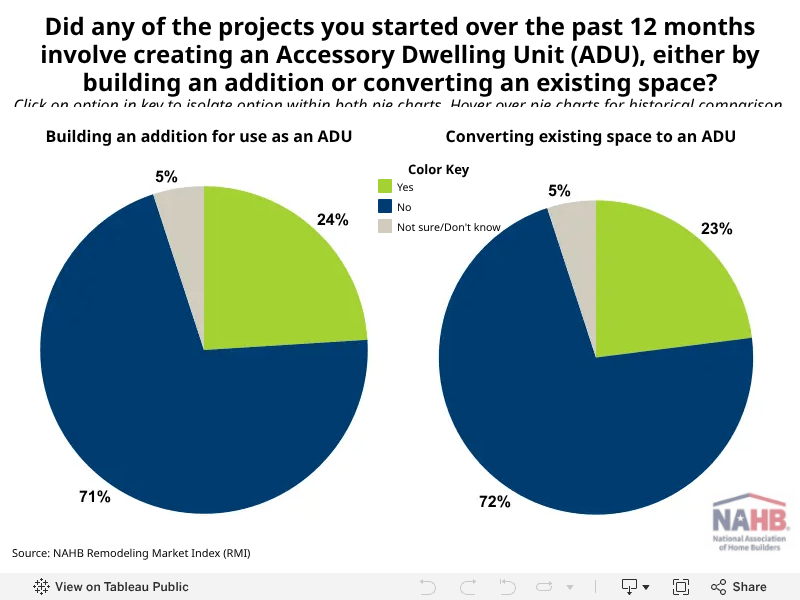
When asked if remodelers started a project involving an Accessory Dwelling Unit (ADU) over the past twelve months, 24% indicated that they were building an addition for use as an ADU and 23% indicated that they were converting an existing space to an ADU, according to NAHB’s Remodeling Market Index (RMI). While the percentage shares for each category rose compared to the last time NAHB asked the question in Q1 2019, a large majority of remodelers still did not start ADUs.

When looking at how each region answered this question, the Northeast was most likely to have remodelers constructing ADUs, with at least one-third indicating both project types (i.e., building an addition and converting existing space), followed by the West with at least 27% of remodelers for both types. Both regions have states with relatively nonrestrictive ADU laws to encourage further production. ADU projects were least likely to occur in the Midwest, with less than 20% of remodelers engaging in this activity.

When asked about the evidence that helped them conclude that these projects involved an ADU, 71% indicated ‘Project involved building a detached structure,’, followed by ‘Renovated area has its own separate entrance’ (67%) and ‘Renovated area has its own kitchen facilities’ (58%). The largest change compared to Q1 2019 was for ‘Project involved building a detached structure,’ which rose 28 percentage points in Q3 2026.

Sixty-two percent of ADU projects cost $150,000 or more, which is more than double the share in Q1 2019 (28%). According to NAHB’s Remodeling Input Price Index (RIPI), input costs for remodelers are up over 51% from Q1 2019 to Q3 2026.