

The Fed interest rate decision today is in, and there’s no hike this time. The Federal Reserve kept its benchmark federal funds rate unchanged at 3.75% to 4.00% on Wednesday, October 28, 2026, after its two-day meeting in Washington. The news came out at 2:00 p.m. Eastern Time, right on schedule.
But don’t read “unchanged” as “relaxed.” Two officials, Fed Governor Lisa Cook and Cleveland Fed President Beth Hammack, voted against the decision because they wanted to raise rates by a quarter point right now. The vote was 10–2. In plain words, the Fed hit pause, but the push for more hikes is still alive inside the room, and December is now the meeting everyone will be watching.
If you have a mortgage, a credit card balance, or plans to buy a home, here’s what the Fed actually said, what changed in its statement, and what it could mean for your monthly payments.
Fed Interest Rate Decision Today: Rates Remain Unchanged at 3.75%–4% as Two Officials Push for a Hike
This hold follows September’s quarter-point hike, the first rate increase in three years. So the Fed is now sitting at the same level it reached six weeks ago. Wall Street saw this coming. Going into the meeting, futures traders put the odds of a hold above 90%, so the decision itself was not a shock. The surprise, if there was one, sits in the details.
What the Fed Said in Its Statement
The Fed’s statement is short, so every word counts. Here are the key lines, taken straight from the official release:
- On the rate: “The Committee decided to maintain the target range for the federal funds rate at 3-3/4 to 4 percent.”
- On the economy: “Economic activity is expanding at a strong pace.”
- On prices: “Inflation remains elevated.”
- On what comes next: “The accumulation of more information will help the Committee determine the policy stance appropriate to ensure a timely return of inflation to the Committee’s 2 percent goal.”
- The closing promise: “The Committee will deliver price stability.”
That last line has been in the statement for months. It’s the Fed’s way of saying, “We’re serious about bringing prices down.” Officials kept it word for word.
Three Changes From the September Statement
When you lay today’s statement next to the one from September 16, three differences jump out.
1. The Economy Got an Upgrade
In September, the Fed said the economy was growing at a “solid” pace. Today it said “strong.” That one-word swap matters. A faster economy gives the Fed more room to keep rates high, or push them higher, without worrying as much about causing a slowdown.
2. The Fed Is Waiting for More Data
September’s statement said that day’s hike “will support a timelier return” to 2% inflation. Today’s version swaps that for a line about gathering “more information” before choosing the right policy. Think of it like a driver who just tapped the brakes and is now watching the road before deciding whether to brake again. It’s a wait-and-see message, not an all-clear.
3. The Vote Split Again
September’s hike passed 12–0. Today’s hold passed 10–2, with both dissenters wanting a hike. Cook’s vote stands out. In July, she voted with the majority to hold rates, according to the Fed’s meeting minutes. Now she wants to move higher. When a member shifts like that, it often hints at where the group may be heading next.
The Fed’s Rate Path at a Glance
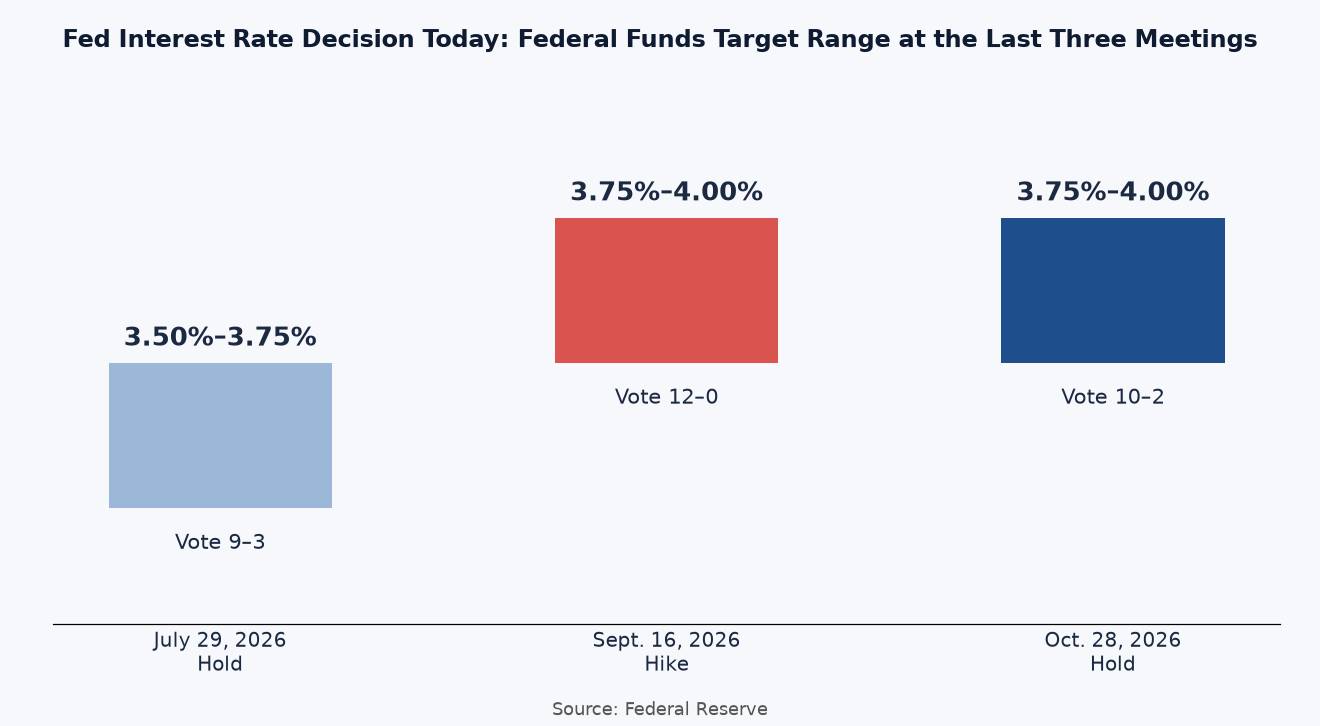
Here’s how the federal funds target range has moved over the Fed’s last three meetings, along with how each vote went.

Notice the pattern. In July, three members wanted a hike and lost. In September, everyone agreed to raise rates. Today, two members wanted another hike. The pressure inside the Fed has pointed in one direction all year: up, not down.
Why the Fed Chose to Wait
Inflation is still well above the Fed’s 2% target. Consumer prices rose 3.7% over the year through September, up from 3.4% in August, according to the Bureau of Labor Statistics. Gasoline prices alone jumped 9.1% that month. So why not hike today?
A few reasons likely played a part:
- September’s hike is still sinking in. Rate changes take months to work through the economy. Moving again just six weeks later can risk overdoing it.
- Hiring has cooled. Employers added only 29,000 jobs in September, and unemployment rose to 4.2%, the BLS reported. That’s a reason to be a bit careful.
- The calendar. The midterm elections are on Tuesday, November 3. The Fed says politics doesn’t drive its choices, but a surprise move days before an election would have drawn a lot of attention.
The statement itself only gives the “more information” reason. The rest is the backdrop the Fed was looking at when it made the call.
Are December Rate Hike Odds Still High?
Before today’s announcement, CME FedWatch showed about a 75% chance of a quarter-point hike at the December 8–9 meeting, up from roughly 42% a month earlier, as reported by Kiplinger. A Reuters poll taken October 16–20 found that all 100 economists surveyed expected a December hike.
Nothing in today’s statement pushes back on that view. The economy got a stronger label, inflation is still called “elevated,” and two voters already want to move. Traders will update their bets after the press conference, so these odds can shift fast in the hours and days ahead. December will also bring the Fed’s new economic projections, including the “dot plot” that shows where each official thinks rates are headed.
What Comes Next: Warsh’s Press Conference
Fed Chair Kevin Warsh is set to hold his press conference at 2:30 p.m. Eastern Time. That’s where reporters will press him on December, the two dissents, and how worried the Fed is about gas prices. Warsh has said in the past that he doesn’t like to give hints ahead of meetings, so don’t be surprised if he keeps his cards close. We’ll update you on what he says once it’s out.
What the Fed Decision Means for Mortgage Rates
Here’s the part most homebuyers care about. The Fed doesn’t set mortgage rates directly. Home loan rates follow the 10-year Treasury yield, which reacts to what investors think the Fed will do over the next few months and years.
Going into the decision, rates were easing a little. According to Zillow, the average 30-year fixed mortgage rate was 7.14% today, and the 15-year fixed was 6.57%. On a $400,000 loan, a 7.14% rate works out to roughly $2,700 a month in principal and interest.
So what happens now? If Warsh sounds firm about December, bond yields could climb and mortgage rates could tick back up. If he sounds patient, rates could drift a bit lower. Either way, a hold usually means small moves, not big ones. For the daily numbers, check our latest mortgage rates update.
What You Can Do Right Now
You can’t control the Fed, but you can control your plan. Here’s a simple checklist:
- If you’re buying soon: Get a few lender quotes this week. If the payment fits your budget, a rate lock before December can protect you from a jump.
- If you’re thinking about refinancing: Know your break-even point. A refinance usually makes sense only if the new rate is low enough to pay back your closing costs in a few years.
- If you have credit card debt: Card rates move almost in lockstep with the Fed. Paying down balances now beats paying more after a possible December hike.
- If you have a HELOC or adjustable loan: Check when your rate resets. A fixed option may give you more peace of mind.
- If you’re a saver: Higher rates help you. Shop around for high-yield savings accounts and CDs.
My Take on Today’s Fed Rate Decision
Today’s hold gives borrowers a short breather, not a turnaround. The Fed called the economy strong, kept calling inflation elevated, and two of its voters wanted to hike. That doesn’t sound like a group getting ready to cut.
My advice is simple: plan as if rates stay high for a while, and treat any dip as a bonus. If the numbers work for your family today, you don’t need to wait for a perfect rate that may not come. And if they don’t work yet, use the next six weeks to build savings and improve your credit, so you’re ready no matter what the Fed does in December.
Read More:
Explore these related articles for even more insights: