



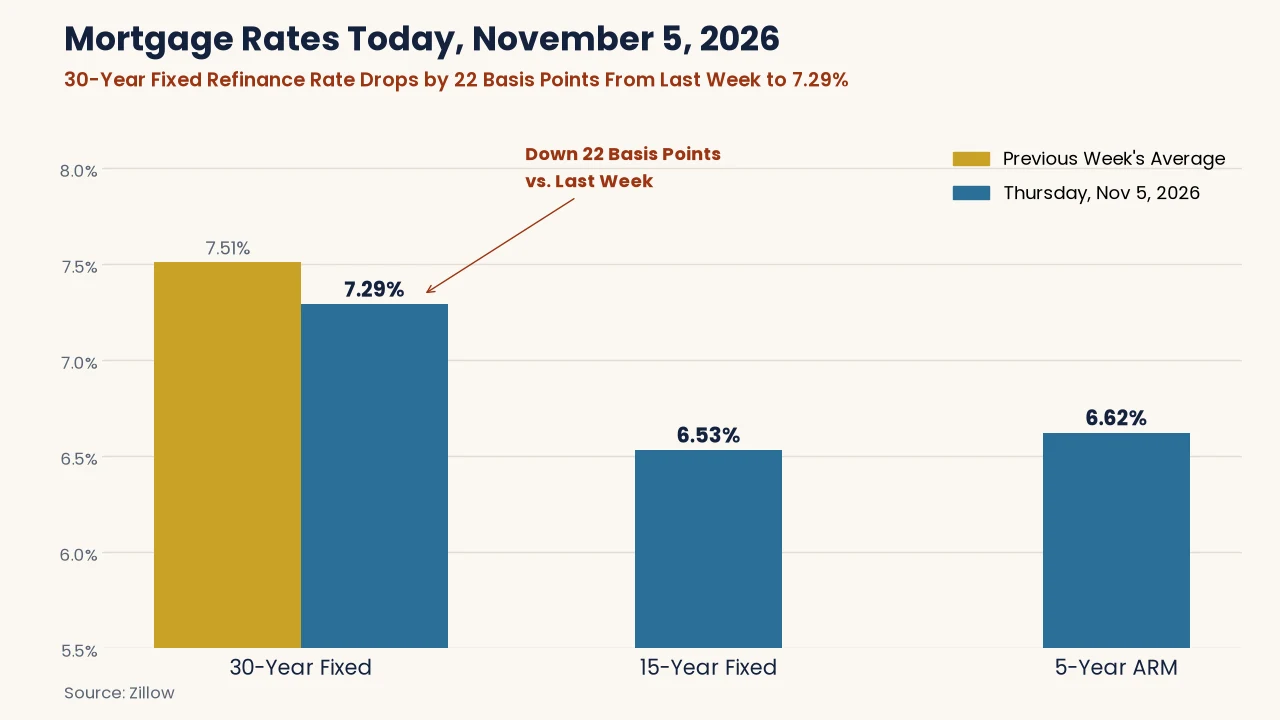
Thursday brought the kind of refinance news homeowners have been waiting for. Zillow reports the national 30-year fixed refinance rate at 7.29% on November 5, 2026. That’s 22 basis points lower than last week’s average of 7.51%, and the rate also fell 13 basis points in a single day, from Wednesday’s 7.42%.
That’s two good signs pointing the same way. Not everything moved lower, though. Zillow shows the 15-year fixed refinance rate rising 11 basis points to 6.53%, while the 5-year ARM held steady at 6.62%. Here’s what Thursday’s numbers mean for your monthly payment and whether now is a good time to make a move.
Mortgage Rates Today, November 5, 2026: 30-Year Refinance Rate Drops by 22 Basis Points From Last Week
Here are Zillow’s national refinance averages for this Thursday:
| Refinance Loan | Zillow Rate, Nov 5 | Change Reported by Zillow |
|---|---|---|
| 30-Year Fixed | 7.29% | Down 13 bps from 7.42%; down 22 bps from last week’s 7.51% |
| 15-Year Fixed | 6.53% | Up 11 bps from 6.42% |
| 5-Year ARM | 6.62% | Equal to 6.62% |
Source: Zillow. Rates as of November 5, 2026.
Three quick takeaways from Thursday’s numbers:
- The 30-year fell on both counts: it’s 13 basis points below Wednesday and 22 basis points below last week’s 7.51% average.
- The 15-year went the other way: a rise of 11 basis points to 6.53% trimmed its edge over the 30-year to 76 basis points.
- The ARM didn’t budge: at 6.62%, it now sits 67 basis points under the 30-year fixed.

Source: Zillow
A Daily Drop and a Weekly Drop at the Same Time
Rates can look confusing when the daily move and the weekly move disagree. Thursday is easier to read. The 30-year slid 13 basis points from Wednesday, and it now sits 22 basis points below where it was a week ago. When both views point down, it’s a clearer sign that the recent trend has been working in borrowers’ favor.
Still, keep it in perspective. A refinance takes weeks from start to finish, and rates can turn around just as quickly as they fell. A good day is a reason to start shopping, not a promise that rates will keep sliding.
What a 22 Basis Point Drop Is Worth in Dollars
Twenty-two basis points equal 0.22%. On a $400,000 refinance with a new 30-year fixed loan, Norada estimates these principal and interest payments:
- At last week’s 7.51% average: about $2,800 a month
- At Wednesday’s 7.42%: about $2,775 a month
- At Thursday’s 7.29%: about $2,740 a month
Compared with last week, that’s about $60 a month saved, or roughly $21,600 over the full 30 years. Even the one-day drop from Wednesday is worth about $35 a month on the same loan.
Your loan size changes the math. On a $250,000 refinance, the weekly drop saves about $38 a month. On a $600,000 loan, it’s closer to $90.
The 15-Year Fixed at 6.53%: Still Worth a Look?
The 15-year fixed lost a little ground on Thursday, but it’s still the cheapest way to pay off a home fast. On a $400,000 refinance at 6.53%, Norada figures a monthly payment of about $3,491. That’s roughly $751 more each month than the 30-year at 7.29%.
Here’s what that extra money buys you. Total interest on the 15-year comes to about $228,400, compared with about $586,200 on the 30-year. That’s a difference of nearly $358,000. If your budget can handle the higher payment without stretching, the 15-year is like putting your mortgage on a fast track to zero.
Curious how 7.29% changes your own payment? Run your loan through the free calculator below in under a minute.
Thursday’s Three Refinance Choices Side by Side
Here’s how the three loans compare on a $400,000 refinance:
| Loan Option | Zillow Rate | Est. Monthly Payment | Est. Balance After 5 Years |
|---|---|---|---|
| 30-Year Fixed | 7.29% | $2,740 | $377,670 |
| 15-Year Fixed | 6.53% | $3,491 | $307,040 |
| 5-Year ARM (30-Year Payoff) | 6.62% | $2,560 | $374,960 |
Norada estimates based on Zillow’s November 5, 2026 refinance rates; principal and interest only, rounded.
After five years, the 15-year borrower owes about $70,600 less than the 30-year borrower. The ARM still has the lowest starting payment, about $180 a month below the 30-year. But its rate is locked only for the first five years and can change every year after that. It works best if you’re fairly confident you’ll sell or refinance before the reset.
Estimate Your Monthly Mortgage Payment
Estimates only. Your actual payment depends on your lender, taxes and insurance.
Estimated Monthly Payment
$0
- Principal & Interest$0
- Property Tax$0
- Home Insurance$0
- PMI$0
- HOA$0
$0Loan Amount
$0Total Interest
$0Total Cost of Loan
Should You Refinance Now? A Quick Gut Check
Start with the rate on your current loan. Then walk through these points.
A refinance may be worth it if:
- Your rate is well above 7.29%. At 8.00%, a $400,000 loan costs about $2,935 a month, roughly $195 more than at Thursday’s average.
- You plan to stay in the home long enough to earn back your closing costs.
- You’d like to trade an adjustable loan for a payment that never changes.
Waiting may make more sense if:
- Your current rate is already below today’s averages.
- There’s a good chance you’ll move within the next two or three years.
To find your break-even point, divide your closing costs by your monthly savings. With $8,000 in costs and $195 in savings, you’d break even in about 41 months. Every month after that is real money staying in your pocket.
What Moves Refinance Rates Up and Down
Refinance rates follow the bond market, and the 10-year Treasury yield is the one to watch. When investors worry about the economy, they tend to buy bonds, and that can pull mortgage rates down. When the economy looks strong or inflation heats up, yields usually rise and mortgage rates follow.
Big reports on jobs and inflation can push rates around in a single morning. The Federal Reserve doesn’t set mortgage rates directly, but its view of the economy shapes how lenders price long-term loans. That’s why a 13 basis point drop in one day can happen, and why no one can promise it will last.
Thinking About a Cash-Out Refinance?
Some homeowners refinance to pull cash out, not to lower their rate. They might want to fix the roof, update a kitchen, or wipe out high-interest credit card debt. A cash-out refinance swaps your current loan for a larger one and gives you the difference.
Just remember that the new rate applies to your whole balance, not only the cash you take out. If your existing loan has a rate well below 7.29%, a cash-out refinance could make all of your debt more expensive. A home equity loan or line of credit may be cheaper in that case, since it leaves your first mortgage alone. Compare the total interest on each option, not just the monthly payment.
Get Ready Before You Call a Lender
A little prep can speed things up. Pull together your two most recent pay stubs, last year’s tax returns, recent bank statements, and your current mortgage statement. Lenders move faster when they have everything up front, which can help you lock in a rate while it’s still low.
When the Loan Estimates come in, ask each lender to walk you through the fees, including appraisal, title, and origination charges. Some of these can be negotiated. Also ask how long your rate lock lasts and what it costs to extend if closing runs late. On a day like Thursday, when rates have just dropped, a solid lock protects you if they bounce back up.
Simple Ways to Get a Better Rate Than Average
- Compare quotes on the same day: rates change daily, so ask at least three lenders for Loan Estimates at once.
- Clean up your credit: paying down card balances can lift your score and lower your rate.
- Check your equity: more equity often means better pricing and fewer fees.
- Be careful with points: buying down your rate only pays off if you keep the loan for many years.
My Take on Thursday’s Refinance Rates
A 7.29% 30-year refinance rate, down 22 basis points from last week, is a welcome change. If you’ve been sitting on a loan at 8% or higher, this is a smart moment to collect a few quotes and do your break-even math. Pull out your current statement, compare offers from the same day, and let the numbers, not the headlines, tell you when to lock.
Read More:
Explore these related articles for even more insights: