



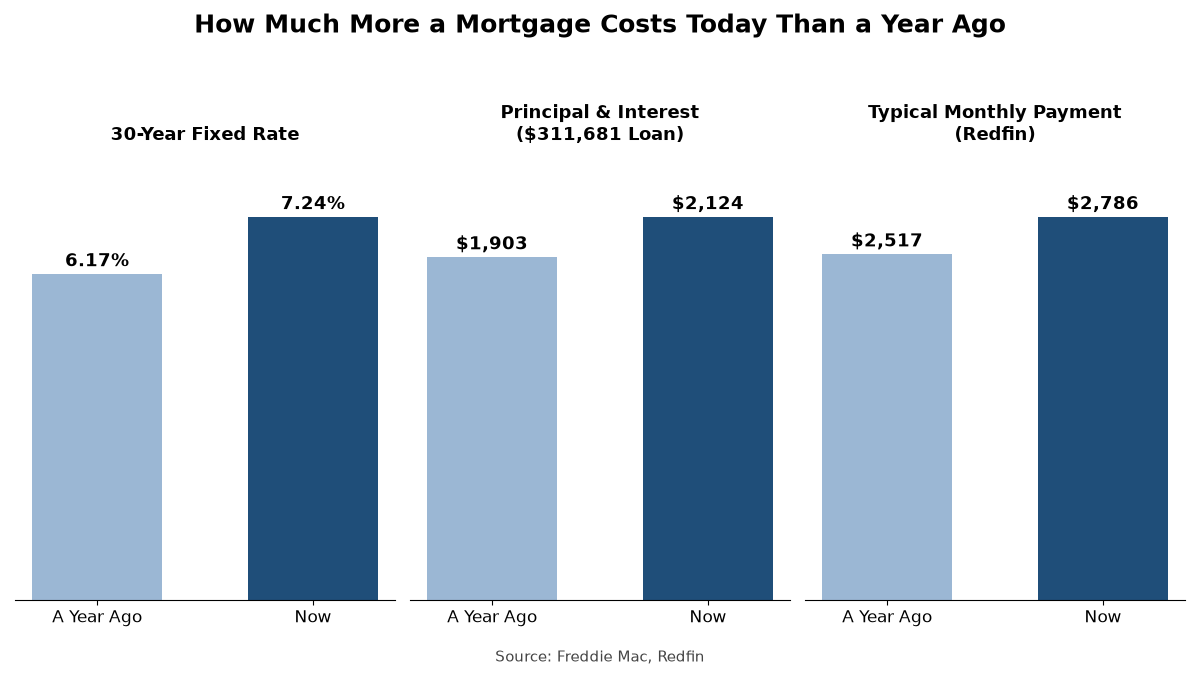
A mortgage costs a new buyer quite a bit more today than it did a year ago. Redfin says the typical monthly mortgage payment hit $2,786 in the four weeks ending October 25, up 10.7% from a year earlier. That works out to roughly $270 more every month, and it happened while the median home-sale price actually slipped 0.1%. In plain words, houses didn’t get pricier. The loan did.
The reason is the mortgage rate. Freddie Mac’s weekly survey puts the 30-year fixed rate at 7.24% as of October 29, 2026, compared with 6.17% at the same time last year. On a typical loan, that gap alone adds about $221 a month to principal and interest. If you already own a home with a fixed-rate loan, relax. Your principal and interest payment hasn’t moved. This story is about people buying now.
How Much More a Mortgage Costs Today Than a Year Ago
Let’s keep it simple and look at the numbers that matter for a buyer shopping this fall. I’m using two sources here: Freddie Mac for rates and Redfin for prices and payments.
The Rate Gap: 6.17% Then, 7.24% Now
Freddie Mac’s Primary Mortgage Market Survey is the go-to weekly reading on mortgage rates. Here is how the latest week compares with a year ago:
- 30-year fixed, a year ago: 6.17%
- 30-year fixed, October 29, 2026: 7.24%
- 15-year fixed, a year ago: 5.41%
- 15-year fixed, October 29, 2026: 6.60%
That’s a jump of 1.07 percentage points on the 30-year loan. It might not sound like much. But a mortgage is a big loan stretched over a long time, so even one point changes the monthly bill in a real way.
There is a little good news inside these numbers. The 30-year rate fell from 7.32% the week before, and Freddie Mac said it was the lowest level of the month. So rates are easing a bit, just from a high starting point.
Want to see what this means for your own price range? Skip down to our payment calculator near the end of this article and plug in your numbers.
The Math on a Typical Home
To show the difference, I took Redfin’s median sale price of $389,601 and assumed a 20% down payment. That leaves a loan of about $311,681. Since prices are almost flat from a year ago, using the same loan for both years is a fair comparison.
| Item | A Year Ago | Now | Change |
|---|---|---|---|
| 30-year fixed rate (Freddie Mac) | 6.17% | 7.24% | +1.07 points |
| Loan amount (80% of $389,601) | $311,681 | $311,681 | $0 |
| Monthly principal and interest | $1,903 | $2,124 | +$221 |
| Extra cost per year | – | – | +$2,655 |
| Extra cost over 30 years | – | – | +$79,636 |
Source: Freddie Mac, Redfin
So a buyer with the very same house and the very same down payment now pays about $221 more each month just for principal and interest. Over a full year, that’s about $2,655. Over the life of the loan, it adds up to almost $80,000 in extra interest if you never refinance.
Redfin’s own measure lands even higher. Its typical monthly payment of $2,786 is up 10.7% from a year ago. Working backward, that puts last year’s figure near $2,517, so the gap is about $269 a month. Redfin’s number is based on a slightly higher weekly rate of 7.32% and its own payment method, which is why it’s a bit bigger than my simple principal-and-interest math. Either way, the message is the same: roughly $220 to $270 more a month.

Source: Freddie Mac, Redfin
What That Extra Money Means for Your Budget
Here’s another way to look at it. Say you could comfortably pay $1,903 a month for principal and interest last year. At today’s 7.24% rate, that same payment only covers a loan of about $279,221. That’s about $32,460 less borrowing power for the exact same monthly budget.
For many first-time buyers, that’s the difference between the house they wanted and the one they settle for. It can also mean a longer search, a smaller home, or a move a few more miles from work.
Keep in mind that principal and interest are only part of the bill. Property taxes, homeowners insurance, and HOA fees come on top. Those vary a lot by state and town, so check them with your lender before you set your budget.
Why Locked-In Owners Feel None of This
If you bought or refinanced with a fixed-rate loan, your principal and interest stays the same for the life of the loan. Today’s 7.24% rate does nothing to it. That’s the beauty of a fixed rate.
Your total payment can still change a little if your escrow costs rise, such as property taxes or insurance. But the loan part is locked. That’s why the “payments are up” headlines mostly describe what new buyers face, not what current owners pay.
Buyers Are Pulling Back
Higher payments are keeping a lot of people on the sidelines. Redfin’s latest report shows a few clear signs:
- Pending sales: 276,352, down 15.9% from a year ago and the lowest level in Redfin’s records going back to 2021.
- All 50 big metros: Pending sales fell year over year in every one of the 50 most populous metro areas for the third week in a row.
- Prices: The median sale price of $389,601 is down 0.1% from a year ago, the first declines in more than three years.
- Time on market: Homes now sit a median of 50 days before going under contract.
In other words, the higher payment is doing what you’d expect. Fewer people can make the numbers work, so fewer contracts are getting signed.
The Silver Lining: More Choices and More Room to Negotiate
Here’s the part buyers don’t hear enough. When demand cools, buyers get more leverage. And the data backs that up.
- More homes for sale: Realtor.com says active inventory rose 8.0% from a year ago in the week ending October 24, the fastest growth since late January.
- Lower asking prices: Realtor.com’s median listing price fell to $414,000, down 1.4% from a year ago. Listing prices have now been lower than the year before for 41 weeks in a row.
- More price cuts: Redfin says 21.5% of listings had a price drop, up from 20.9% a year ago.
- Balanced supply: Redfin puts months of supply at 4.5, up from 4. Four to five months is generally seen as a balanced market.
Redfin also says there are hundreds of thousands more home sellers than buyers nationwide, which gives buyers more negotiating power than they’ve had in over a decade. That’s real. You may be able to ask for a lower price, seller-paid closing costs, or help buying down your rate.
Smart Ways to Shrink the Gap
You can’t control mortgage rates. But you can control a few things that soften the hit:
- Ask for seller concessions. With more price cuts and longer market times, sellers are more open to paying some of your costs. A seller-paid rate buydown can lower your payment for the first years or for the whole loan.
- Shop more than one lender. Rates can differ from lender to lender on the same day. Getting a few quotes is free and can save you real money every month.
- Look at the 15-year loan if you can afford it. Its rate is 6.60%, lower than the 30-year. The monthly bill is higher, but you pay far less interest overall.
- Negotiate the price, not just the rate. A lower price shrinks the loan and the payment for good. You can always try to refinance later if rates fall, but the price you pay is permanent.
- Build in a cushion. Set your budget a little below what the lender approves. Taxes, insurance, and repairs have a way of growing.
So Should You Buy Now or Wait?
Buying now could make sense if you plan to stay at least five to seven years, your job feels steady, and the payment fits your budget without stretching. You also get the upside of more listings and more willing sellers.
Waiting could make sense if the payment would leave you with no savings cushion, you may move soon, or your credit score could improve in the next few months. A better score can lower the rate you’re offered.
Nobody can promise where rates go next. They did ease for a second week in late October. If they keep sliding, today’s buyers may get a chance to refinance. If they don’t, a fixed payment you can live with is still a solid place to be.
My Take
A mortgage costs about $220 to $270 more a month than it did last year, and that’s a real squeeze for new buyers. But the full picture isn’t all bad. Prices have stopped rising, more homes are on the market, and sellers are cutting prices and listening to offers. If you’re buying, run your own numbers, use your leverage, and choose a payment that still lets you sleep at night.
Estimate Your Monthly Mortgage Payment
Estimates only. Your actual payment depends on your lender, taxes and insurance.
Estimated Monthly Payment
$0
- Principal & Interest$0
- Property Tax$0
- Home Insurance$0
- PMI$0
- HOA$0
$0Loan Amount
$0Total Interest
$0Total Cost of Loan
Read More:
Explore these related articles for even more insights: