



Strong labor market growth continued to put pressure on the nation’s housing supply in 2024, as home building activity did not fully keep pace with demand driven by job gains. Comparing net new jobs with prior-year permitting activity helps show whether the pace of housing construction is keeping up with potential household formation and broader economic growth.
This analysis uses net new jobs created in 2024, measured against housing permits issued in 2023, reflecting the typical time required for permitted units to move through the construction pipeline and reach the market.
Using this framework, the U.S. economy added approximately 1.8 million net new jobs in 2024 relative to 2023, while total housing permits issued in 2023 reached 1.51 million units. This results in an overall jobs-to-permits ratio of 1.2, indicating that the economy added 1.2 new jobs for every housing unit authorized.
Recent data suggests a “balanced” ratio of jobs-to-permits has historically fallen between 1.25 and 1.5 jobs per housing permit. However, it is important to note that this ratio is highly dependent on sub-regions and whether the income levels of new jobs match the affordability of the houses being built.
Therefore, this metric is most useful interpreted across metropolitan areas, particularly at the high and low ends of the distribution. High ratios indicate job-heavy areas with a housing deficit and lower ratios suggest that there are more housing units available than new jobs added.
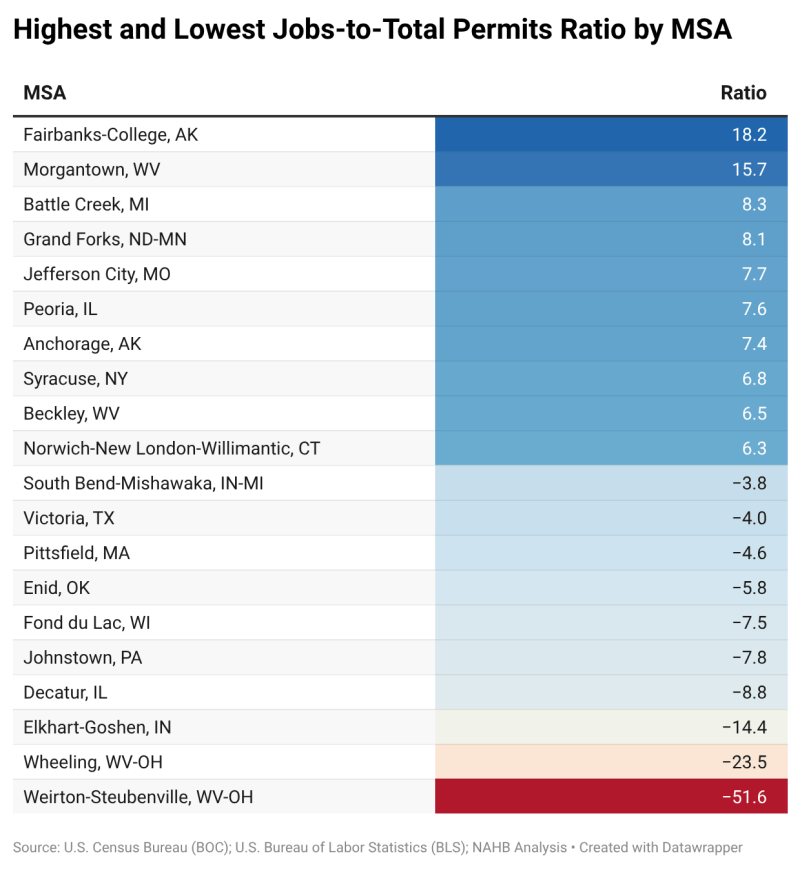
The ten metro areas with the highest jobs-to-total permits ratios are shown in the chart below, led by Fairbanks, AK with 18.2 new jobs per housing permit. Other metros with exceptionally high ratios include Morgantown, WV; Battle Creek, MI; Grand Forks, ND; and Jefferson City, MO.
In most cases, these elevated ratios reflect housing markets where residential construction has not kept pace with employment growth. At the same time, many of these metros are relatively small and issue a limited number of permits, meaning even modest job gains can generate disproportionately elevated ratios. These elevated ratios may also reflect structural barriers to housing production including smaller builder industries, higher development costs, labor shortages, limited infrastructure expansion, or restrictive land availability.
Metro areas with low jobs-to-total permits ratios, such as Weirton, OH; Wheeling, OH; Elkhart, IN Decatur; and Johnstown, PA, generally reflect markets where housing permitting activity has remained relatively stable despite weak, stagnant, or declining employment growth. In many older industrial or slower-growth regions, labor market expansion has lagged due to demographic challenges, slower population growth, or structural economic shifts away from manufacturing.
As a result, even modest levels of residential permitting can produce comparatively low ratios when job creation is limited. Overall, lower ratios suggest less acute housing supply pressures, though they may also reflect higher vacancy rates and weaker underlying economic and population growth.

Single-Family Construction
Focusing specifically on single-family permits provides a clearer view of conditions in the owner-occupied housing market. With 975,584 single-family permits issued in 2023, the jobs-to-single-family permits ratio reached 1.84, meaning nearly two new jobs were created for every single-family permit authorized. This elevated ratio points to ongoing supply constraints in the owner-occupied housing market, where higher construction costs, elevated mortgage rates, labor shortages, and limited lot availability have continued to restrain new home production. As a result, upward pressure on home prices and worsening affordability conditions persist.
This imbalance is highlighted by metro areas with particularly high jobs-to-single-family permits ratios as shown below. The metro area with the highest ratio, Hagerstown–Martinsburg (38.3), experienced strong commuter demand that outpaced the local single-family construction pipeline. Large Northeastern markets such as New York and New Haven face particularly tight land-use constraints and elevated development costs. Meanwhile, smaller markets like Fairbanks and Helena often contend with limited builder capacity, infrastructure constraints, and higher material or transportation costs. Overall, elevated single-family ratios in these metros point to tight owner-occupied housing market conditions where new home construction continues to lag behind employment-driven demand.
The metro areas with low single-family jobs-to-permits ratios such as Weirton, Wheeling, Elkhart, Decatur, and Pittsfield generally mirror the trends observed in the total permits analysis, where weaker employment growth and slower population gains have reduced pressure on local housing markets. In these metros, single-family permitting activity has remained relatively stable or sufficient relative to modest labor market expansion, resulting in lower ratios compared with faster-growing regions. Many of these areas are characterized by mature or slower-growing economies tied to legacy manufacturing or industrial sectors, where demographic growth has been limited and housing demand has remained comparatively soft. Overall, the low ratios suggest that owner-occupied housing supply pressures are less severe in these metros, though they also reflect slower economic momentum and weaker household formation trends relative to higher-growth markets.

Multifamily Construction
Moving over to multifamily permits gives us a signal of how the rental market responds to labor market growth. Based on 689,504 multifamily permits (units) issued in 2023, the jobs-to-multifamily permits ratio stood at 2.61, meaning about 2.6 new jobs were created for every multifamily unit approved. Even though this ratio is higher than the single-family measure, multifamily construction has played a particularly important role in adding new supply in large, high-demand metro areas.
For the local-area multifamily component of this analysis, the jobs-to-permits ratios shown in the chart below are based on permits issued within the nation’s top 100 metropolitan statistical areas (MSAs). This narrower geographic focus is used because multifamily development is highly concentrated in large urban markets, and avoids dilution by smaller metros with limited or infrequent multifamily construction.
Metro areas with high multifamily jobs-to-permits ratios such as Oklahoma City, Baltimore, Las Vegas, Kansas City, and Philadelphia generally indicate markets where employment growth has significantly outpaced multifamily permitting activity, pointing to tighter rental market conditions and relatively constrained apartment supply pipelines. Elevated ratios in these areas may signal increasing pressure on rental affordability, lower vacancy rates, and a greater need for additional multifamily supply to accommodate continued economic and demographic growth.
The metro areas showing low or negative multifamily ratios such as San Francisco, San Jose, Asheville, Portland, and Santa Rosa, generally reflect markets where multifamily permitting activity has outpaced job growth, or where employment conditions have softened relative to prior construction cycles.
In several high-cost coastal metros, particularly in the Bay Area and Portland, earlier waves of multifamily development combined with slower tech-driven job growth, remote work shifts, and weaker in-migration have led to supply running in front of demand. In smaller or tourism-oriented markets like Asheville and Santa Rosa–Petaluma, seasonal employment can amplify these imbalances in the rental markets.

Taken together, these findings illustrate the ongoing challenge of aligning housing production with labor market growth. While the national jobs-to-permits ratio has moved closer to historical norms, significant imbalances remain across metropolitan areas, particularly in markets where strong employment gains continue to outpace new housing construction. The results also highlight important differences between owner-occupied and rental housing markets, with single-family construction facing more persistent supply constraints while multifamily development has helped absorb a portion of growing demand in many large metro areas. Looking ahead, continued increases in housing production will be necessary to address the nation’s accumulated housing deficit. Recent gains in permitting activity and multifamily completions have begun to narrow the gap between housing supply and demand. However, this outcome will depend on maintaining a consistent pace of new construction, improving housing affordability, and overcoming ongoing challenges related to financing costs, labor availability, land development, and regulatory barriers.