



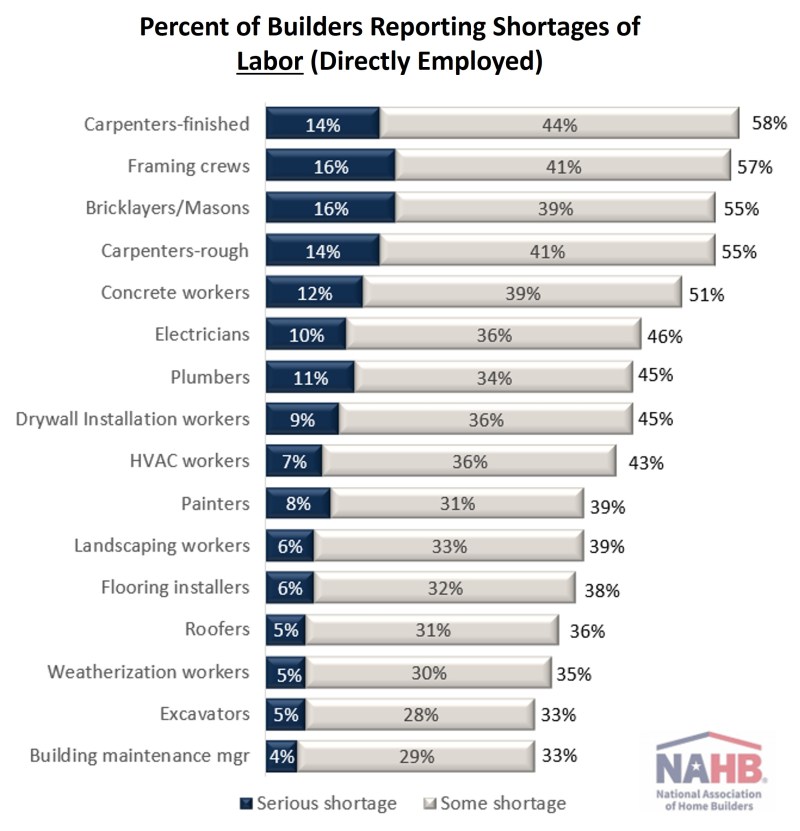
Labor shortages in the home building industry are becoming more widespread, according to recent results from the NAHB/Well Fargo Housing Market Index (HMI) survey.
The September 2026 HMI survey asked builders about shortages in 16 specific trades. The percentage of builders reporting a shortage (either serious or some) of labor they employ directly ranged from a low of 33% for excavators and building maintenance managers to a high of 58% for workers who perform finished carpentry.

The shortage percentages were generally up from the last time NAHB conducted the survey, in April of 2025. The shortage percentages for plumbers and HVAC workers were unchanged at 45% and 43%, respectively, but were up at least slightly for each of the other 14 listed trades. The three trades seeing the largest spikes in shortages are framing crews (up 9 percentage points to 57%), landscaping workers (up 7 pp to 39%), and roofers (up 6 pp to 36%). Averaged across the 9 trades NAHB has been covering in a consistent fashion since 1996, the shortage percentage was 47% in September 2026—up from 42% in April 2025.
At 47%, the current 9-trade shortage percentage is now higher than it had been at any time during the boom period of 2004-2006, when total housing starts were consistently over 1.8 million annually. In contrast, starts in August of 2026 came in at a seasonally adjusted annual rate of under 1.3 million.
After peaking during the COVID pandemic, the reported shortages of residential construction labor declined consistently between 2022 and 2025, before rising back up in the latest survey.

The recent uptick in the percentage of home builders reporting labor shortages is not surprising, given that employment in residential construction has been trending downward, as home building competes for labor with other segments of the construction industry—particularly data centers. Immigration enforcement is also heightening worker fears and further contributing to the shortage.
Along with the shortages, home builders also reported rising labor costs in the September HMI survey. The median increase in the cost of labor for the same home over the previous 12 months was 4.2%.
In the typical case, a substantial share of the physical work required to build a home is performed not by laborers employed directly by the builders, but by subcontractors. As a 2020 NAHB study showed, builders on average use two dozen different subcontractors and subcontract out 84% of their total construction costs to build a single-family home.
NAHB’s HMI survey asks home builders a separate set of questions about shortages of subcontractors. From 2012 through 2020, as home building began the long process of recovery from the Great Recession, shortages of subcontractors were consistently more widespread than shortages of labor directly employed by builders. However, that difference has vanished, and the graph for subcontractor shortages now closely mirrors the equivalent graph for directly employed labor. In fact, more than 50% of builders report shortages of subcontractors and direct laborers in the same five trades: framers, rough and finished carpenters, bricklayers, and concrete workers.

For more detail—including the complete history for every question in the HMI labor availability survey going back to 1996—please consult the September 2026 HMI Special Questions report.