



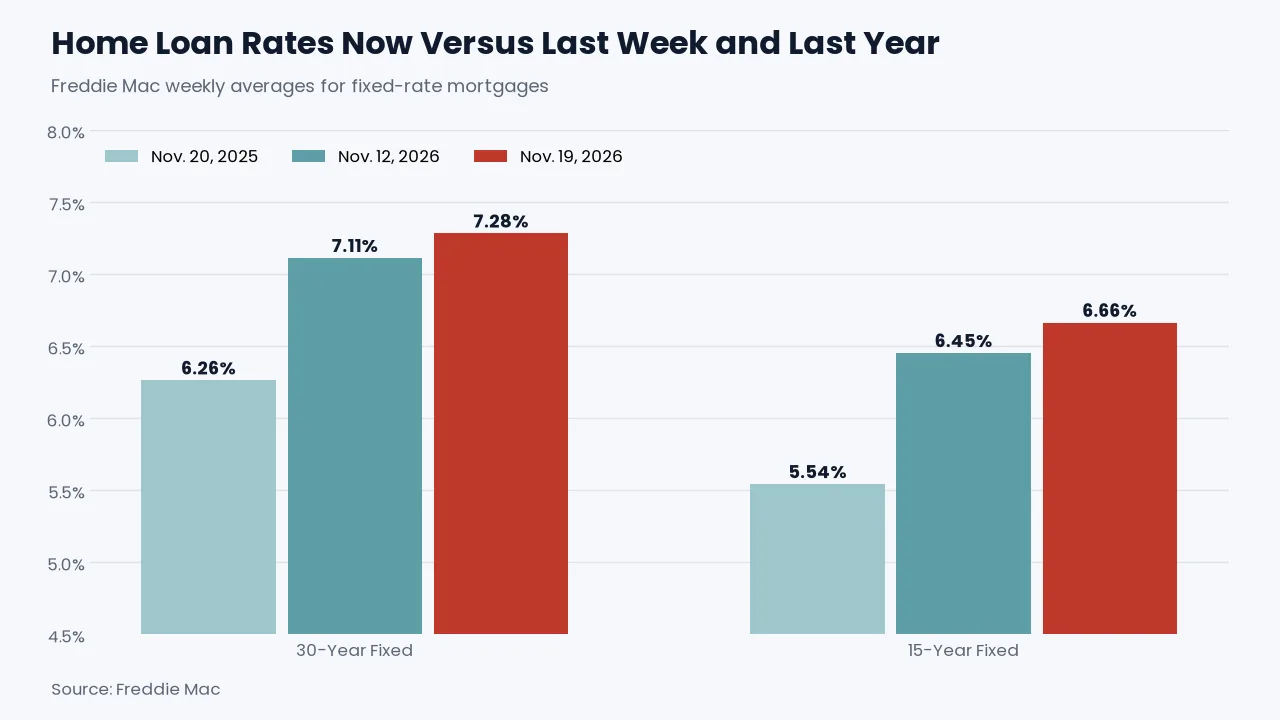
Mortgage rates moved up this week, and inflation is the main reason. Freddie Mac says the average 30-year fixed rate rose to 7.28% from 7.11%, which ends a four-week run of declines. A hotter-than-expected inflation report has made another Federal Reserve rate hike in December look very likely, and that kept pressure on the bond yields that mortgage rates follow.
If you were hoping the October peak was behind us for good, this week is a reminder to stay flexible. Rates are still below the 7.40% high from mid-October, but the easy part of the pullback may be over.
Mortgage Rates Climb as Hotter Inflation Raises Odds of a December Fed Hike
According to Freddie Mac’s weekly survey, released November 19, 2026, the benchmark 30-year loan came in at 7.28%, compared with 7.11% a week earlier and 6.26% a year ago. The 15-year loan came in at 6.66%, compared with 6.45% last week and 5.54% a year ago.

Source: Freddie Mac.
Why Inflation Is Pushing Mortgage Rates Higher
Mortgage rates do not follow the Fed’s rate directly. They tend to follow longer-term Treasury yields, and those yields react to what investors think inflation and the Fed will do next. When inflation looks stubborn, investors ask for higher yields, and lenders pass that along in the rates they quote.
That is the story Realtor.com reported this week. The October Consumer Price Index came in above expectations on both the headline and core measures. Realtor.com says that all but guarantees the Fed raises its benchmark rate at its next meeting on December 8, and that the 10-year Treasury yield moved back toward 5% this week.
What Markets Are Betting On
Realtor.com also noted that traders are now putting a 93% chance on a 25-basis-point hike next month, based on the CME FedWatch tool. Its senior economist, Anthony Smith, put the shift this way: “The debate has shifted from whether the Fed hikes in December to how aggressively it moves.”
That matters for you because mortgage lenders price in what they expect, not only what has already happened. When a hike looks nearly certain, a lot of the effect can show up in rates before the meeting even happens. A surprise in either direction could move rates again.
A Slow Season for Housing Gets Slower
The timing is awkward. Winter is already a quiet stretch for home sales, and recent reports show how hard the rate surge was on buyers. Realtor.com reports that pending home sales fell to a record low in October, and existing home sales reached their lowest level since 2010. The surge in mortgage rates through mid-October took its toll on buyers and sellers.
Builders are feeling it too. Realtor.com says builder confidence from the National Association of Home Builders fell to a new 14-year low earlier this week, while permit activity dropped to its lowest level since the early days of the pandemic. Fewer permits can mean fewer new homes down the road, which is something to keep an eye on if you expect prices to soften later.
Where Buyers Still Have Some Leverage
Higher rates are not all bad news for a patient buyer. The same Realtor.com report points to a few things that work in your favor right now:
- Less competition. There are fewer other shoppers going after the same homes.
- More choice. Inventory is up 8.6% from a year ago.
- Room to negotiate. Sellers are increasingly willing to negotiate on price.
- Lower asking prices. The median listing price was $405,000, down 2.4% from a year ago, which matches the steepest decline since early October.
These pluses do not cancel out a 7.28% rate, but they can soften it. A seller who cuts the price or pays part of your closing costs can offset some of the added monthly cost.
How Rates Got Here Since September
The weekly survey gives a clear picture of how fast things changed this fall. The 30-year fixed rate averaged 6.71% on September 3, then 7.03% on September 24, and it reached 7.40% on October 8 and again on October 15. After that it eased for four weeks, down to 7.11% on November 12, before this week’s move up to 7.28%.
In other words, buyers who shopped in early September saw a much cheaper rate than buyers shopping today, even after the recent pullback. The gap between 6.71% and 7.28% is 57 basis points, and on a $400,000 loan that is about $153 more per month in principal and interest.
What the Rate Change Does to a Monthly Payment
Here is a simple example on a $400,000 loan with a 30-year fixed rate, counting principal and interest only. Last week’s 7.11% meant a payment near $2,691. This week’s 7.28% pushes it to about $2,737, roughly $46 more each month. A year ago, at 6.26%, the payment would have been about $2,465.
The calculator at the bottom of this article starts at 7.28%. Try your own price and down payment, then change the rate by half a point either way to see how sensitive your budget is.
Quick Steps for Anyone Buying or Refinancing Soon
- Shop several lenders. Freddie Mac’s own economist pointed out this week that comparing multiple quotes can save borrowers thousands over the life of a loan.
- Know your lock options. If you are under contract, ask whether you can lock now or float, and what a lock costs.
- Stress-test your budget. Make sure the payment still works if rates are a quarter point higher by closing day.
- Do not time the market. Nobody can promise where rates will land after the December meeting.
If You Are on the Fence
Some people feel pushed to buy before rates rise again. Others feel pushed to wait for a drop. Both feelings can lead to a poor choice. A better question is whether the payment fits your life today, with room left over for repairs, savings and surprises.
If the answer is yes, a slightly higher rate may be something you can live with, especially if you plan to stay in the home for years. If the answer is no, waiting and saving a larger down payment may be the safer path, even though nobody can say where rates will be in six months. Talk to a lender about your own numbers before you decide, and ask about options such as seller credits or a temporary rate buydown.
What to Watch Next
Three things are worth watching. First, the Fed’s December 8 decision and what officials say about how many more hikes may follow. Second, the next inflation report, which could confirm or ease the worry behind this week’s move. Third, the 10-year Treasury yield, because mortgage rates usually move with it.
Freddie Mac will update its survey next Thursday. If the 10-year yield keeps climbing, it would not be surprising to see another rise. If it steadies, the average could settle near this week’s level. Either way, one week does not make a trend.
The Bottom Line
Mortgage rates rose this week because inflation came in hotter than expected and a December Fed hike now looks close to certain. The 30-year fixed rate averaged 7.28% and the 15-year averaged 6.66%, both higher than last week and a year ago.
If you are buying, the best moves are the practical ones: compare lenders, keep a cushion in your budget, and use the extra negotiating room the market is giving buyers. If you already own, a low rate you locked in earlier is probably worth keeping.
Estimate Your Monthly Mortgage Payment
- Principal & interest$0
- Property tax$0
- Home insurance$0
- PMI$0
- HOA fees$0
$0Loan amount
$0Total interest
$0Total of payments
Yearly amortization schedule
| Year | Principal | Interest | Balance |
|---|
Estimates only. Your actual payment depends on your lender, taxes and insurance. PMI applies only when the down payment is under 20%.