


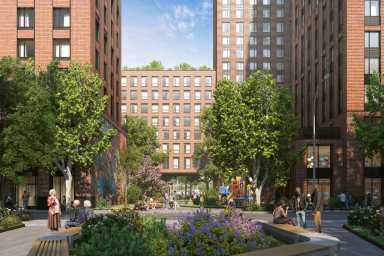

All 18 existing NYCHA buildings holding the 2,056 units will be demolished and rebuilt into six taller and narrower buildings over the course of seven years, with current residents moving into the new residences as they are finished. The project will be completed jointly by the city and private developers Related Companies and Essence and include an additional 3,454 privately owned mixed-income apartments on the NYCHA campus, 1,038 of which will be set aside at affordable rates.
The additional units will begin construction after all existing public units have been rebuilt, and will fill the space created by condensing the current units into fewer buildings.
NYCHA has said the redevelopment is necessary because the existing buildings have deteriorated beyond repair. Approximately 94% of current residents will be able to remain in their current apartment until their new one on the Chelsea campus is built.
But the project has been held up in court by a small group of the 6% of tenants who will be forced to relocate to other NYCHA buildings during a three-year construction process, then return to their original location on the Chelsea campus after their units are rebuilt.
While 73 of the approximately 120 households who will have to relocate — those who live in Chelsea Addition and Fulton 11 buildings at 436 West 27th Drive, 401 West 19th St. and 419 West 19th St. – have already done so, some were still fighting the process via this lawsuit. The opponents said they did not trust that they would get an apartment after the redevelopment, objecting to the fact that the city’s public housing provider was contracting with private developers to carry out the redevelopment and arguing the plans didn’t go through the proper approval processes.
“NYCHA has strayed far from its mandate. This project is a land grab,” Layla Law-Gisiko, a housing activist and Democratic district leader for Assembly District 75, said previously. She and others argued that renovations were a possible alternative to the complete rebuild and that private developers shouldn’t be building on public land.
The Appellate Division, First Department, said Thursday that it was unconvinced by the tenants’ arguments, particularly because they filed their suit after the statute of limitations had passed – roughly five months after the June 2025 date when NYCHA announced its redevelopment plans and started relocating tenants.
“Plaintiffs’ complaint … was untimely, and plaintiffs are not likely to prevail on the merits of their claims,” the court wrote. “The balance of the equities is not in favor of [the tenants], who delayed more than three months after the relocation process began and after most residents had already relocated to seek injunctive relief.”
Additionally, the court said that even though temporarily relocating might be annoying, it believed the benefits of the redevelopment outweighed the inconvenience and that NYCHA was providing tenants with sufficient support and satisfactory interim accommodations, so no one would be experiencing a level of harm that required the court to intervene.
“It is undisputed that the tenants have been guaranteed appropriate and accessible relocation apartments, units in the new buildings once complete, and packing and moving assistance,” the court wrote. “While relocation may be inconvenient and difficult, particularly for seniors, petitioners have not demonstrated that it rises to the level of irreparable harm.”
Federal laws and regulations protect tenants’ right to an apartment after the rebuild, guarantee they will move directly into the new unit once it’s complete, and ensure they’ll be offered a new lease no matter what – even if they owe back rent. All will pay 30% of their income in rent in their new units.
Once the public-private redevelopment is completed, the NYCHA campus will hold up to 5,510 total units, of which up to 3,094 will be permanently affordable, the agency said. The buildings will include modern amenities, community spaces, publicly programmed outdoor space, and new retail and commercial space, which will house businesses like healthy grocers.
NYCHA CEO Lisa Bova-Hiatt applauded the court’s decision and said the project and relocation processes will resume imminently. The agency said it will begin re-engaging the 30 households that remain in Fulton 11 and Chelsea Addition to complete the remaining lease signings and relocations.
Mayor Zohran Mamdani has supported the project in the past. His Deputy Mayor for Housing and Planning, Leila Bozorg, said she was glad work will continue on the project and looks forward to working with NYCHA residents through the process.
“This is a meaningful milestone for the Fulton and Elliott-Chelsea redevelopment, which will deliver brand-new apartments for thousands of NYCHA tenants along with much-needed new housing for more New Yorkers,” Bozorg said.