



Environmental activists in the South Bronx are warning that congestion pricing may be worsening air pollution in neighborhoods already burdened by some of the highest asthma rates in the country, even as New York City officials announced a new $20 million investment Tuesday to combat childhood asthma in the Bronx.
The announcement, made by Mayor Zohran Mamdani and the city’s Department of Health in recognition of World Asthma Day, will use funds from the Metropolitan Transportation Authority’s congestion pricing mitigation program to expand services for children and families.
“Asthma rates for children in the Bronx have decreased in the past 15 to 20 years, but remain concerningly high in parts of the Bronx,” said NYC Health Commissioner Dr. Alister Martin.
“This critical funding will continue and accelerate that improvement in children’s respiratory health through environmental justice initiatives like these. Congestion pricing has been a win-win: fewer cars, safer streets, and better quality of life.”
The investment will be split between two major initiatives: $8.9 million for the Bronx Asthma Program, which supports community-based outreach and education, and $11.1 million to expand the city’s Asthma Case Management Program.
The case management program provides in-school support for students with asthma, including medication administration, care coordination and self-management education for families. Fifteen additional Bronx schools are expected to join the program.
Officials also said the funding will help modernize how families submit asthma medication forms, creating an electronic system expected to be in place before the 2026–27 school year.
“Reducing air pollution has always been one of the core parts of New York’s Congesting Pricing program,” said MTA Chair and CEO Janno Lieber.
“The data shows it’s already succeeding, and now we’re taking the next step by using revenues to fund improvements for Bronx residents.”
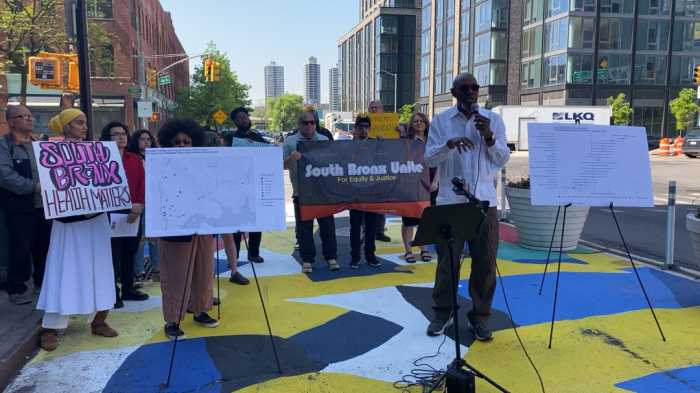
South Bronx Unite study findings
But just miles away in the South Bronx, environmental activists say data from the ground paints a much more grim picture.
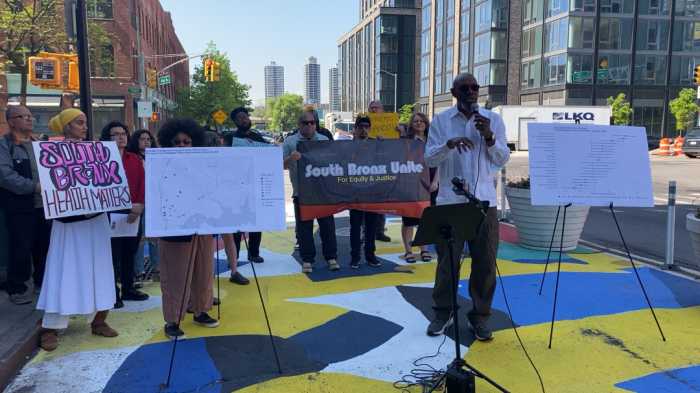
At a press conference near the Third Avenue Bridge, members of South Bronx Unite released findings from a two-year air quality study conducted in partnership with researchers from Columbia University Mailman School of Public Health.
Analyzing data from 19 air monitors across the South Bronx between January 2024 and December 2025, researchers found that 13 recorded increases in PM2.5—fine particulate matter linked to asthma and other respiratory illnesses. Overall, average PM2.5 concentrations increased by 0.22 micrograms per cubic meter following the implementation of congestion pricing.
For years, South Bronx Unite has sounded the alarm about air quality in the South Bronx, often referred to as “Asthma Alley” because of its disproportionately high asthma rates and concentration of highways, warehouses and truck traffic.
They argue that the city’s congestion pricing program —intended to reduce traffic, fund public transit improvements and cut emissions— has instead redirected more traffic through the South Bronx as drivers attempt to avoid tolls when entering Manhattan.
“While it was relatively clear that the congestion pricing policy would result in air quality improvements in the congestion pricing zone, there was concern that this would not be the case in the surrounding areas such as the South Bronx,” said Dr. Markus Hilpert, an associate professor at Columbia’s Mailman School of Public Health.
The most significant increase —1.29 micrograms per cubic meter— was recorded outside South Bronx Unite’s office in Mott Haven, located between the Third Avenue Bridge and the Major Deegan Expressway, a heavily trafficked truck corridor.
South Bronx Unite co-founder Mychal Johnson said the MTA should work directly with community groups and take neighborhood-level monitoring seriously.
“Let’s discuss what we should be doing together and understand that the problem here cannot be solved with peanuts or crumbs,” Johnson said. “It has to be intentional measures that’s going to reduce the burden our community has suffered for generations.”
“We’re willing to share, we’re willing to talk,” he added. “We want them to really look at the science and look at real measures in which we can deter and create changes that we need with research-driven solutions,” Johnson said.
Reach Marina Samuel at msamuel@schnepsmedia.com. For more coverage, subscribe to our newsletter and follow us on Twitter, Facebook and Instagram!