



Advantages of Stocks vs. Real Estate
So, what are the pros of investing in stocks vs. real estate?
Yes, I’m a “real estate guy,” but that doesn’t mean I don’t love stocks. Stocks have some undeniable advantages, and no retirement portfolio is complete without a diverse set of equity holdings.
As you explore stocks vs. real estate for FIRE, try playing around with this FIRE calculator from How to FIRE. Working with real numbers makes financial independence and retiring early tangible rather than a pleasant daydream.
Liquidity
You can buy and sell stocks instantaneously.
Got hit with a $5,000 medical bill and need money right now? Sell some stocks, and you have cash in hand today.
Of course, that same ease of buying and selling drives stocks’ notorious volatility. Stock markets can fluctuate wildly based on a single financial news story. It may be forgotten entirely by tomorrow, and the market swings in the other direction.
But there’s a certain reassurance in knowing that if you want your money out today, you can have it out today.
Low Barrier to Entry
Have an extra $100 sitting in your bank account? You can invest it in stocks with few headaches, knowledge, or costs.
No, really. You can open a brokerage account (I personally use Charles Schwab, but Vanguard is excellent as well), transfer money into it, and buy a low-cost index fund that tracks the S&P 500, Russell 2000, or some other stock index. Accounts are free to open, and Schwab recently stopped charging commissions when you buy and sell.
In other words, stock investing is completely free. If you buy an index fund, even the fund management fee is extremely low.
Don’t get me wrong, evaluating and picking individual stocks takes knowledge. But you don’t have to go that route – you can simply invest money “in the market” by investing in an index fund. No skill is required.
There’s no equivalent option when buying a rental property or flipping a house.
Easy Tax-Free Retirement Contributions
You can invest in stocks tax-free for retirement with an IRA, 401(k), or other related retirement accounts.
And it’s easy – within five minutes, you can set up an IRA through your brokerage. Buying or selling stocks in your IRA account is no different than in your brokerage account.
That said, you can also invest in real estate through a self-directed IRA. But it’s a little more complicated, and you must go through a trust company to administrate it.
Easy Diversification
With $100 and a few clicks, you can invest in index funds that own hundreds of companies. You can invest in US stock funds, European stock funds, Asian stock funds, and emerging market stock funds.
Small or large market cap in sectors ranging from technology to healthcare, energy, and beyond. It’s incredibly easy to diversify your stock portfolio.
Why does diversification matter? In a word, risk. The idea is simple, and an old proverb sums it up nicely: don’t put all your eggs in one basket.
Diversification is one of the great advantages of stocks vs. real estate.
Completely Passive Income
When you buy shares in an index fund, you can let them sit there, compounding as dividends reinvest, until you’re ready to retire. The only second thought you might have is rebalancing, and even that can be done passively through “cash flow rebalancing” (adjusting new stock purchases to shift your asset allocation as desired).
In the debate over real estate vs. stocks, sometimes proponents of real estate gloss over the fact that rental properties are not a passive income source. It takes some labor to manage rental properties. Even if you outsource that labor to a property manager, you’ll still occasionally get phone calls from them asking for a check for $2,500 to replace the furnace.
Your stocks won’t call you at 4 AM complaining that a light bulb blew out, but your tenants might.
Disadvantages to Stocks
I touched on some of these above already when reviewing some of the advantages of real estate investing vs. stocks. Keep these disadvantages in mind when deciding between real estate and stocks.
Volatility
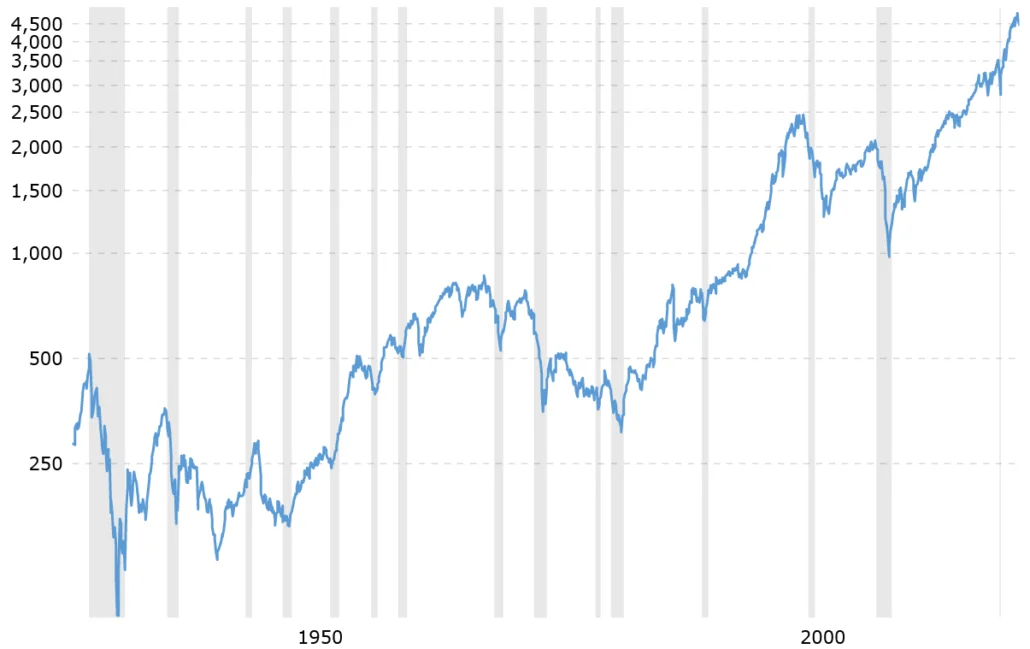
Stocks swing wildly in value. Real estate doesn’t.
That matters because volatility represents risk. If you buy a stock, high volatility means higher unpredictability. It could drop by 50% or rise by 50%; you buy it and hope for the best.
Check out the S&P 500’s gyrations from 1928-2022:

Economists measure risk vs. return of an investment by dividing its average annual return over its volatility (measured by the standard deviation of the return). This is called a Sharpe ratio, literally a ratio of return over risk.
Remember that 145-year study I mentioned at the outset? Stocks had a Sharpe ratio of 0.27, while real estate had a Sharpe ratio of 0.7 – a much better ratio of returns over risk.
No Control over Returns
When you buy a stock, your only control is when to sell it. You have zero control over its performance.
The company’s earnings could drop. Its CEO could be fired for a sex scandal. Or a competitor could buy it out, and shares could skyrocket. None of which you can control.
No Predictability of Returns
Likewise, stock investors can’t predict any of those swings in value. You don’t know if earnings will rise or fall or a merger will occur. You just buy and hope for the best.
A huge advantage of real estate vs. stocks is that investors can predict returns.
Sequence Risk
Sequence risk is a lengthy conversation, but here’s the short version. When you first retire, a stock market crash would have a much greater impact on your returns than if it happened later in your retirement.
It’s a little counterintuitive, but the order – the sequence – of your returns actually matters just as much as the long-term average. A crash right after you retire can put such a large dent in your stock portfolio that it’s hard to recover.
But if a stock market crash occurs later in retirement, after years of strong returns, your portfolio may have reached a “critical mass” where it can survive a bear market with less trauma.
Here’s exactly how rental properties can reduce sequence risk and a reminder of how real estate complements stocks in your retirement portfolio.
The Data on Real Estate vs. Stocks for FIRE
First of all, what do stocks earn on average?
The S&P 500 (an index of large-cap US stocks) has returned an average of roughly 10% annually since its inception in 1928. About 40% of that long-term average has come from dividends – in a perfectly average year, the S&P 500 might return a dividend yield of around 4% and see a 6% increase in stock prices.
With that said, inflation has averaged around 3% over the last 90 years, which must be subtracted to determine the real return. In adjusting for inflation, investors could expect a return of around 7%.
Of course, stocks don’t just rise slowly and steadily. They leap by 25% one year, collapse by 20% the next year, and wobble the next. See the S&P 500 chart above.
Meanwhile, home prices average around 5.3% annual appreciation. However, that doesn’t include inflation and doesn’t account for US homes growing larger during that period.
Besides, we’re not concerned with appreciation if we’re interested in FIRE. It won’t pay our bills, but rental cash flow will, and rents will adjust for inflation (more on that below).
Sample Numbers for FIRE: Stocks
Stanley invests only in stocks, while Rachel invests only in rental properties. We’ll be generous and give both of them 10% returns. Both want $50,000/year in income from their investments to cover their living expenses in retirement.
Stanley plans on selling 3.5% of his stock portfolio every year to live on upon reaching FIRE. That number is not arbitrary – financial planner Michael Kitces has demonstrated that investors can withdraw 3.5% yearly and never run out of money. Compare that to the traditional “4% Rule;” investors who sell off 4% of their investment portfolio yearly can only depend on it for around 30 years.
If Stanley wants $50,000/year in income, he needs a nest egg of $1,428,571. Wait, huh? Don’t fret—the math is actually super simple: 3.5% of $1,428,571 = $50,000.
But that’s a lot of money. Stanley needs to save $1,428,571 in ten years, with a 10% return, or $89,636.25 a year.
No small feat. I hope Stanley earns a good income!
Sample Numbers for FIRE: Real Estate
Rachel buys properties for $100,000 apiece, rents them for $1,500, and has around $670 in monthly expenses. That leaves her with $830 monthly in profit/cash flow – a return of around 10%.
Except Rachel doesn’t pay cash for her properties. She finances them with a 30-year rental property loan and puts down 20%, or $20,000. At a 6% interest rate, she pays $479.64/month for principal and interest. That lifts her total expenses per property to around $1,150 for a monthly cash flow of $350.
But it also lifts her cash-on-cash return. She invests $20,000 in cash and gets back $4,200/year, boosting her cash-on-cash return from around 10% to over 20%.
It would take 12 properties earning $4,200/year to generate $50,000 in income. At $20,000 a pop, that comes to $240,000 in down payments—a far cry from the $1,428,571 that Stanley needs!
This is why I love to argue that rental properties bend the normal retirement planning rules!
Correcting for Oversimplification
The numbers above are oversimplified, of course. They don’t include closing costs, and critics would object that it’s hard to find real estate deals with returns that high.
But that simplicity cuts in the other direction, too. We didn’t add money for Rachel’s property appreciation. We didn’t deduct money for Stanley’s brokerage fees or account for the inflation that Stanley will face.
Rachel’s rental income, meanwhile, will automatically rise to adjust for inflation and, in all likelihood, rise faster than inflation.
Alternative Investment Models
Most people think investing in real estate requires massive down payments, and stocks are your only option. But think again. Modern investment platforms have created some interesting alternatives for FIRE seekers.
Real Estate Crowdfunding
As mentioned, platforms like Fundrise and Streitwise have entirely changed the barrier to entry. Instead of scraping together $30,000 for a rental property down payment, you can start investing in real estate with as little as $10. These platforms let you:
-
- Own pieces of multiple properties
- Earn quarterly dividends
- Benefit from property appreciation
- Avoid tenant headaches
- Diversify across different markets
REITs and Other Options
Don’t you want to tie up your money through crowdfunding? No problem. Real Estate Investment Trusts (REITs) trade just like stocks but invest purely in real estate. They’re required to pay out 90% of their profits as dividends, often yielding 4-8% annually.
If you’re more adventurous, you might explore:
-
- Real estate mutual funds
- Private lending
- Note investing
- Real estate ETFs
Perhaps the best part is that you can mix and match these alternatives with traditional real estate and stock investments. You see, it’s not about choosing just one path to FIRE – it’s about finding the right combination that works for your goals and risk tolerance.
Real Estate or Stocks for FIRE? Invest in Both
Yes, in the sample numbers above, reaching FIRE with real estate is far faster than with stocks. But reaching FIRE isn’t just about dollars and cents.
Financial independence and early retirement also depend on security and risk management. As you know by now, diversification is crucial for risk management.
I personally recommend investing in rental properties for income and stocks for growth and diversity. Why choose only real estate or stocks? Invest in both, and get the best of both worlds.
If you encounter a true financial emergency, you can liquidate stocks for immediate cash. If your stocks have a terrible year, you can lean more heavily on your rental properties and not sell any stocks.
Your savings rate is less important than whether you invest in real estate vs. stocks. If you can live on half your income or even less, you can reach financial independence quickly.
The trick to reaching FIRE is trimming expenses and pumping every penny into investments. Real estate investments, stock investments, private notes, bonds; just start building an investment portfolio. Check out our free FIRE calculator to play around with different numbers.
You’ll learn as you go, but there’s no getting back lost time!
What’s your plan for reaching financial independence and early retirement?
More FIRE-y Reads: