

The new month opened with a quiet day on the rate board, but the weekly trend still leans in buyers’ favor. As of Sunday, November 1, 2026, Zillow’s average 30-year fixed purchase rate stands at 7.10%, down 2 basis points from a week earlier, when it was 7.12%. The 15-year fixed dropped 3 basis points over the same stretch to 6.45%, and the 20-year fixed matched last Sunday at 6.83%.
Compared with Saturday, nothing moved at all. Every one of the eight purchase rates Zillow reports for Sunday is identical to Saturday’s figure, which is normal over a weekend. So today’s story is really about the week. The two most popular fixed loans are cheaper than they were seven days ago, while adjustable and VA loans mostly cost more. Below you’ll find the week-over-week table, the payment math on a typical loan, and my thoughts on which term makes sense right now.
Today’s Mortgage Rates, November 1: 30-Year Fixed Drops 2 Basis Points This Week
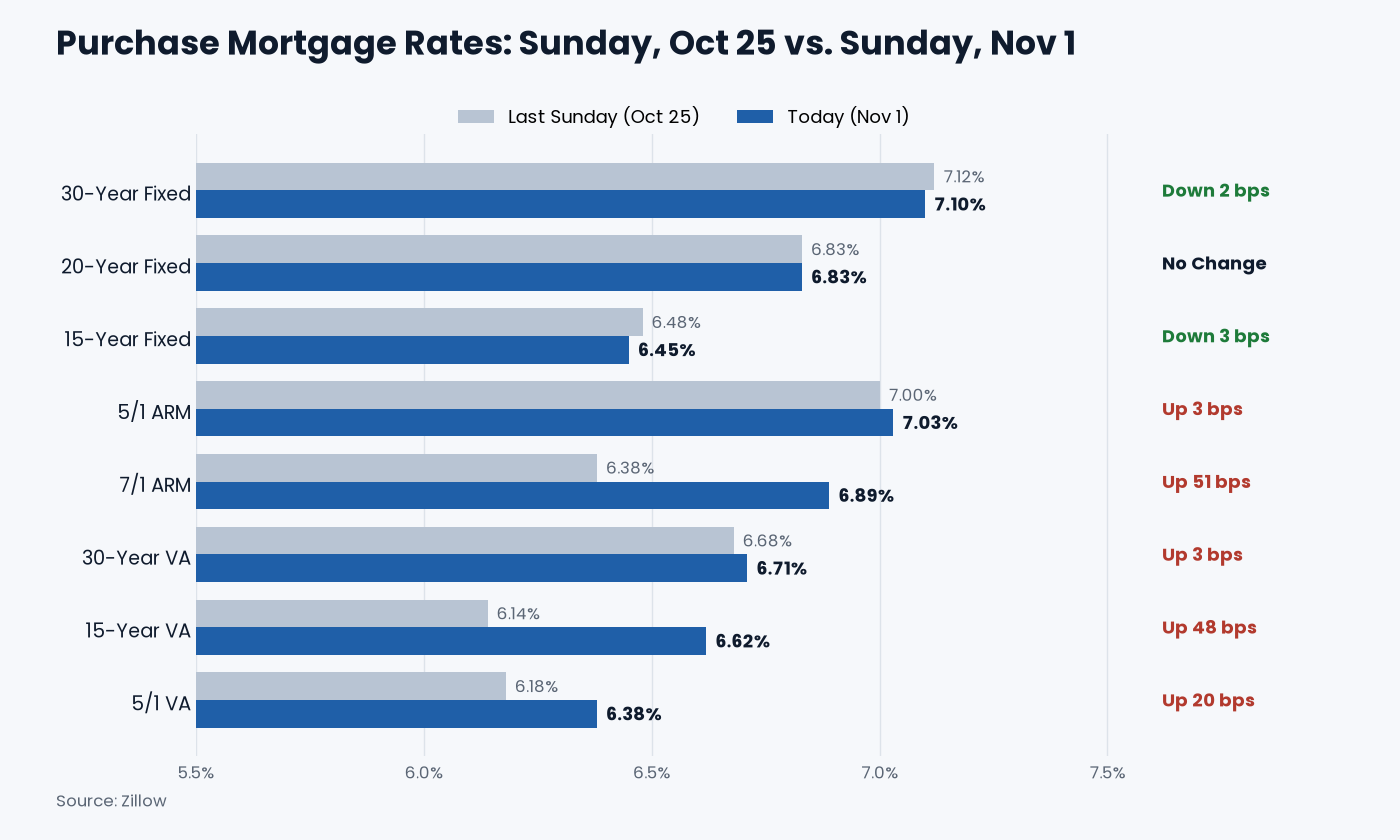
Zillow Purchase Rates for Sunday, November 1, 2026
This table compares Sunday’s national averages with last Sunday, October 25. The day-over-day change is zero across the board, so the weekly column is the one to watch:
| Loan Type | Sunday (Nov 1) | Last Sunday (Oct 25) | Weekly Change |
|---|---|---|---|
| 30-year fixed | 7.10% | 7.12% | Down 2 bps |
| 20-year fixed | 6.83% | 6.83% | No change |
| 15-year fixed | 6.45% | 6.48% | Down 3 bps |
| 5/1 ARM | 7.03% | 7.00% | Up 3 bps |
| 7/1 ARM | 6.89% | 6.38% | Up 51 bps |
| 30-year VA | 6.71% | 6.68% | Up 3 bps |
| 15-year VA | 6.62% | 6.14% | Up 48 bps |
| 5/1 VA | 6.38% | 6.18% | Up 20 bps |
Source: Zillow
Here’s my quick read of the week:
- The two biggest fixed loans got cheaper. Both the 30-year and the 15-year fixed are lower than a week ago.
- The 7/1 ARM lost its bargain status. Last Sunday it was the cheapest conventional option at 6.38%. Now it sits at 6.89%.
- VA rates rose across the board. The 15-year VA posted the largest weekly jump among VA loans, up 48 basis points.
- The 5/1 VA remains the lowest rate on the list at 6.38%, even after its rise.
Remember, a basis point equals 0.01%. A 2 basis point drop trims the rate by two hundredths of a percentage point.

The 30-Year Fixed Drop in Dollars
The 30-year fixed is the loan most buyers choose, so its weekly drop is the one that touches the most budgets. On a $400,000 mortgage, Sunday’s 7.10% rate works out to roughly $2,688 a month in principal and interest. At last Sunday’s 7.12%, the same loan ran about $2,694.
That’s a saving of around $5 a month. I won’t pretend that changes anyone’s life on its own. What matters more is the direction. The 30-year has now held at or below where it was a week ago, and small declines that stick tend to add up over a few weeks.
15-Year Fixed: The Bigger Weekly Drop
The 15-year fixed fell a bit further, from 6.48% to 6.45%. On $400,000, the monthly payment slips from about $3,480 to about $3,473, close to $7 less each month.
The real appeal of the 15-year is total interest. At 6.45%, you’d pay about $225,200 in interest over the life of the loan. A 30-year at 7.10% would cost roughly $567,700 in interest on the same amount. That’s a difference of more than $342,000, in exchange for a payment that’s about $785 higher each month. If your income can carry it, few financial moves save more money.
Estimated Payments on a $400,000 Loan
These Norada estimates compare principal-and-interest payments at Sunday’s rates with last Sunday’s. Taxes, insurance and mortgage insurance aren’t included.
| Loan Type | Last Sunday Payment | Sunday Payment | Weekly Difference |
|---|---|---|---|
| 30-year fixed | $2,694 | $2,688 | $5 less |
| 20-year fixed | $3,061 | $3,061 | No change |
| 15-year fixed | $3,480 | $3,473 | $7 less |
| 5/1 ARM | $2,661 | $2,669 | $8 more (first five years) |
| 7/1 ARM | $2,497 | $2,632 | $135 more (first seven years) |
Payment figures are Norada estimates.
The 7/1 ARM line is the eye-catcher. A buyer who priced that loan last weekend would now see a payment about $135 higher. That’s a good reminder that adjustable-rate averages can jump far more in a week than fixed rates do.
Adjustable Loans Lost Ground This Week
Last Sunday, the 7/1 ARM undercut the 30-year fixed by 74 basis points. Today that cushion has shrunk to 21 basis points. The 5/1 ARM, at 7.03%, now saves you only 7 basis points compared with the 30-year fixed, or about $19 a month on $400,000.
With so little discount left, I’d be cautious about taking on reset risk right now. An ARM makes the most sense when it offers a meaningful payment break and you’re fairly sure you’ll sell or refinance before the fixed period ends. This week, the break is thin.
VA Buyers Saw Higher Rates
All three VA averages moved up over the week. The 30-year VA rose 3 basis points to 6.71%, which still sits 39 basis points below the conventional 30-year fixed. On $400,000, that’s about $104 less a month than a conventional 30-year loan.
The 15-year VA had a rougher week, climbing from 6.14% to 6.62%. That adds about $105 a month on a $400,000 loan, and it now prices 17 basis points above the conventional 15-year fixed. If you’re VA-eligible and want a short term, get quotes on both before deciding.
What to Watch in Early November
The most recent Freddie Mac weekly survey, released Thursday, October 29, put the average 30-year rate at 7.24%, the lowest reading of October. Zillow’s daily 30-year average has drifted down alongside it, finishing the week at 7.10%.
Zillow’s research team expects any relief to come slowly. In its October 28 outlook, Zillow forecast that rates will “ease only gradually, remaining at 7% or higher for the rest of 2026 and 6.5% or higher in 2027.” Fresh jobs and inflation data in the weeks ahead could nudge that path either way, but a sudden plunge doesn’t look likely.
For buyers, my takeaway is that small weekly declines are welcome, but they’re not a reason to put plans on hold. A home you can afford today is worth more than a rate you might get someday.
Picking the Right Term for You
Lean toward a 15-year fixed if:
- Your budget can absorb a payment several hundred dollars higher than a 30-year loan.
- Cutting total interest is your top goal.
- You want the house paid off well before retirement.
Lean toward a 30-year fixed if:
- Keeping the monthly payment low gives you peace of mind.
- You expect to stay put for many years.
- You’d like room to refinance if rates come down later.
Consider an ARM only if:
- The rate discount versus a fixed loan is large enough to matter.
- You can handle the payment even if the rate resets higher.
Before You Lock a Rate
- Compare offers from the same day. Rates change daily, so same-day quotes give you an honest comparison.
- Read the Loan Estimate closely. Points and lender fees can outweigh a small rate difference.
- Match your lock to your closing. Longer locks often carry a higher price.
- Tidy up your credit. Lower card balances can lift your score and your rate offer.
My Take for Sunday, November 1
Sunday’s rates didn’t budge from Saturday, but the week tells a better story for fixed-rate buyers. The 30-year fixed dropped to 7.10% and the 15-year fixed slipped to 6.45%, both lower than last Sunday. Adjustable and VA loans moved the other way, which makes the plain fixed-rate mortgage look like the steadier choice heading into November.
These figures are a snapshot of Zillow’s national averages for Sunday, November 1, 2026. Your own rate will depend on your credit score, down payment, loan amount and lender, so request a personalized quote before you commit.
Read More:
Explore these related articles for even more insights: