


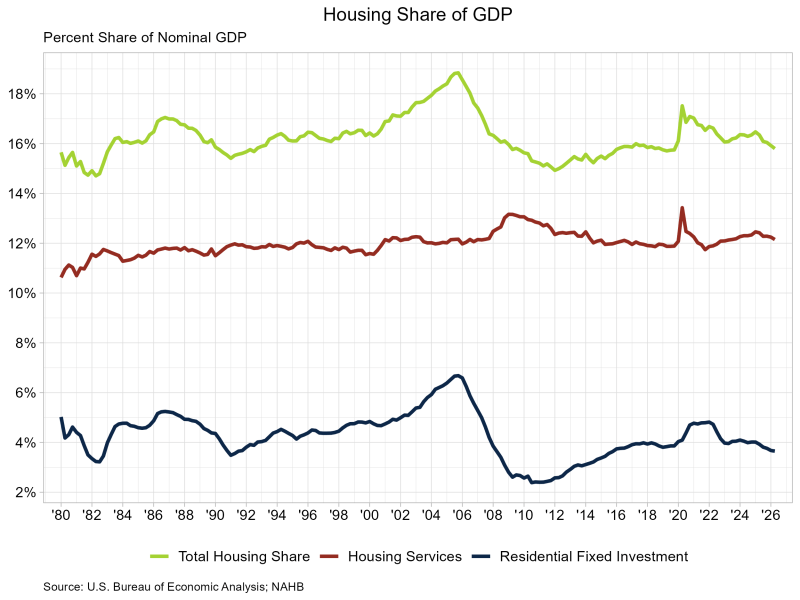
Housing’s share of the economy was 15.8% in the second quarter of 2026, according to the latest estimates of GDP produced by the Bureau of Economic Analysis. This share is down from 15.9% in the first quarter and is at the lowest level since 2019. Residential construction, measured by residential fixed investment, rose for the first time in over a year, while households’ expenditure on housing services fell due to lower household consumption of utilities.
The more cyclical home building and remodeling component–residential fixed investment (RFI)–was 3.7% of GDP, even with the previous quarter. The second component, housing services, was 12.1% of GDP, down from 12.2% in the previous quarter. The graph below plots the share for housing services and RFI, along with housing’s total share of nominal GDP.

Housing service expenditures are much less volatile when compared to RFI due to the cyclical nature of RFI. Historically, RFI has averaged roughly 5% of GDP, while housing services have averaged between 12% and 13%, for a combined 17% to 18% of GDP. These shares tend to vary over the business cycle. However, the housing share of GDP lagged during the post-Great Recession period due to underbuilding, particularly in the single-family sector.

Residential Fixed Investment
In the second quarter, RFI contributed 5 basis points to the headline GDP growth rate. This was the first positive contribution to GDP from RFI since the fourth quarter of 2024. RFI was 3.7% of the economy, recording a $1.2 trillion seasonally adjusted annual pace.
RFI can be split into two segments, structures and equipment. Residential structure investment not only consists of new single-family and multifamily units but also includes manufactured homes, improvements, and dormitories. Residential equipment, which accounts for under 2% of total RFI, consists of furniture or household appliances that are purchased by landlords for rental to tenants. Real private investment in structures rose 1.3%, while investment in residential equipment rose 12.1%.

Breaking down the components of residential structures, single-family RFI rose 4.4%, while multifamily RFI fell 1.8%. Permanent site structure RFI, which is made up of single-family and multifamily RFI, rose 1.3%. The “other structures” RFI category was down 0.1% in the second quarter. This component consists primarily of manufactured homes, improvements, and dormitories. On a seasonally adjusted annual basis in the second quarter, private investment in permanent site structures was at $523.8 billion, while other structures totaled $639.3 billion.

Housing Services
The second impact of housing on GDP is the measure of housing services. Similar to RFI, housing services consumption can be broken into two components. The first component, housing, includes gross rents paid by renters, owners’ imputed rent (an estimate of how much it would cost to rent owner-occupied units), rental value of farm dwellings, and group housing. The inclusion of owners’ imputed rent is necessary from a national income accounting approach, because without this measure, increases in homeownership would result in declines in GDP. The second component, household utilities, is composed of consumption expenditures on water supply, sanitation, electricity, and gas.
For the second quarter, housing services represented 12.1% of the economy or $3.9 trillion on a seasonally adjusted annual basis. Real housing services expenditure declined 0.1% at an annual rate in the second quarter. Real personal consumption expenditure for housing grew 1.1%, while real household utilities expenditures declined 8.2%.

Personal consumption expenditure (PCE) on housing services is the largest component of PCE, making up 17.9% in the second quarter. The second largest component of PCE is health care services, at 16.8%. Expenditure on services was $15.2 trillion on a seasonally adjusted annual basis in the second quarter, more than double the expenditure on goods ($6.9 trillion).