



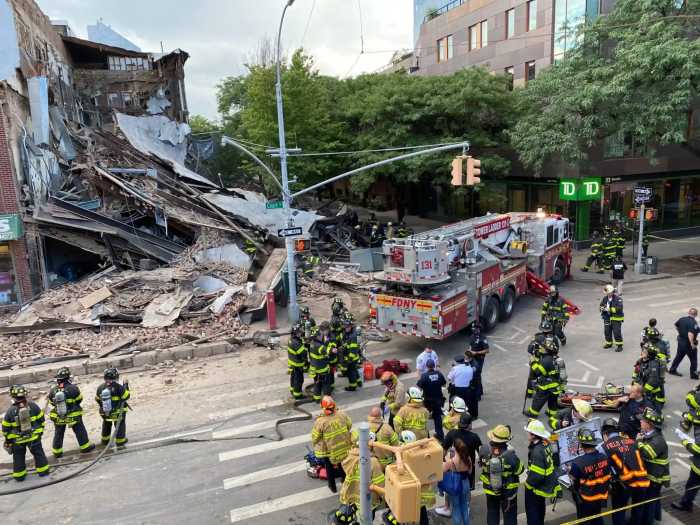
Brooklyn has seen building collapses in neighborhoods across the borough, from Williamsburg to Borough Park. Some have left residents injured or displaced, while others have killed construction workers and residents.
The latest tragedy in Flatbush, where a three-story building crumbled on the afternoon of Nov. 11, killing eight people and injuring even more at the time of writing, has renewed questions about the safety of the borough’s aging building stock — and what happens when construction, demolition or inadequate structural maintenance puts that safety at risk.
The collapse happened shortly after 4 p.m. at 1321 Flatbush Ave., near Bedford Avenue. The rear portion of the three-story building fell into an adjoining construction site, where excavation work had been underway. Emergency crews worked through the night searching the rubble, while the Department of Buildings began investigating what caused the structure to give way.
The cause has not officially been determined. But the circumstances have brought renewed attention to a recurring issue in the borough: the vulnerability of buildings when structural integrity is compromised, particularly around active construction sites.
While not every incident involved an entire building collapse, Brooklyn’s history of structural failures includes partial collapses, falling walls, floor and roof failures and damage caused by nearby construction.
A history of collapses across Brooklyn
The Flatbush disaster is not the first time a building has partially or completely collapsed in Brooklyn.
In Carroll Gardens, a July 2020 gym building collapse prompted concerns about the condition of the structure and the surrounding properties. A gym building on the corner of Court and Union streets “fell in on itself,” leaving one injured. The DOB found that the building had multiple citations, according to ENR East.
The building had also been the subject of a safety complaint the previous month. On June 10, 2020, workers removing cement stucco from an exterior wall prompted another safety complaint after a roughly 20-by-15-foot section of brick masonry began bulging over the public sidewalk, according to city records. Officials subsequently issued a partial stop-work order.

A separate August 2020 collapse at 204 Bedford Ave. in Williamsburg involved a vacant three-story storefront whose facade and part of its structure crumbled into the street, burying parked cars in debris. No injuries were reported, but the neighboring building and ground-floor restaurant Red Bowl were evacuated.
That incident was attributed to water damage, rot and structural deterioration during a storm, rather than the circumstances surrounding the most recent collapse. Still, it highlighted broader concerns about the structural integrity and upkeep of aging buildings across the borough.
Other incidents have involved construction work itself. In February 2024, a construction worker died when the first floor of a two-story building at 1266 50th St. in Borough Park collapsed into its basement. The Department of Buildings said the site had no approved construction plans and that workers had violated a stop-work order.
In May 2026, a four-alarm fire at 927 Grand St. in Williamsburg caused significant structural damage to three buildings. The exterior wall of the fire-struck building collapsed into the street, while damage to a neighboring building’s rear wall prompted evacuations. Eighteen people were displaced.

Not every incident has involved an entire building falling. Brooklyn Paper has also reported on a wall collapse during a Sunset Park demolition project earlier this year, and two incidents in 2025: a ceiling collapse at an IHOP in Georgetown that injured nine people and a fatal roof collapse in Marine Park.
Although the circumstances differed, the incidents demonstrate how structural failures can affect residents, workers, businesses and neighboring properties — sometimes with fatal consequences.
What can cause a building to collapse?
There is no single explanation for the borough’s building collapses.
Attorney Kevin Dean told Brooklyn Paper that several factors can contribute to structural failures in densely developed cities, including metal fatigue, overloading and inadequate inspections. Older buildings may have been constructed with materials or structural components that do not meet today’s standards, he said, making routine inspections and maintenance particularly important.
“Over time, you have significant metal fatigue and overloading,” Dean said. “Maybe the metal beams and structure that were utilized 30 or 40 years ago was a grade lower than what’s used today. And you overload those beams and overload those structures and you don’t inspect, then bad things happen over time.”

He also pointed to limited government resources and a shortage of qualified inspectors as contributing factors.
“Governments, unfortunately, are [faced with] lack of resources and lack of qualified inspectors, and people cut corners,” he said. “Lack of inspection is a significant problem that’s been known for a long time.”
How construction can put neighboring buildings at risk
In densely developed neighborhoods, construction and excavation can pose risks beyond the property where work is taking place.
Removing soil, disturbing the ground or failing to provide adequate lateral support can affect a building’s foundation and stability. Demolition work can also put adjoining properties at risk if shared walls or other structural supports are disturbed.
The city’s Department of Buildings specifically identifies “vibrations, changes in soil condition or capacity and loss of lateral support” as construction operations that can impair adjoining buildings.
That concern is especially relevant in Brooklyn, where new development often takes place alongside older residential and mixed-use buildings.
In Flatbush, excavation and foundation work were underway at the neighboring construction site at 2625 Bedford Ave. when the building collapsed. The work was being conducted under active DOB permits, but the agency has since issued a full stop-work order at the site as investigators examine what caused the collapse.

The construction site had also received a DOB violation in April after inspectors found that demolition work had continued despite a previous stop-work order. That violation was subsequently marked resolved. Officials have not established whether the neighboring construction activity contributed to the collapse.
Dean explained that changes to the soil beneath and around a building can shift the way weight is distributed across a structure and its neighbors. Water infiltration, for example, can gradually wash away soil and create underground cavities, while excavation and other construction activity can further shift the ground.
He also highlighted the importance of soil compaction testing before construction begins. The process involves examining the ground to determine whether it can adequately support the planned structure and foundation.
“That’s an engineering soil ground test where you have to bore into the soil and study the foundation before you start putting footers in and you start putting in foundational things,” Dean said. “You want to check soil compaction to see if things have changed over the last 50 years.”
He compared the process to a row of dominoes, explaining how a loss of support in one area can set off a chain reaction affecting surrounding structures. When soil shifts beneath a building, the movement can alter how weight is distributed, placing additional stress on neighboring buildings.

“It doesn’t take much movement on one corner or one loaded area,” Dean said. “Once something starts collapsing, it changes the load on the rest of the structures.”
He described how a failure at one point can trigger additional structural failures as weight shifts elsewhere.
“Clearly either a corner or somewhere it started and just kept going, because the load shifted and you had a failure at one point, and it’s all downhill from there due to gravity,” he said.
Dean cautioned that he had not investigated the Flatbush site and could not determine whether soil conditions or excavation contributed to the collapse. He noted, however, that inadequate supervision, excavation that goes too deep and changes to soil conditions can create risks that need to be carefully evaluated.
Aging buildings and the importance of maintenance
Also at play is the age and condition of Brooklyn’s existing buildings.
Age alone does not mean a building is unsafe, but structural components can deteriorate over time if maintenance and necessary repairs are neglected. Exposure to weather, water infiltration, corrosion and deteriorating masonry can weaken parts of a building, while problems with foundations, load-bearing walls, floors and roofs may not always be visible from the street.
The 2020 Williamsburg collapse, which was attributed to water damage, rot and structural deterioration, illustrates how a building’s condition can become a safety concern for the surrounding block. The May 2026 Williamsburg fire also demonstrated how damage to one property can create risks for neighboring buildings, particularly when exterior walls or other structural elements fail.
A larger question about building safety
Brooklyn’s history of building collapses does not point to one universal cause. Rather, it highlights several vulnerabilities that can threaten structures: aging infrastructure, inadequate maintenance, unsafe construction practices and the potential impact of nearby development.
The Flatbush investigation will be important in determining whether any of those factors contributed to Wednesday’s disaster.
For Dean, preventing future collapses requires stronger inspection protocols and additional oversight of construction projects. He said city agencies may not have enough personnel or resources to adequately monitor the volume of construction happening across New York City.
“It’s almost like the city doesn’t allocate sufficient resources for proper inspections,” he said.

He suggested the city consider bringing in independent third parties to provide additional checks and balances.
“It just seems to me that there’s not a sufficient inspection protocol and checks and balances if this continues to happen,” Dean said.
He also emphasized the importance of preserving evidence at collapse sites so investigators can determine what happened.
For now, the tragedy has put a renewed spotlight on a question facing a borough that continues to grow and redevelop: How can Brooklyn make room for new construction while ensuring the buildings already standing — and the people living and working inside them — remain safe?