



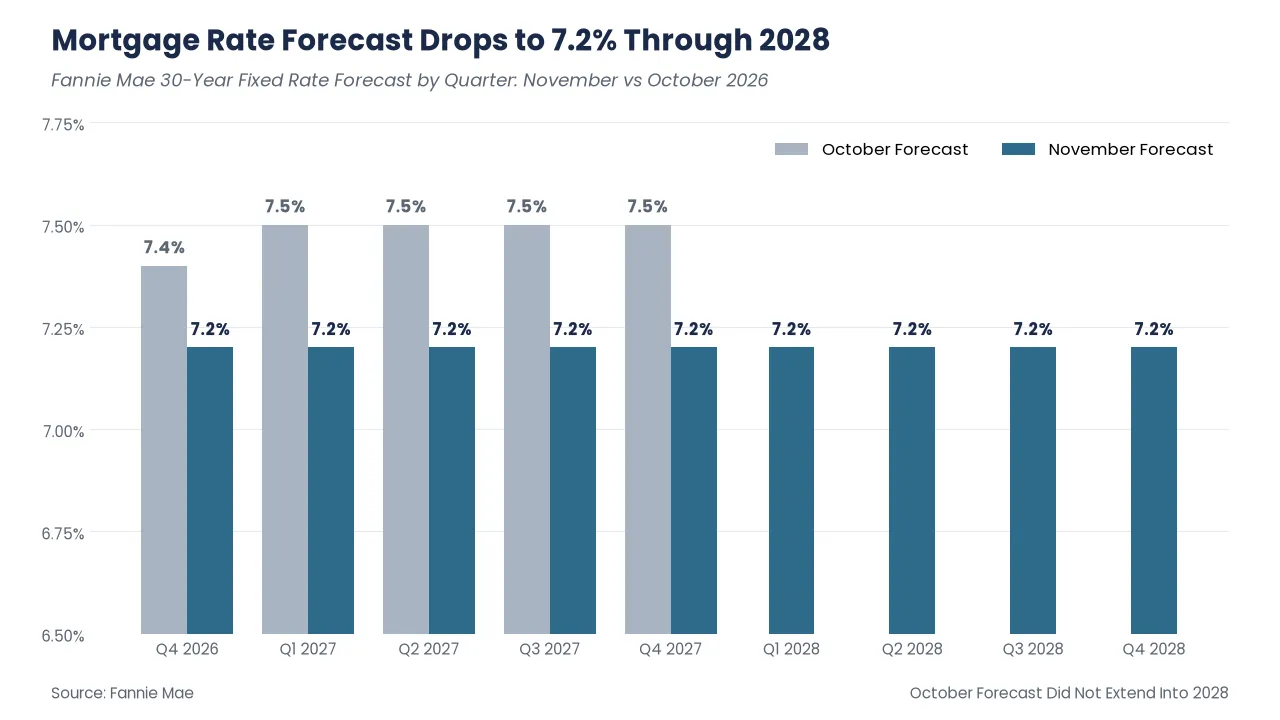
Fannie Mae just lowered its mortgage rate forecast, and that’s the drop in this story. To be clear, this is a change in the forecast, not in the rates lenders are quoting today. In its November 12, 2026 Housing Forecast, Fannie Mae now expects the 30-year fixed rate to average 7.2% in the fourth quarter of 2026 and in every quarter of 2027 and 2028. A month ago, it was calling for 7.4% this quarter and 7.5% all through 2027. At the same time, Fannie Mae cut its forecasts for existing-home sales and housing starts, so the outlook is a little easier on rates but a little weaker for the market.
For buyers, that means the forecast no longer has rates creeping toward 7.5%. It doesn’t mean a big drop is coming. It means “high, but steady” now looks more likely than “higher still.”
Mortgage Rate Forecast Drops to 7.2% Through 2028
Fannie Mae’s Economic and Strategic Research (ESR) Group updates its housing outlook every month. The November Housing Forecast is the first one to stretch all the way through 2028, and it shows a flat line: 7.2% for every quarter from now until the end of 2028.
Compare that with the October Housing Forecast, dated October 12. That one called for 7.4% in the fourth quarter of 2026 and 7.5% in each quarter of 2027. So the new forecast is 0.2 points lower for this quarter and 0.3 points lower for every quarter of next year.

Source: Fannie Mae
Quarter by Quarter: November vs October Forecast
Here’s how the two forecasts line up for the average 30-year fixed rate:
| Quarter | October Forecast | November Forecast | Change |
|---|---|---|---|
| Q4 2026 | 7.4% | 7.2% | Down 0.2 Points |
| Q1 2027 | 7.5% | 7.2% | Down 0.3 Points |
| Q2 2027 | 7.5% | 7.2% | Down 0.3 Points |
| Q3 2027 | 7.5% | 7.2% | Down 0.3 Points |
| Q4 2027 | 7.5% | 7.2% | Down 0.3 Points |
| 2028 (Each Quarter) | Not Forecast | 7.2% | New |
Source: Fannie Mae
On a yearly basis, Fannie Mae now sees the 30-year rate averaging 7.2% in 2027, down from 7.5% in October. It expects 7.2% again in 2028. The 2026 annual average was trimmed to 6.6% from 6.7%, thanks to the lower estimate for this quarter.
Why the Forecast Came Down
Fannie Mae’s rate forecasts are built from market rates on a set day. The October forecast used rates from September 30. The November forecast used rates from October 30. By late October, mortgage rates had eased from their mid-October high of 7.40% in Freddie Mac’s survey, and the new forecast reflects that softer backdrop.
The bond market tells the same story. Mortgage rates tend to follow the 10-year Treasury yield. In the November Economic Forecast, Fannie Mae expects the 10-year yield to average 5.0% in 2027, down from 5.3% in the October forecast. A lower yield path usually means a lower mortgage rate path.
What didn’t change is just as telling. Fannie Mae still expects the federal funds rate to average 4.4% in 2027, the same as in October. And it now sees consumer prices rising 4.0% from the fourth quarter of 2025 to the fourth quarter of 2026, up from 3.7% in October. Inflation that sticky is a big reason the forecast flattens at 7.2% instead of sliding toward 6%.
How 7.2% Compares With Today’s Rates
Here’s the reality check. In Freddie Mac’s Primary Mortgage Market Survey, the 30-year fixed rate averaged 7.28% for the week of November 19, 2026. That was up from 7.11% the week before. A year ago, it was 6.26%.
So the forecast of 7.2% is only a hair below where rates sit right now. Think of it like a weather forecast that used to say “hotter next week” and now says “about the same as today.” That’s welcome news, but you’ll still need the air conditioning.
For a sense of scale, take a $400,000 30-year loan. At 7.5%, principal and interest come to about $2,797 a month. At 7.2%, it’s about $2,715. That’s roughly $82 a month, or about $980 a year. At this week’s 7.28%, the payment is about $2,737. Those figures leave out taxes, insurance and any mortgage insurance.
Home Sales and Housing Starts Forecasts Were Lowered Too
The lower rate outlook didn’t come with a sunnier sales outlook. Fannie Mae trimmed several of its housing numbers:
- Existing-home sales: 3.989 million in 2027, down from 4.061 million in the October forecast. For 2026, the estimate slipped to 4.003 million from 4.031 million.
- Total home sales: 4.645 million in 2027, down from 4.713 million.
- Total housing starts: 1.277 million in 2027, down from 1.301 million. Single-family starts were cut to 886,000 from 898,000.
- New single-family home sales: 656,000 in 2027, a touch higher than the 652,000 in October.
- Home prices: Fannie Mae’s home price index is still expected to rise just 0.6% in 2027, unchanged from October. Its new 2028 forecast calls for 1.1%.
The starts cut fits what we’re seeing in the real data. Census figures released this week showed single-family building permits falling to the lowest level since 2023. Builders are being careful, and Fannie Mae expects that caution to last.
Here’s my read on the sales cut. With rates stuck in the 7% range, many owners who locked in 3% or 4% loans a few years ago still don’t want to move. Fewer listings means fewer sales, even when buyers are out there.
What It Means for Refinancing
There’s one small bright spot. Fannie Mae raised its 2027 refinance forecast to $462 billion, up from $430 billion in October. A slightly lower rate path gives a few more homeowners a reason to run the numbers.
Purchase lending went the other way, cut to $1.398 trillion from $1.435 trillion, in line with the lower sales outlook. Total single-family originations for 2027 are now forecast at $1.860 trillion, nearly the same as the $1.865 trillion in October.
If you bought in the past year or two at a rate near or above 7.5%, keep an eye on rates. For owners with loans from 2020 or 2021, refinancing still won’t make sense at these levels.
My Take: Steady Beats Scary
Forecasts change every month, and this one could move again in December. October’s forecast jumped sharply from September’s, and now November’s has eased back. That’s a reminder not to treat any single forecast as a promise.
Still, I like the direction. A forecast that flattens at 7.2% gives buyers something to plan around. If you can afford a home at around 7.2% to 7.3% today, the forecast suggests you aren’t likely to miss out on a much better deal by waiting. And if rates do come in lower than expected, you can look at refinancing later.
Here’s a simple way to decide:
YES, consider moving ahead if: the payment fits your budget at today’s rate, you’ve saved a cushion for repairs, and you plan to stay at least five to seven years.
Maybe WAIT if: your credit score needs work, your down payment is thin, or your job feels shaky. A stronger profile can lower your rate more than market timing will.
Where to Go From Here
If you want the longer view, our mortgage rate predictions for the next 12 months break down the scenarios for the year ahead. Our 90-day mortgage rates forecast covers the near term through January, and the two-year outlook for 2026 to 2028 looks further out.
The bottom line: Fannie Mae now expects the 30-year rate to hold near 7.2% through 2028, a bit lower than it expected a month ago, while sales and building stay soft. That’s not a rate cut for your wallet today, but it does take some worry about higher rates off the table. Use the calculator below to see what a home could cost you each month at today’s rates.
Estimate Your Monthly Mortgage Payment
- Principal & interest$0
- Property tax$0
- Home insurance$0
- PMI$0
- HOA fees$0
$0Loan amount
$0Total interest
$0Total of payments
Yearly amortization schedule
| Year | Principal | Interest | Balance |
|---|
Estimates only. Your actual payment depends on your lender, taxes and insurance. PMI applies only when the down payment is under 20%.