


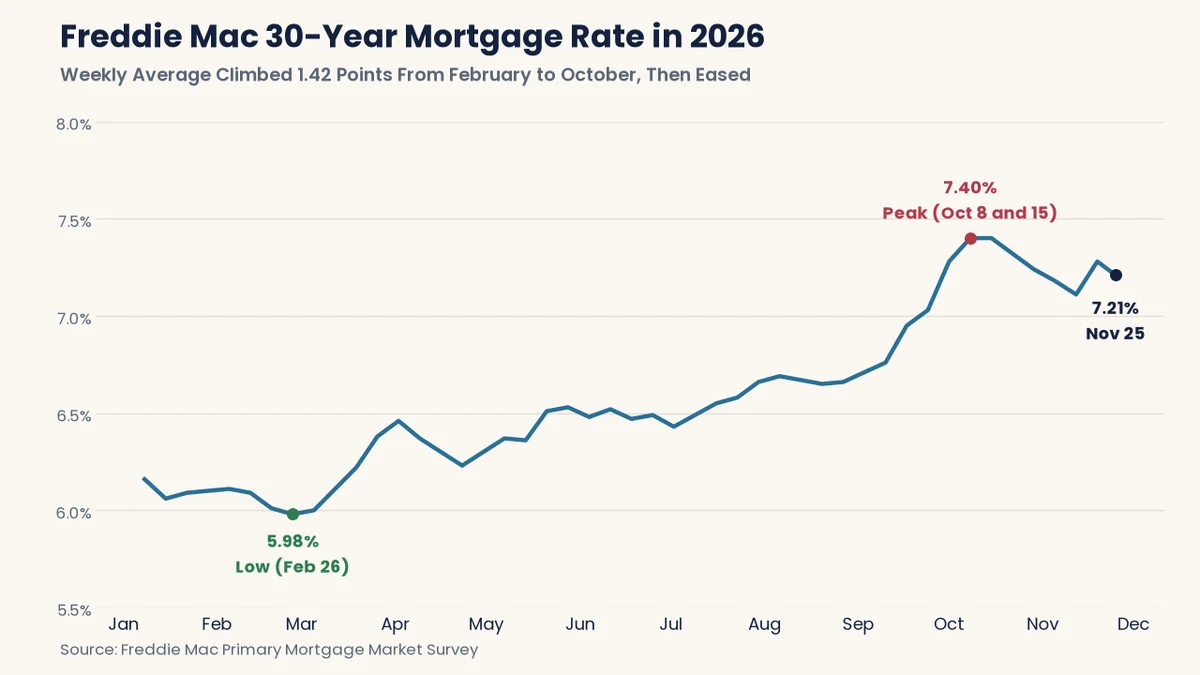
Mortgage rates head into December 2026 at 7.21%, and my base case is that they stay in a range of roughly 7.00% to 7.35% for the month. That is the national weekly average for a 30-year fixed loan in Freddie Mac’s survey on November 25. It is down from the 7.40% peak on October 8 and 15, but it is still almost a full point above the 6.23% a year ago. A drop below 7% is possible in December. It is not the most likely result.
The biggest event is the Federal Reserve’s meeting on December 8 and 9. The Fed raised its key rate in September, held it in October, and said inflation “remains elevated.” Two of the 12 voting members wanted another hike in October, and the Fed’s own meeting minutes say almost all members judged that more hikes would likely be appropriate. A November jobs report on December 4 and an inflation report on December 10 land within days of that meeting. Those three events will likely decide whether rates drift down toward 7% or climb back toward 7.5%.
Mortgage Rate Predictions for December 2026: Where Rates Are Likely to Go
Where Mortgage Rates Stand Right Now
Here are the latest weekly averages from Freddie Mac’s Primary Mortgage Market Survey, released on November 25. The survey came out a day early because of Thanksgiving.
- 30-year fixed: 7.21%, down from 7.28% the week before.
- 15-year fixed: 6.54%, down from 6.66% the week before.
- One year ago: the 30-year averaged 6.23% and the 15-year averaged 5.51%.
Freddie Mac described the week this way: “Mortgage rates moved back down this week, offering modest relief for prospective homebuyers heading into the Thanksgiving holiday.” The word “modest” is the right one. The 30-year was 7.11% on November 12, then bounced up to 7.28% on November 19 before easing again.
The 30-year rate has averaged about 7.27% since the start of the fourth quarter, based on the nine weekly readings from October 1 through November 25. That is a useful yardstick for December. A reading near 7.2% would be normal for this stretch, not a surprise.
How Rates Got Here in 2026
The year started with rates near 6.1%. The weekly average hit a 2026 low of 5.98% on February 26. After that, rates rose over most of the year. They crossed 7% in late September and peaked at 7.40% in early October, a rise of 1.42 percentage points from the February low.

Three things pushed rates up this year:
- The Fed raised its rate. On September 16, the Fed voted 12 to 0 to raise its target range by a quarter point to 3.75%–4%.
- Treasury yields jumped. The 10-year Treasury yield reached 5.31% on October 5, according to Federal Reserve data.
- Inflation stayed high. Energy costs rose sharply this year. The government’s gasoline price index was up 37.4% from a year earlier in October, and the Fed’s minutes say high energy prices keep adding to inflation.
Since early October, rates have eased about 0.19 points from the peak. Most of that came from lower Treasury yields.
What the Fed Did and What It May Do on December 9
The Fed’s last move was a hold. On October 28, it kept its target range at 3.75% to 4%. The vote was 10 to 2. Lisa Cook and Beth Hammack voted no because they wanted to raise the range by another quarter point right away.
The Fed’s statement said inflation “remains elevated” and that economic activity is “expanding at a strong pace.” That is not the language of a Fed that is ready to cut.
What the Fed’s Meeting Minutes Say
The minutes of the October meeting came out on November 18. They say “almost all participants” judged that “further action to raise the target range for the federal funds rate” would likely be appropriate if inflation and the job market follow their baseline outlook. A couple of members said a hike bigger than a quarter point could be considered if inflation data came in worse than expected.
The minutes also describe what traders expected in late October. Futures prices showed a high chance of a quarter-point hike by the end of the year. A survey of market participants, run by the New York Fed’s trading desk, had a median forecast of one hike in December and another in March 2027. Those readings are from late October, so the picture may have shifted since then.
Why a Hike Might Not Push Mortgage Rates Higher
Mortgage rates do not follow the Fed’s rate directly. They follow longer-term bond yields, which already reflect what investors expect the Fed to do. If the Fed hikes by a quarter point as expected, the move may already be in today’s rates. The bigger risk is the message. The December meeting also comes with new economic projections from Fed members, and a signal of more hikes in 2027 could push yields up.
The 10-Year Treasury Yield Is the Number to Watch
Mortgage rates usually move with the 10-year Treasury yield. That yield closed at 4.85% on November 25, down from 5.31% on October 5. It was 4.84% on November 5, rose to 5.15% on November 13, and has fallen back since.
In recent weeks, the weekly Freddie Mac 30-year rate has been about 2.2 points above the average 10-year yield. That is my own math from the weekly numbers. If that gap holds, a 10-year yield near 4.8% points to a 30-year rate near 7%. A 10-year yield back above 5.1% points to a 30-year rate near 7.3% or higher. This is a rough guide, not a rule, because the gap can shift.
Key Dates That Could Move Rates in December
| Date | Report or Event | What to Watch |
|---|---|---|
| December 1 | JOLTS Job Openings (October) | Fewer openings would point to a cooler job market |
| December 3 | Freddie Mac Weekly Mortgage Rates | First December reading; released Thursdays at noon Eastern |
| December 4 | Jobs Report (November) | October added 165,000 jobs; unemployment was 4.1% |
| December 8–9 | Fed Meeting | Decision on December 9, plus new Fed projections |
| December 10 | Consumer Price Index (November) | October prices rose 0.4% for the month; core prices rose 0.3% |
| December 15 | Producer Price Index (November) | A second look at inflation pressure |
The report dates come from the Bureau of Labor Statistics and Federal Reserve calendars. Freddie Mac releases its survey every Thursday at noon Eastern, so a new weekly reading follows each week after December 3.
The jobs report and the CPI report matter most. Strong hiring and hot price numbers would raise the odds of more Fed hikes and push Treasury yields up. Weak hiring and cooler prices would do the opposite.
What the Forecasters Expect
The two big public forecasts both see rates staying above 7% for a long time. Neither calls for a quick return to the 6s.
| Forecaster | Release Date | 30-Year Rate Forecast |
|---|---|---|
| Mortgage Bankers Association (MBA) | November 17, 2026 | 7.3% in Q4 2026; 7.2% in Q1 to Q3 2027; 7.1% in Q4 2027 |
| Fannie Mae | November 12, 2026 | 7.2% in Q4 2026 and in every quarter of 2027 and 2028 |
Both forecasts are quarterly averages. MBA says its forecast is based on Freddie Mac’s survey rate, so it can be compared directly with the weekly numbers above. Fannie Mae said its rate forecast is based on rates as of October 30.
MBA’s October 11 release said it expects mortgage and Treasury rates “are likely to come down from their recent peaks,” and that the 30-year rate will “remain above 7 percent through 2027.” Its November table keeps the same path for the 30-year rate.
Compare those forecasts with the 7.27% average so far this quarter. MBA’s 7.3% for the fourth quarter is almost exactly where the quarter stands. Fannie Mae’s 7.2% is a little lower. Both point to a December that looks much like the last two months.
Our December 2026 Mortgage Rate Forecast
Here is how I see December playing out. This is Norada’s view, not a promise. Rates can move in a single afternoon, and none of these ranges is guaranteed.
| Scenario | What Happens | 30-Year Fixed (Freddie Mac) |
|---|---|---|
| Base Case (Most Likely) | Jobs and inflation come in near expectations; the Fed hikes a quarter point or holds, with no surprise in its message | Mostly 7.00% to 7.35% |
| Better Case | A softer jobs report and a cool CPI reading pull the 10-year yield toward 4.7% or lower | Dips to about 6.85% to 7.00% |
| Worse Case | Hot inflation or a Fed signal of larger or more frequent hikes lifts the 10-year yield above 5.1% | Rises to about 7.40% to 7.50% |
My base case is the middle row. Rates have been stuck between 7.11% and 7.40% for eight straight weeks, and nothing on the calendar suggests a sharp break in either direction without a surprise. The 30-year would most likely end December within about 0.15 points of today’s 7.21%.
Factors That Could Push Rates Lower
- A cooler November CPI. Core prices rose 0.3% in each of the last three months. A smaller number would help.
- Slower hiring. A jobs gain well below October’s 165,000 would take pressure off the Fed.
- Falling energy prices. High energy prices have been a big part of this year’s inflation.
Factors That Could Push Rates Higher
- A hotter CPI or strong hiring. Either one raises the odds of more hikes.
- A hawkish Fed message. Signals of hikes into 2027 could lift the 10-year yield.
- Government debt worries. Some Fed members raised concerns in October about government debt and rising long-term yields.
What a Rate Move Means for Your Payment
Small changes in rates add up. This table shows the monthly principal and interest payment on a $400,000 30-year fixed loan. It leaves out taxes, insurance and fees.
| 30-Year Rate | Monthly Payment | Compared With 7.21% |
|---|---|---|
| 7.50% | $2,797 | $79 more |
| 7.40% (October Peak) | $2,770 | $52 more |
| 7.21% (November 25) | $2,718 | Baseline |
| 7.00% | $2,661 | $57 less |
| 6.85% | $2,621 | $97 less |
A move from 7.21% to 7.00% saves about $57 a month, or roughly $680 a year. That is real money, but it is not enough to justify waiting months for a better deal if a home fits your budget today.
What This Means for Buyers and Refinancers
If You Are Buying a Home
- Shop several lenders. Freddie Mac’s number is an average. Two lenders can quote you very different rates on the same day.
- Ask about a float-down option. Some lenders let you lock now and take a lower rate if rates fall before closing. Ask what it costs.
- Use your leverage. With rates near 7%, many buyers are sitting out. Ask sellers to pay closing costs or help buy down your rate.
- Plan for the December 9 Fed day. If you are about to lock, know that rates can swing on that afternoon.
If You Are Thinking About Refinancing
- Run the break-even math. Divide your closing costs by your monthly savings. If you will stay in the home longer than that number of months, refinancing may pay off.
- Most owners should wait. If your rate is below about 6.5%, today’s rates are unlikely to help you. If your rate is near 7.5% or higher, keep watching, since a dip toward 7% could start to make sense.
My Take for the Month Ahead
I do not expect a big change in December. The most likely path is a flat month with rates drifting inside a narrow range, and the Fed’s December 9 decision and the two data reports around it deciding which edge of the range we touch. Both MBA and Fannie Mae expect rates to stay above 7% through next year, so I would not plan around a quick return to the 6s.
If you are ready to buy and the payment fits your budget at 7.2%, you do not need to wait for December’s reports. If the payment only works at 6.9%, a few weeks of patience is reasonable, but make a plan for what you will do if rates rise instead. Watch December 4, December 9 and December 10. If you are a refinancer, the best move is to keep your numbers ready and act only if a rate dip clearly beats your break-even math.
Estimate Your Monthly Mortgage Payment
- Principal & interest$0
- Property tax$0
- Home insurance$0
- PMI$0
- HOA fees$0
$0Loan amount
$0Total interest
$0Total of payments
Yearly amortization schedule
| Year | Principal | Interest | Balance |
|---|
Estimates only. Your actual payment depends on your lender, taxes and insurance. PMI applies only when the down payment is under 20%.