


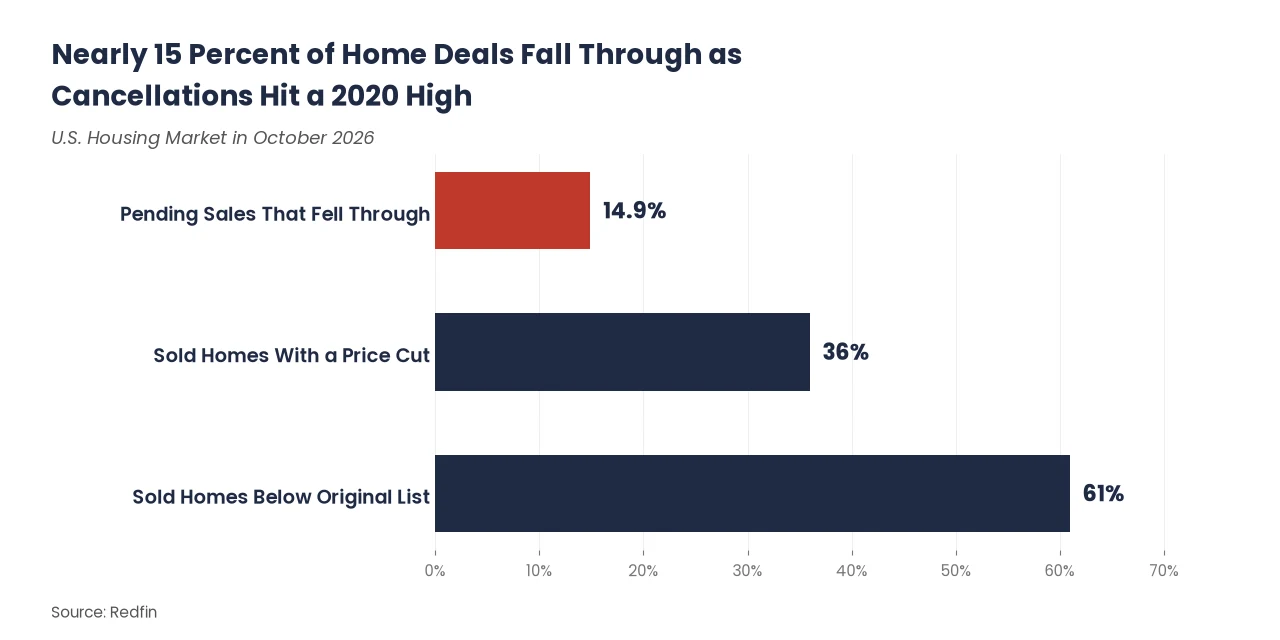
Nearly 15% of U.S. home deals fell through in October. According to Redfin, home purchase cancellations reached 14.9% of pending sales, up 0.2 percentage points from September and 1.8 points from a year earlier. Other than the pandemic spike in March and April 2020, that is the highest share in Redfin’s records. Buyers have more homes to choose from, and more of them are walking away before closing.
Nearly 15 Percent of Home Deals Fall Through as Cancellations Hit a 2020 High

Source: Redfin.
Redfin published the October figures on November 10, 2026, in its monthly housing-market report. The cancellation rate is the share of pending sales that fell out of contract. In everyday terms, a buyer and seller had a deal, and then the deal did not make it to the closing table. According to Redfin, 14.9% of pending sales ended that way in October.
That is not a rounding error. If you apply the 14.9% share to October’s 300,430 pending sales, about 45,000 deals fell through. Redfin notes that a home can fall out of contract in a different month from the one in which it went pending, and the data can be revised later. Even so, the message is clear: a much larger slice of signed deals is breaking down than we usually see outside of 2020.
Why More Buyers Are Walking Away
Cancellations tend to rise when buyers have options. If the inspection uncovers a costly repair, the monthly payment comes in higher than expected, or the buyer simply has a change of heart, it is easier to step back when another house is sitting down the street. That is the market Redfin is describing now.
The company also ties the softer tone to high borrowing costs. Mortgage rates averaged 7.33% in October, a three-year high, up 0.47 percentage points from September and 1.08 points from a year earlier. A payment that looked workable at 6.8% can feel tight at 7.3%. When that happens after a contract is signed, some buyers use their contingencies and walk.
Redfin’s head of economics, Chen Zhao, summed up the contradiction: “It’s a buyer’s market, but not many people can afford to buy.” Leverage has shifted toward shoppers, but a 7% mortgage still leaves many households stuck on the sidelines. The buyers who do write an offer are choosier, and a larger share of those offers are not lasting until closing.
Callie Kimmel, a Redfin Premier agent in Philadelphia, said buyers are nervous about rates, the economy, and the news, “so they need the house and the price to line up perfectly before they’ll make an offer.” That same caution helps explain why a signed deal can still fall apart if the inspection or the payment does not line up.
Sellers Are Already Giving More Ground
Cancellations are not the only way buyers are pushing back. Among the homes that did close in October, 36% had at least one price cut, the highest share in Redfin’s records. Three out of five, or 61%, sold below the original asking price, and the typical closed sale came in at 96.1% of that first ask.
In other words, even the deals that survive are often being renegotiated. A seller may cut the price once or twice to keep a buyer, and still close under the original list. Set that beside the 14.9% of contracts that never close, and you can see why shoppers feel they have more room to ask for a better number.
This is not the same as a panic. Move-in-ready homes in the most popular neighborhoods can still draw interest. It does mean the first price on a listing is often a starting point, not the final number.
Pending Sales Fell to Their Lowest Level Since 2013
Fewer deals are getting signed in the first place, which makes the higher cancellation rate even more important. Pending home sales fell 3.6% from September, on a seasonally adjusted basis, to 300,430. That is down 15.1% from a year earlier and the lowest level since 2013, except for April 2020. Redfin says fewer homes went under contract in October largely because of that 7.33% average mortgage rate.
Every major metro Redfin tracks had fewer pending sales than a year earlier, the second month in a row that has happened. Seattle led the decline, down 28.7%, followed by San Diego at 26.6% and Denver at 24.2%. The mildest drops were in Newark, New Jersey (4%), Pittsburgh (5%), and West Palm Beach, Florida (5.8%). Closed sales also cooled, falling 2.1% from September to 274,987, down 6.7% year over year and the lowest since December 2023.
Existing-home sales, measured as a seasonally adjusted annual rate, ran at about 4.09 million in October, down 1.7% from September and 6.8% from a year earlier. Many of the homes that closed in October went under contract in August or September, when rates were already climbing. The weaker October pending numbers are a clue that November closings may stay soft as well.
More Homes Are for Sale, but New Listings Are Slowing
Supply keeps building even as sales slow. Active listings rose to 1,526,984 in October, up 0.9% from September and 2% from a year earlier, the most homes for sale since early 2020. Buyers had 4.3 months of supply to work with, half a month more than last year, and the typical home spent 50 days on the market before going under contract.
The wrinkle is that fewer owners are listing in the first place. New listings slipped 1% from September to 372,431, down 3.9% from a year earlier and the weakest showing in more than two years. As demand cools and prices lose steam, some would-be sellers are holding off. So the homes already listed are stacking up, while new “for sale” signs are appearing more slowly.
Sale prices are starting to reflect that imbalance. The median U.S. home-sale price was $388,634 in October, down 0.4% from a year earlier. That was the first annual decline since May 2023, and a sharp slowdown from the 2.5% year-over-year gain just two months earlier. A 0.4% dip is modest on its own. Next to record price cuts and a 14.9% cancellation rate, it is another sign that buyers have more say than they did during the three-year climb.
What Buyers and Sellers Should Do Now
If you are buying, do not treat a signed contract as a done deal, and do not feel stuck with the first house you like. With nearly one in seven pending sales falling through, you may see listings come back to the market. That can be an opening, but only if you stay ready: keep your financing in order, budget for the payment at today’s rate, and use the inspection period to check the home carefully. If the price or the payment is not right, you can move on. A larger pool of listings makes that possible.
If you are selling, the higher cancellation rate is a warning to price honestly and keep the deal simple. Kimmel is advising sellers to “price just below current market value from day one—and not comps from six months ago, but homes that are listed right now.” A home that sits, or a deal that falls through after a tough inspection, can cost you time and bargaining power. Be prepared to negotiate on repairs or closing help, and respond quickly when a serious buyer has a fair concern.
A high cancellation rate is frustrating if you just lost a deal, and it can feel like a window if you are still shopping. It is not a sign that the housing market has frozen. It is a sign that buyers have more choices and less patience for a house or a payment that does not fit. Your next step still comes down to your timeline, your city, and the monthly bill you can carry at a 7% mortgage.