


If you have been waiting for mortgage rates to give you a break, you just got a fourth one in a row. The average 30-year fixed rate fell to 7.11% this week, down from 7.18% last week and down from a 7.40% stall in mid-October. That is real relief on the monthly payment. It is also not a promise that next week will be cheaper. If the house and the payment already work for you, this is a good time to lock in. If you can wait a little without losing the home, a short float can still make sense, as long as you can live with the risk that rates move back up.
Is It a Good Time to Lock In as Mortgage Rates Drop for the Fourth Straight Week
The Four-Week Drop in Plain Numbers
Freddie Mac’s Primary Mortgage Market Survey, released on Thursday, November 12, put the 30-year fixed rate at 7.11%, down from 7.18% the week before. The 15-year fixed rate fell to 6.45% from 6.57%.

Source: Freddie Mac
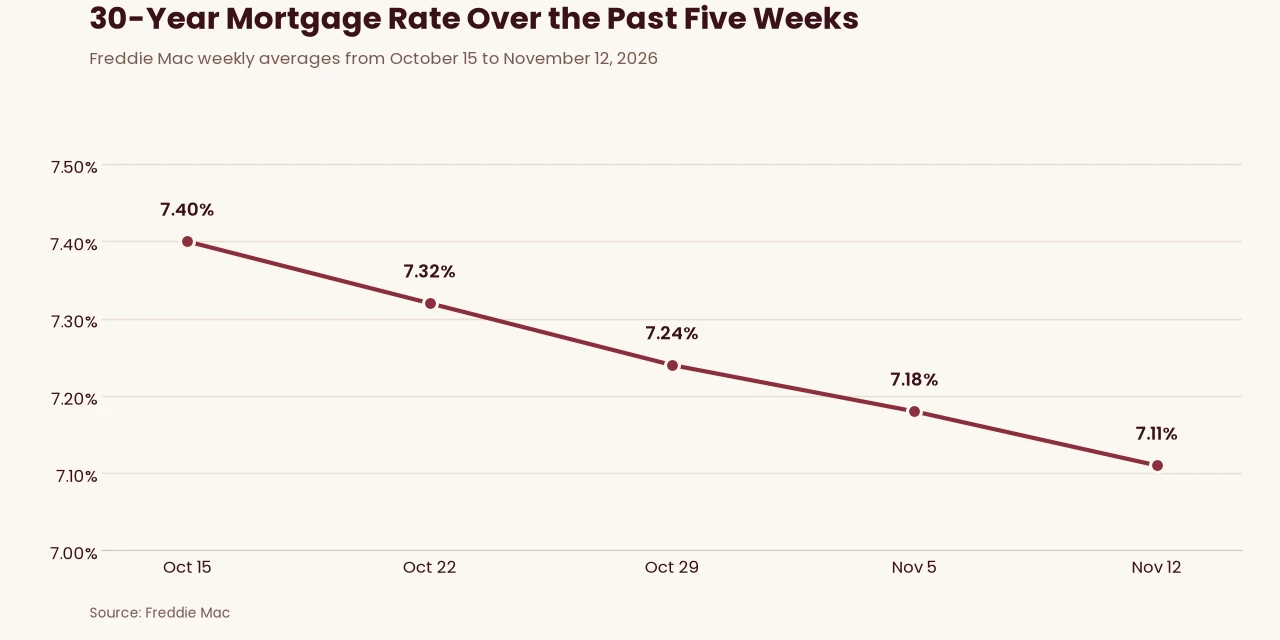
That 30-year figure is the lowest in seven weeks. It is also the fourth straight weekly drop. Here is the path from mid-October:
- October 15: 7.40% (unchanged from October 8)
- October 22: 7.32%
- October 29: 7.24%
- November 5: 7.18%
- November 12: 7.11%
From that 7.40% stall to 7.11% is a 29-basis-point decline. A basis point is 0.01%, so that is 0.29 percentage points. The weekly steps were 8, 8, 6, and 7 basis points. The 15-year has been sliding too, from 6.71% on October 15 to 6.45% now.
A year ago, the 30-year averaged 6.24%. Even after four weeks of relief, today’s rate is still 87 basis points higher than last November. And 7.11% is still a little above the 7.03% average from September 24, the last time rates were lower than this week’s print.
Freddie Mac’s chief economist, Sam Khater, called the decline “a welcome development that gives borrowers greater flexibility as they navigate the current housing market.” I agree it is welcome. I would just add that flexibility helps when you have a plan. A four-week streak is not a plan by itself.
What This Week’s Decline Means for Your Payment
Let’s put a round number on it. On a $400,000 30-year loan, a 7.11% rate works out to about $2,691 a month for principal and interest. At last week’s 7.18%, that payment was about $2,710, so this week’s drop saves about $19 a month.
The bigger change is from mid-October. At 7.40%, that same loan cost about $2,770 a month. Today’s rate saves about $79 a month, or about $944 a year, and a little more than $28,000 over the full term.
That is meaningful money. It is also not a return to last year’s payment. At last November’s 6.24% average, the same loan would have cost about $2,460 a month, roughly $231 less than today.
Your actual quote will differ. Credit score, down payment, points, loan type, and the lender all matter. The Freddie Mac number is a national average for conventional purchase loans with 20% down and strong credit. Use it as a benchmark, then shop your own rate.
Purchase Rates and Refinance Rates Are Heading in Different Directions
One more wrinkle is worth a plain warning. The 7.11% figure is Freddie Mac’s average for home purchase loans. Refinance rates are not following the same path this week.
On Saturday, November 14, Zillow’s national average 30-year fixed refinance rate was 7.60%, up 28 basis points from the prior week’s 7.32%. So purchase rates have been falling for a month, while the refinance average just jumped.
If you are buying a home, the weekly purchase average is the one that just improved. If you are refinancing, the quotes you see this weekend may not feel like a drop at all. Don’t let a purchase headline talk you into a refinance you have not priced for yourself.
Lock vs Float After Four Straight Weeks of Relief
A rate lock freezes the rate your lender already quoted, usually for 30, 45, or 60 days, while you finish the purchase and close. A float means you leave the rate open and take whatever the market gives you when you are closer to closing.
After four declines in a row, the tug is obvious. Why lock at 7.11% if next Thursday could be 7.05%? Maybe it could. Rates were 7.03% as recently as September 24. Another modest drop is possible.
But four drops in a row can also trick you into thinking the fifth is guaranteed. It isn’t. This week’s print is an average of rates from the prior Thursday through Wednesday, so the market may already have moved by the time you read the headline. I have seen borrowers float through a winning streak, wait for “one more week,” and then watch rates hop back toward the old level.
The right question is not “Will rates fall again?” The right question is “Can I live with the payment I can lock today, and how badly would I feel if rates rose while I waited?”
When Locking In Now Makes Sense
Yes, I would lean toward locking in now if:
- You have a home under contract, or you are close, and the payment at your actual quote already fits your budget.
- You are closing in the next 30 to 60 days and you want the rate settled before the holidays.
- A move back toward 7.30% or 7.40% would stretch you, delay the purchase, or keep you up at night.
- You would rather keep this 29-basis-point improvement than gamble it on another small drop.
In that situation, you are locking in a better rate than you could have gotten in mid-October, and you are buying peace of mind.
When You May Want to Float a Little Longer
You may want to float a bit longer if:
- You are still shopping and are weeks away from an offer. There is no rate to lock until you have a loan in motion and a quote in hand.
- Your closing is further out, and you have a clear walk-away point, such as “I will lock if my quote rises by 10 basis points.”
- Your lender offers a float-down, and you understand the rules: how much rates have to fall, whether there is a fee, and whether you can use it only once.
- You are refinancing, and your quote is closer to that higher 7.60% refinance average. In that case, you are not really deciding on this week’s purchase drop. You are waiting for a refinance quote that actually improves.
Floating is not a strategy if you have no deadline and no number that would make you lock.
How a Rate Lock Works Right Now
A few practical notes, because this is the time of year when closings slip. Ask your lender to price 30-, 45-, and 60-day locks side by side. A longer lock can cost a little more, but it may be cheaper than paying to extend later if your closing runs into holiday delays.
Ask about a float-down in writing. If rates fall after you lock, a float-down can let you recapture some of that drop, often once, and often only if the drop is large enough.
Lock the rate you were actually quoted, not the 7.11% average in the headline. And once you lock, keep your credit quiet. A new car loan or a fresh credit card can change the file your lender already approved.
If you are thinking about a much longer wait, into 2027, that is a different decision. I covered it separately in Should You Lock In Your Mortgage Rate Now or Wait for 2027. This piece is about the shorter call: lock this week’s improvement, or float a little longer.
My Take
My take is pretty simple. Four straight weeks of lower rates have given buyers a better entry point than they had in mid-October. If you are ready to buy and the payment works, I would lock in. You can still ask for a float-down in case the streak runs one more week.
If you are not ready, don’t force a lock you can’t use, and don’t treat this streak as a reason to wait forever. Set a date and a rate that would make you act, then use the calculator below to see what today’s 7.11% average, or your own quote, does to the payment.
Estimate Your Monthly Mortgage Payment
Estimates only. Your actual payment depends on your lender, taxes and insurance.
Estimated Monthly Payment
$0
- Principal & Interest$0
- Property Tax$0
- Home Insurance$0
- PMI$0
- HOA$0
$0Loan Amount
$0Total Interest
$0Total Cost of Loan
Read More:
Explore these related articles for even more insights: