


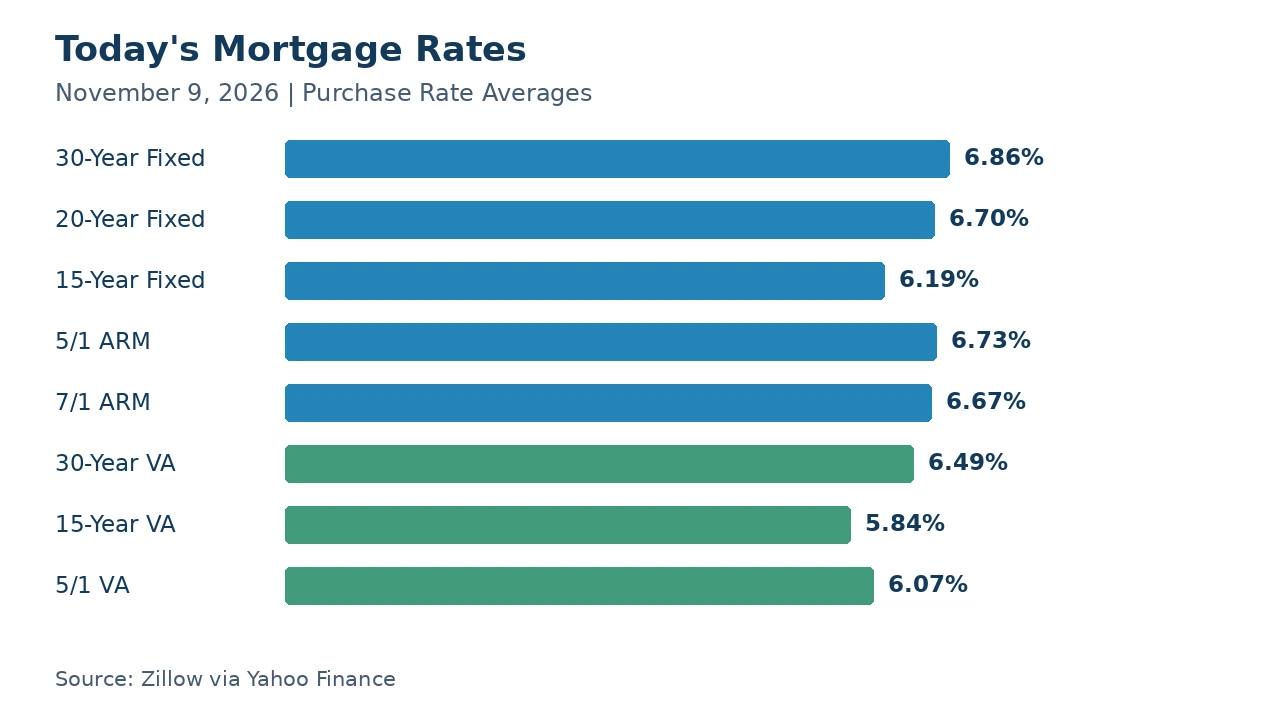
Today’s mortgage rates keep the 30-year fixed purchase rate at 6.86% on Monday, November 9, 2026, according to Zillow data reported by Yahoo Finance. Yahoo’s Monday report notes that purchase rates remain below refinance rates. Yahoo’s Monday purchase table also lists the 15-year fixed, both common adjustable-rate loans, and VA options. For the current rates below, we use the report’s purchase rate table.
If you are shopping for a home, treat a weekly decline as a reason to compare fresh quotes, not as a green light to stretch your budget. A useful rate is still one that works with the home price, the fees, and the amount you can comfortably pay each month. Keep your budget in view before you chase a larger loan.
Today’s Mortgage Rates, November 9: Purchase Rates Stay Below Refinance Rates
Current Purchase Rates From Zillow
The following national averages come from the purchase rate table in Yahoo Finance’s Monday report. Your lender’s offer can differ based on your loan details and finances.
| Purchase Loan Type | Current Rate |
|---|---|
| 30-Year Fixed | 6.86% |
| 20-Year Fixed | 6.70% |
| 15-Year Fixed | 6.19% |
| 5/1 ARM | 6.73% |
| 7/1 ARM | 6.67% |
| 30-Year VA | 6.49% |
| 15-Year VA | 5.84% |
| 5/1 VA | 6.07% |
Source: Zillow via Yahoo Finance.
These are interest rates, not full borrowing costs. Before comparing offers, check whether the lender charges points or other upfront fees. Also ask for the annual percentage rate, or APR, which includes certain loan costs alongside interest.
Where Purchase Rates Stand Today
Yahoo Finance’s Monday purchase table shows the 30-year fixed at a 6.86% average. The 15-year fixed purchase rate is listed at 6.19%, and the 5/1 ARM purchase rate is listed at 6.73%. Those figures are national averages, not a forecast of the next move.
A basis point is a small unit used to describe changes in interest rates. One hundred basis points equal one percentage point. It helps keep the rate change separate from the change in your payment. A decline can reduce borrowing costs on a new loan, but how much you feel it depends on the amount you borrow and the terms you choose.

Start With the Payment You Can Keep
A home search often begins with a price range. It helps to work backward from a monthly budget as well. Add the loan payment, property taxes, homeowners insurance, and any mortgage insurance or association dues. Then leave space for upkeep and savings.
Yahoo Finance’s Monday examples help put the averages in dollar terms. On a $300,000 loan at today’s 6.86% 30-year rate, principal and interest run about $2,368 a month, with roughly $408,401 in interest over the full term. The same balance on a 15-year loan at 6.19% jumps the monthly payment to about $2,962, while cutting lifetime interest to about $161,244. Those illustrations are starting points only; your taxes, insurance, and lender fees still change the full bill.
The lender may approve a bigger loan than you want to carry. That approval does not know every detail of your life, such as child care, travel to work, or plans to help a family member. Decide what feels comfortable before you see a house that makes you want to stretch. Today’s lower weekly rates can create a little room without requiring you to spend it all.
What a Fixed Rate Gives You
A fixed-rate mortgage keeps the interest rate unchanged through its term. That makes the principal-and-interest payment easier to plan around. The other parts of your housing bill can still rise, so fixed does not mean every cost stays the same.
The table lists the 30-year fixed at 6.86%. Its longer repayment period can make monthly payments more manageable than a shorter loan on the same balance. The tradeoff is more time spent paying interest. Ask your lender how extra principal payments work if you want the flexibility of a longer term while aiming to repay sooner.
Look Beyond the Lowest Fixed Rate
The 15-year fixed appears at 6.19%, and the 20-year fixed is 6.70%. Those choices can appeal to buyers who want to build equity faster and shorten their repayment timeline. Yet the lower rate on a shorter loan does not automatically mean a smaller monthly bill.
Get written payment estimates for each term using the same loan amount. See whether the shorter term still leaves an emergency cushion. If it forces you to pause retirement saving or rely on credit cards for repairs, a longer loan may be a better fit. The goal is a home you can keep, not just a loan you can pay off quickly on paper.
ARMs Need a Plan for Later
The current purchase table puts the 5/1 ARM at 6.73% and the 7/1 ARM at 6.67%. An ARM begins with a fixed rate period, then can adjust under the contract’s rules. Its opening rate should never be treated as a promise for the whole loan.
Have the lender walk through the first adjustment, later adjustment dates, and the limits on rate changes. Ask to see a possible higher payment in writing. A plan to sell before the rate resets may sound simple, but moving dates and home values can change. Do not choose an ARM unless you understand what happens if you stay longer than expected.
VA Rates Belong in Eligible Borrowers’ Comparisons
For eligible borrowers, the VA table shows 6.49% on the 30-year loan, 5.84% on the 15-year loan, and 6.07% on the 5/1 adjustable loan. These options deserve their own lender quotes rather than being folded into a general purchase estimate.
Ask about eligibility, any applicable funding fee, lender charges, and the cash needed at closing. Compare the full cost with other loans you qualify for. Be sure the quotes use matching loan amounts and lock periods. A rate can look attractive while the fee details tell a different story.
Locking Is About Managing Risk
You do not have to predict the bottom in mortgage rates to make a sound choice. If your closing is close and the payment fits, a rate lock may help protect your plans. Read the lock agreement, including its expiration date and any extension costs.
If you have more time, you may prefer to watch offers. Just decide in advance what you will do if rates move higher. Ask whether a float-down option exists, whether it costs extra, and what conditions apply. Waiting is a choice with risks, not a free chance at a better deal.
A Simple Checklist Before You Apply
- Use matching details: Give lenders the same property, loan amount, down payment, and loan type.
- Compare fresh quotes: Offers gathered close together are easier to judge fairly.
- Review points: Ask what the rate would be without paying upfront for a discount.
- Protect your cash: Allow for moving, repairs, and savings after closing.
- Read the paperwork: Check that the written terms match what you discussed.
Use Some Quiet Time to Get Your Papers Ready
If you are not ready to request a quote yet, use the time to organize what lenders may need. Gather recent income records, bank statements, and a clear picture of your debts. Ask the lender which documents apply to your situation, especially if you work for yourself or have income that changes from month to month.
Keep track of where your down payment money is coming from. If part of it will be a gift, ask what paperwork is required before moving funds. Clear records can help avoid confusion when the lender reviews your file.
This preparation does not commit you to a purchase. It simply puts you in a better position to compare real offers when you find the right property. While you wait, avoid taking on new debt without discussing the effect on your application. A clean, current picture of your finances is more useful than guessing what a national rate average means for you.
Monday’s Takeaway for Buyers
The 24-basis-point weekly drop, with the 30-year fixed purchase rate still listed at 6.86%, gives buyers a clear reason to revisit financing with fresh numbers. Bring your own budget to that conversation, not just a headline. National averages set the direction; your credit, down payment, and loan type still shape the offer you receive. Use the calculator below to explore a payment, then ask lenders to turn those rough numbers into clear written offers you can compare side by side.
Estimate Your Monthly Mortgage Payment
Estimates only. Your actual payment depends on your lender, taxes and insurance.
Estimated Monthly Payment
$0
- Principal & Interest$0
- Property Tax$0
- Home Insurance$0
- PMI$0
- HOA$0
$0Loan Amount
$0Total Interest
$0Total Cost of Loan