


The housing market has changed greatly since the COVID-19 pandemic, along with consumer spending behaviors. During this period, housing demand surged, home prices appreciated rapidly, inflation increased, supply-chain disruptions happened, and mortgage rates moved from historic lows to elevated levels. These changes raise important questions about whether home buyer spending patterns have changed and how long the spending boosts associated with a home purchase last.
Using pooled Consumer Expenditure Survey (CES) microdata from 2020 to 2023, we find buyers of newly built and existing single-family detached homes generate almost the same increase in spending during the first year after purchase, about $8,750 and $8,674, respectively. The key difference is not the amount of additional spending, but its composition. Buyers of newly built homes spend more on furnishings, while buyers of existing homes spend more on property alterations and repairs. For both groups, most appliance purchases occur during the first year after buying a home.
Spending Attributable to Home Buying
Because these socio-economic characteristics also influence spending, comparing group averages alone overstates the effect of the home purchase itself. Therefore, it is worthwhile to estimate how much additional spending is associated with purchasing a home after taking these differences into account[1]. We then use the results to compare predicted spending for similar households under different homeownership situations.

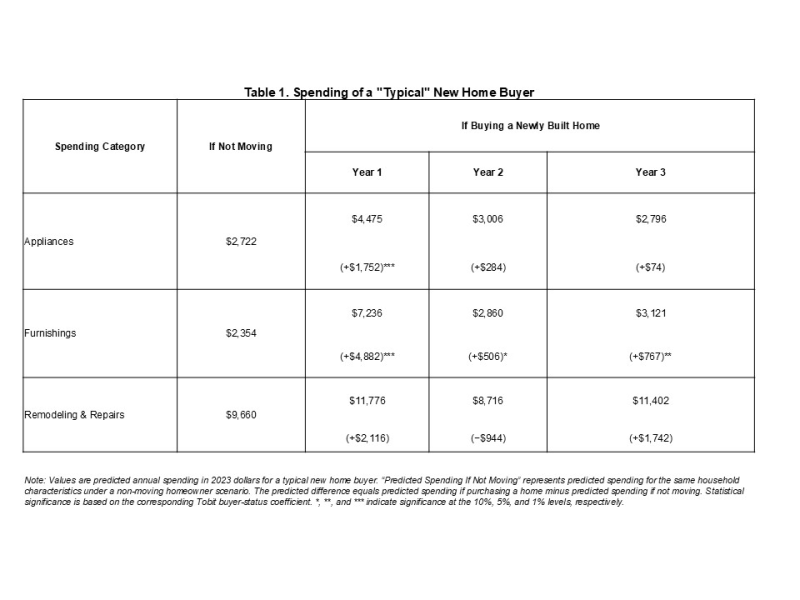
Table 1 shows how purchasing a newly built home affects household spending after accounting for differences in household characteristics. The estimates compare the same household under two scenarios: if it purchases a newly built home and if it does not move. The Year 1, Year 2, and Year 3 columns show the predicted annual spending of a typical newly built home buyer in the first three years after purchasing a home, while the “If Not Moving” column shows the predicted spending for the same household had it remained in its current home in one year. The differences shown in parentheses represent the additional spending associated with buying a newly built home compared to a nonmoving counterpart.
If the typical new home buyer does not move, it is predicted to spend about $2,722 per year on appliances, $2,354 on furnishings, and $9,660 on property alterations and repairs. During the first year after purchasing a newly built home, spending increases in all three categories. The largest increase is in furnishings, where predicted spending rises to $7,236, about $4,882 more than for an otherwise identical non-moving homeowner. Appliance spending also increases substantially to $4,475 (+$1,752). Property alterations and repair spending rises to $11,776 (+$2,116), although this increase is not statistically significant.
The spending boost changes over time. Appliance spending is concentrated in the first year after purchase and returns close to the non-moving level thereafter. Furnishing spending also peaks in the first year but remains moderately higher in the second and third years, suggesting that households continue furnishing their homes over time. In contrast, property alterations and repair spending shows little evidence of a lasting increase. This pattern is consistent with newly built homes requiring fewer repairs and replacements, so post-purchase property alterations projects are generally more discretionary.
Table 2 presents a similar comparison for households with characteristics typical of an existing home buyer. During the first year after purchase, a typical buyer of existing homes spends significantly more than otherwise identical homeowners who does not move on appliances, furnishings, and property alterations and repair projects. The largest increase occurs in property alterations and repairs, with predicted annual spending of $13,882, approximately $5,498 more. A typical buyer of existing homes also spends more on furnishings (+$1,973) and appliances (+$1,202).
Typical existing home buyers spend more on appliances primarily during the first year after purchase. Furnishing expenditures decline after the first year but remain modestly elevated through the third year. Property alterations and repair spending exhibits the greatest persistence. Even in the second and third years after purchase, buyers of existing homes continue to spend substantially more on property alterations and repairs. This sustained spending reflects that existing homes often required renovations, repairs, and deferred maintenance that are completed over time after purchase.

[1] Tobit regression is used in this statistical analysis, because many households reports no spending in a given category.